How to Choose Keywords for SEO in 2026?
Most keyword research advice stops at “use a tool, pick high-volume low-competition terms.” That’s not wrong, exactly, but it’s incomplete enough to get people into trouble. I’ve seen plenty of content calendars built entirely around keyword volume that produced zero leads, because volume was the only thing anyone checked.
This is the version of keyword research that accounts for the messier reality: limited domain authority, limited writer bandwidth, and – now – the fact that a chunk of searches never turn into a click at all because Google’s AI Overview already answered the question. Here’s how to actually pick keywords worth building content around.
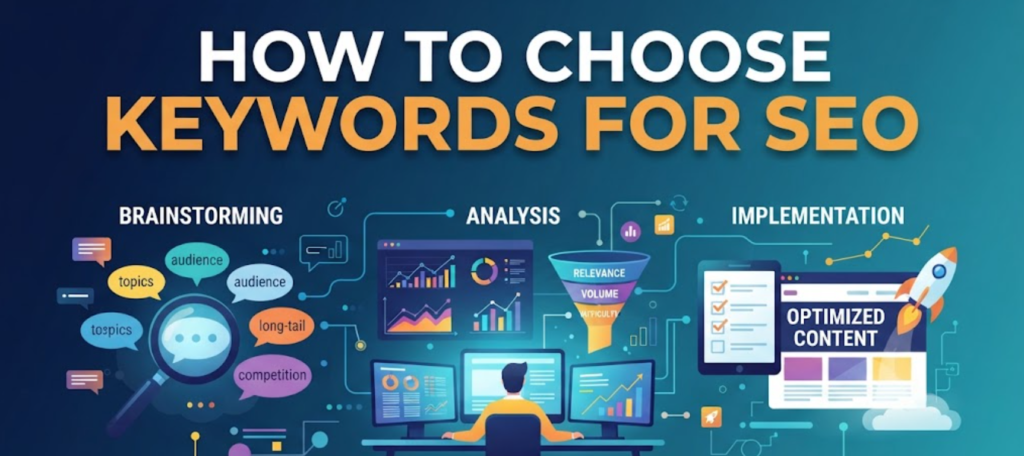
Start With Intent, Not the Keyword Tool
Open a keyword tool too early and you’ll drown in a spreadsheet of terms that all look plausible. Before that, figure out what kind of question you’re dealing with, because it decides everything downstream – what format the content needs to be, whether it can convert, whether it’s even worth your time.
There are basically four flavors of intent:
Informational – someone’s trying to understand something. “What is technical SEO,” that kind of thing. No wallet involved.
Navigational – they already know where they want to go. “Google Search Console login” isn’t a content opportunity, it’s someone looking for a specific URL.
Commercial investigation – they’re shopping around but not ready to click buy. “Best SEO tools for small business” sits here.
Transactional – they’re ready to act. “Buy SEO audit service,” “hire SEO consultant Noida.”
The mistake people make constantly: writing an informational blog post and expecting it to rank for a transactional query, or vice versa. It won’t happen. Google’s ranking systems match intent first, keyword match second – and AI Overviews are even more intent-strict, since they’re summarizing an answer, not a sales pitch.
Build a Seed List From Real Sources, Not Guesses
Seed keywords are the broad topics everything else branches from. Don’t brainstorm these in a vacuum – pull them from places where real language already exists:
- Actual customer questions from support tickets or sales calls
- Competitor category pages (read the language they use, not just the products)
- Your own Search Console data – you’re probably already ranking for terms you never intentionally targeted
- Industry-specific terminology that outsiders wouldn’t think to search but insiders use constantly
If you’re writing for, say, a commercial solar company, your seed list isn’t “solar energy” – that’s too broad to be useful. It’s “open access solar,” “rooftop solar for industries,” “commercial solar EPC,” things specific enough to signal who’s actually searching.
Expand the List
Once you’ve got seeds, run them through actual tools. A few worth knowing:
Google Search Console is free and honestly underrated – it shows exactly what you already rank for, including long-tail phrasing you never targeted on purpose. Google’s own autocomplete and the “People Also Ask” boxes are free too, and they show you real phrasing rather than a tool’s guess at phrasing.
If you’ve got budget, Ahrefs is strong for finding gaps between you and competitors, SEMrush is solid for the same plus broader competitive research, and Moz’s difficulty scoring tends to be reliable.
Don’t filter anything out at this stage. Export everything. You’ll cut the list down later – right now you just want coverage.
Judge Every Keyword on Four Things
Not every term earns a page. Before committing writer time to something, check it against these:
Volume tells you the size of the opportunity, but don’t treat it as gospel. A term with 200 searches a month that actually converts beats a 5,000-search term that brings in tire-kickers.
Difficulty is basically a proxy for “how strong are the sites currently ranking here.” Be honest about your own domain’s authority. Chasing a KD-70 keyword from a brand-new site is a good way to burn six months on a page 40.
Intent match – look at what’s actually ranking. If the top ten are all product pages and you’re planning a blog post, that’s your answer before you even start writing.
Business value – does ranking for this actually move something that matters? A term that brings traffic but has nothing to do with what you sell is a vanity win, not a business one.
| What you’re checking | What it tells you | Where to look |
|---|---|---|
| Search volume | How big the demand is | Search Console, Ahrefs, SEMrush |
| Keyword difficulty | How hard it’ll be to break in | Ahrefs, Moz, SEMrush |
| Search intent | What format the content needs | Manually reading the SERP |
| Business value | Whether it’s worth the effort at all | Your own conversion data |
Long-Tail and Question Keywords Deserve More Attention Than They Get
Short keywords are the ones everyone fights over. “SEO keywords” – good luck. But “how to choose keywords for a blog with zero traffic” is a completely different game: lower volume, sure, but also way less competition and a much clearer picture of what the person actually wants.
This matters more now than it used to, because long, specific, natural-sounding phrases are exactly how people talk to AI chat tools and voice search. A five-word head term doesn’t map well onto that; a full question does.
Good places to steal this phrasing from: the “People Also Ask” box, the related-searches list at the bottom of a SERP, actual Reddit or Quora threads on the topic, and – again – Search Console, which will show you the weird long queries real humans typed that you’d never have thought to target.
Actually Look at the SERP Before You Commit
This step gets skipped constantly and it shouldn’t. Before locking in a keyword, go look at what’s currently ranking for it.
Is it listicles? Product pages? Video results? How long and thorough is the top content? Is there already an AI Overview showing up – and if so, which source is it pulling from, and how did that source structure the answer? Is there a featured snippet, which usually means the query rewards a short, direct answer near the top rather than a slow build-up?
If every result in the top ten is a major publication with a decade of backlinks, that keyword probably isn’t winnable right now no matter how good your content is. Better to find the adjacent, slightly less competitive version of it.
Group Keywords Into Topics Instead of Writing One Page Per Term
Rather than a separate thin page for every keyword variation, cluster related terms and build one genuinely thorough page around the group.
Take “keyword research” as an example cluster: how to choose keywords for SEO, keyword research tools, long-tail keyword strategy, keyword difficulty explained. One well-organized pillar page hitting all of these will usually beat four separate half-effort posts – and it’s also just a better fit for how AI Overviews work, since they favor pages that cover a topic comprehensively in one place rather than piecing an answer together from several thin sources.
Placement Matters – For Google and For AI Overviews Differently
Once you’ve got your keywords, where and how you use them changes whether you rank at all, and separately, whether an AI summary decides to quote you.
For traditional on-page SEO, the basics still hold: primary keyword in the H1, in the first hundred words, secondary terms woven naturally through your H2s, relevant terms in alt text and the URL slug.
For AI Overviews and general answer-engine visibility, a few things matter more than they used to:
Answer the question in the first sentence or two of a section, then explain – don’t build up to the answer over three paragraphs. Put a clear, short definition near the top when the topic calls for one; that’s frequently the exact sentence that gets lifted into a summary. Break things into lists, tables, and clear steps instead of dense paragraphs. And show real expertise – original data, firsthand experience, a credentialed author – because these systems are increasingly picky about which sources they trust enough to cite.
Padding hurts you here in a way it didn’t as much before. AI summarization tends to grab the single most information-dense sentence in a section, so if that sentence is buried under filler, you’re less likely to be the one quoted.
Keep Watching the Data After You Publish
Keyword selection isn’t something you do once and move on from. Check Search Console regularly for:
Queries you’re ranking for that you never deliberately targeted – often your best new content ideas. Impressions that are high but clicks that are low, which usually points to a weak title or meta description rather than a keyword problem. Position changes over time on your priority terms. And, harder to measure directly but worth watching, whether you start showing up as a cited source in AI Overviews – brand-name search upticks and referral traffic patterns are decent proxies even without a clean dashboard for it.
Pages that stall out are usually fixable: tighten the intent match, add whatever new “People Also Ask” questions have popped up since you wrote it, update anything stale.
A Few Mistakes Worth Avoiding
Chasing volume and ignoring intent is the single most common one – a huge search term with the wrong intent will never convert, no matter how well you rank. Targeting keywords way above what your domain can realistically compete for is another. So is writing one page per keyword instead of clustering by topic, and stuffing keywords in unnaturally, which reads badly to people and increasingly hurts you with AI systems too, since they’re built to reward clarity over repetition. And skipping the manual SERP check – trusting a difficulty score alone without actually looking at who you’re up against – leads to a lot of wasted effort on content that was never winnable in the first place.
Want This Done For You?
Keyword research eats time – the good kind of work, but still time most teams don’t have to spare every month. If you’d rather hand this off, ViralFry builds out keyword strategy, content clusters, and SEO reporting so you’re not stuck buried in spreadsheets chasing search volume. Worth a look if you’d rather spend your time writing than researching.
Questions People Usually Ask After This
How many keywords should one page realistically target?
One primary term plus somewhere around three to eight closely related secondary terms, all sharing the same intent, is a workable range for most pages. More than that and you’re usually diluting focus rather than adding value.
What counts as a reasonable difficulty score for a newer site?
Under 20–30 on most tools’ 100-point scales, generally, until you’ve built up enough authority to compete higher.
Does the rise of AI Overviews mean ranking on page one matters less?
It changes the value, not really the importance. Getting cited inside an AI Overview still builds visibility and brings some traffic, and – this is the part people miss – ranking well organically is still one of the strongest predictors of getting pulled into an AI Overview in the first place, since these systems draw heavily on top-ranking pages.
Is it worth targeting a keyword that shows zero volume in the tools?
Sometimes, yes. Tools chronically underreport specific, conversational phrases. If the query clearly reflects real intent and matches something you can write well, the tool’s number shouldn’t be the deciding factor.
Add as Preferred Source