Generative Engine Optimization vs SEO: What US Brands Need to Know
We get one question from US B2B SaaS and fintech clients more than any other right now. “Our traffic looks fine, so why does it feel like fewer people are actually finding us?” The answer usually comes down to one shift: buyers are asking ChatGPT, Google AI Overviews, and Perplexity for answers instead of clicking through ten blue links. That shift is exactly what Generative Engine Optimization exists to solve.
Here is the short version before we go deep. SEO gets your page ranked. GEO gets your brand mentioned inside the answer itself, even when the user never visits your site. Both matter, but they require different tactics, different content structures, and different ways to measure success.
What Is Generative Engine Optimization?
Generative Engine Optimization, or GEO, is the practice of structuring your content so AI systems like ChatGPT, Google AI Overviews, Claude, and Perplexity can find it, trust it, and quote it in their generated answers. Instead of optimizing a page to rank on a results page, you optimize a piece of content to become the source an AI model pulls from when it builds a response.
Think about how often you now type a question into ChatGPT instead of Google. Your buyers do the same thing. A VP of Finance researching accounts payable software does not always browse ten websites anymore. They ask an AI tool to compare options and summarize the answer. If your brand is not part of that summary, you lose the deal before the buyer ever visits your homepage.
How Is GEO Different From Traditional SEO?
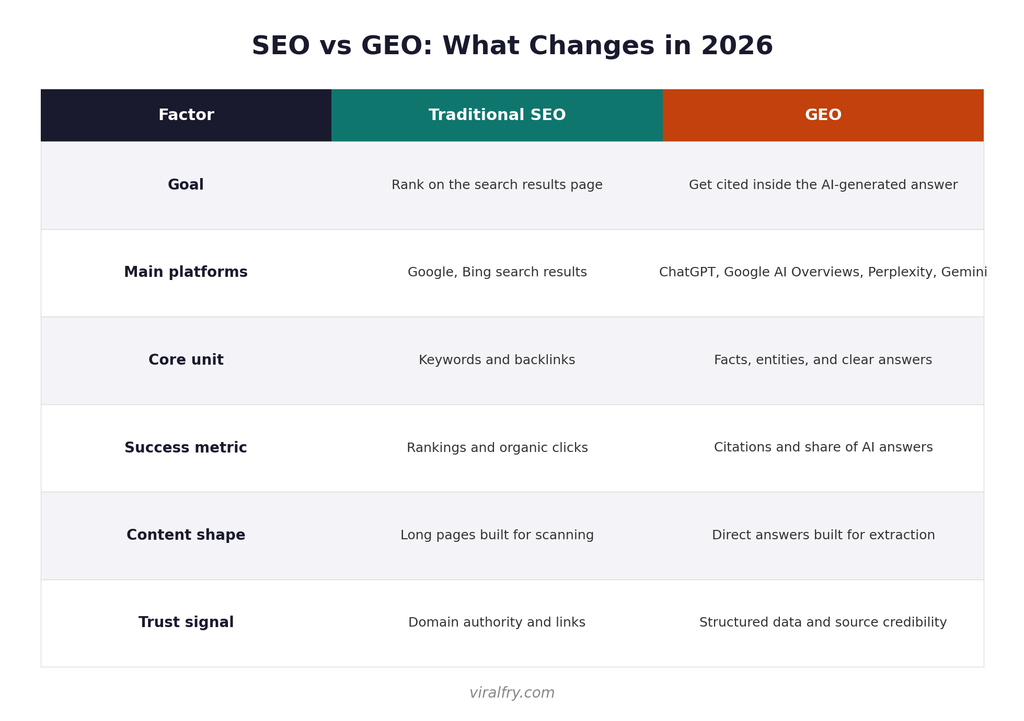
The two disciplines share a foundation, but they diverge in four important ways.
SEO targets rankings. GEO targets citations. Traditional SEO measures success by where you land on a search results page. GEO measures success by whether an AI model cites, quotes, or references your content when it answers a related question.
SEO rewards length. GEO rewards clarity. Long, comprehensive articles still help SEO because they signal topical depth to Google. AI models, on the other hand, favor short, direct, well-structured answers they can lift and repurpose. A confusing 3,000-word article with the right answer buried in paragraph 14 will lose to a competitor’s tight 150-word answer every time.
SEO relies on backlinks. GEO relies on structured facts. Domain authority and backlink profiles still influence traditional rankings. AI models care more about whether your content contains clear, verifiable, well-organized facts that they can extract with confidence. Schema markup, FAQ blocks, and clean data presentation carry real weight here.
SEO measures clicks. GEO measures visibility inside the answer. You can track SEO through rankings and organic traffic in Google Search Console. GEO requires a different kind of tracking, checking how often your brand shows up when you or a tool prompts ChatGPT, Gemini, or AI Overviews with buyer-intent questions in your category.
The graphic below breaks this down side by side.
Show Image
Why Does GEO Matter for US Brands Right Now?
US buyers, especially in B2B SaaS and fintech, have moved fast toward AI-assisted research. A growing share of product research now starts inside a chat window rather than a search bar. For SaaS companies selling to finance, HR, or operations teams, that means the buyer’s first impression of your brand often comes from how an AI model describes you, not from your website’s headline.
There is also a trust dimension. When an AI model cites your company by name in an answer, it carries an implied endorsement. That is a different kind of credibility than a paid ad or even a top organic ranking. Brands that show up consistently across ChatGPT and AI Overview answers are building a form of authority that traditional rankings cannot replicate.
What Are the Core Pillars of a GEO Strategy?
Answer the question in the first two sentences. AI models extract answers, not narratives. Lead every section with the direct answer, then support it with context.
Use structured formats AI models can parse. FAQ blocks, numbered steps, comparison tables, and definition-style paragraphs all perform well because they mirror how AI systems chunk and retrieve content.
Add schema markup. FAQ schema, Article schema, and Organization schema give AI crawlers explicit signals about what your content covers and who is publishing it.
Build topical entity clarity. AI models trust sources that consistently cover a topic in depth. Publishing a cluster of related content around your core expertise builds the kind of entity recognition that gets you cited repeatedly.
Keep facts current and specific. Vague claims get skipped. Specific numbers, named examples, and dated data get quoted.
Do not abandon SEO fundamentals. Fast page speed, clean technical SEO, and solid on-page optimization still feed into whether AI crawlers can access and trust your content in the first place. GEO builds on SEO, it does not replace it.
How Do You Measure GEO Success?
Traditional SEO tools do not track AI citations well yet, so most teams run manual or semi-automated citation audits. That means picking 15 to 25 buyer-intent prompts your ideal customer would realistically ask, running them through ChatGPT and Google AI Overviews on a regular cadence, and logging whether your brand appears, how it is described, and which competitors show up instead. Over time, this builds a clear picture of your share of voice inside AI-generated answers, separate from your organic rankings.
Need help building this out? Viral Fry runs exactly this kind of GEO and AEO citation tracking for B2B SaaS and fintech brands, alongside the technical SEO work that makes AI visibility possible in the first place. If you want a clear picture of where your brand shows up in ChatGPT and AI Overviews today, get in touch with Viral Fry and we will map it out for you.
Frequently Asked Questions
Is GEO replacing SEO?
No. GEO builds on top of strong technical and content SEO. Brands with weak SEO foundations rarely perform well in AI-generated answers either, since AI crawlers still rely on many of the same signals search engines do.
Which AI platforms should US brands optimize for first?
Start with ChatGPT and Google AI Overviews, since they carry the largest share of AI-assisted search traffic among US B2B buyers. Perplexity and Gemini are worth monitoring as adoption grows.
How long does it take to see GEO results?
Most brands see early citation movement within 60 to 90 days of restructuring content and adding schema markup, though full authority building takes longer, similar to traditional SEO timelines.
Do I need separate content for GEO and SEO?
No. The best approach restructures existing content to serve both, leading with clear answers, adding structured data, and keeping the page optimized for traditional rankings at the same time.
Can small and mid-sized B2B companies compete in GEO?
Yes. AI models often favor clear, specific, well-structured answers over sheer domain authority, which gives smaller brands with strong niche expertise a real opportunity to get cited alongside much bigger competitors.
Add as Preferred Source