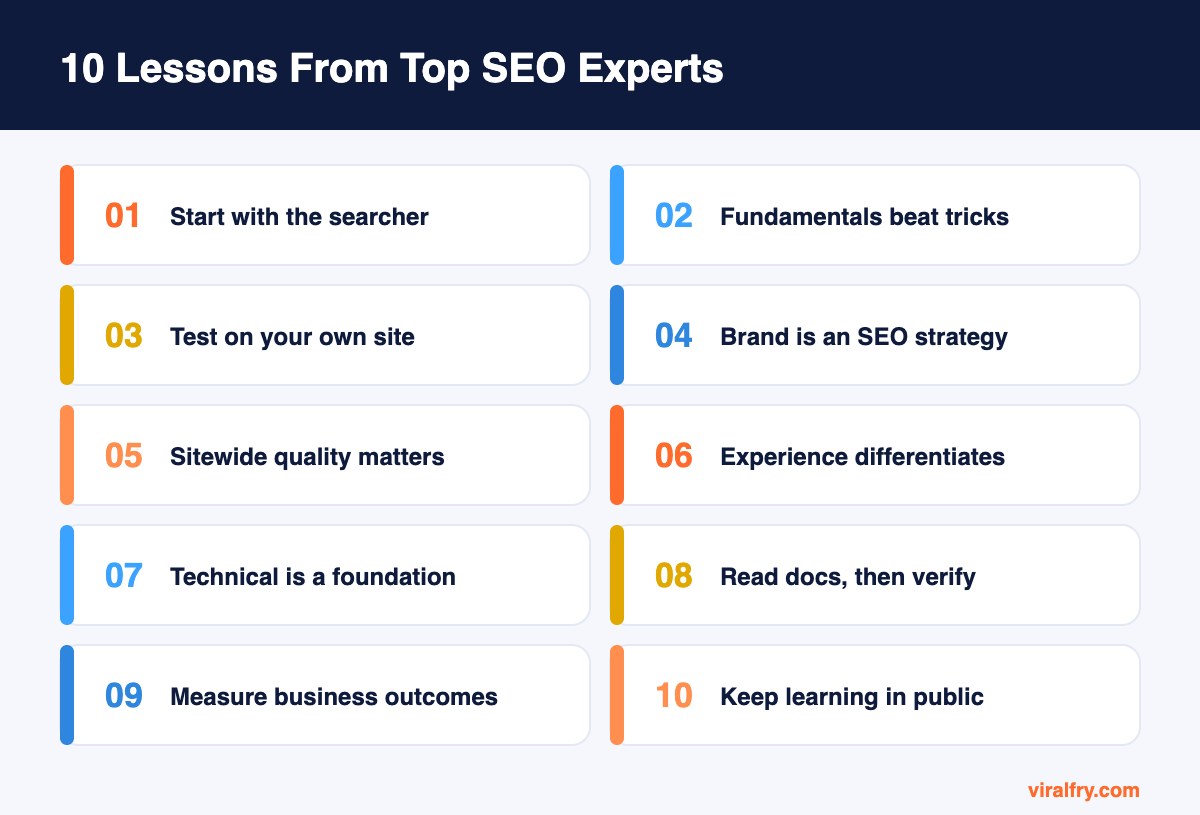
The most valuable lessons from the world’s best SEO experts are to start with the searcher, trust fundamentals over tricks, test on your own site, treat brand as an SEO strategy, manage quality across the whole site, lead with first-hand experience, keep technical SEO healthy, read official documentation and verify it, measure business outcomes, and keep learning in public. These ideas have survived many algorithm updates and still apply in an AI-driven search world.
We have followed, learned from, and occasionally argued with many leading SEOs over the years. Their styles differ, but certain lessons come up again and again. These are the ones we see making the biggest difference on real client sites. To find people worth following, see our list of SEO experts shaping AI search.
What Can You Learn From the Best SEO Experts?
1. Start with the searcher, not the keyword
Almost every respected SEO repeats some version of this: understand what the person searching actually wants before you write a word. Keywords are clues to intent, not targets in themselves.
In practice, that means reading the current results, studying People Also Ask, and talking to customers. Pages built around real needs outlast pages built around keyword density.
2. Fundamentals beat tricks
Experts who have survived many algorithm updates tend to sound boring on purpose. Crawlable sites, helpful content, clear structure, and genuine authority have worked for twenty years. Tricks rarely last more than one update.
When a new tactic promises shortcuts, ask whether it would still make sense if search engines understood your site perfectly.
3. Test everything on your own site
Researchers like Cyrus Shepard and many technical SEOs emphasize experiments. What worked for one site may not work for yours. Change one thing, log the date, and measure.
A simple change log, kept in a spreadsheet, turns opinions into evidence and helps you explain results to stakeholders.
4. Brand is an SEO strategy
Voices like Rand Fishkin have argued for years that brand demand and audience matter more as zero-click search grows. People who already know your name search for you, click you, and trust you.
Invest in being known in your niche: newsletters, communities, podcasts, and PR. It strengthens every other SEO effort.
5. Quality is judged across the whole site
Analysts who study core updates, such as Lily Ray, Glenn Gabe, and Marie Haynes, often point out that sitewide quality patterns matter. Large amounts of thin or unhelpful content can drag down an otherwise strong site.
Regular content audits that update, merge, or remove weak pages are a core habit, not a one-off project.
6. Experience is the new differentiator
With AI producing endless generic text, experts increasingly stress first-hand experience: real testing, original data, screenshots, and clear opinions from people who have done the work.
Ask before publishing: what does this page offer that a language model could not write from existing articles?
7. Technical SEO is a foundation, not a phase
Technical specialists like Mike King and Aleyda Solis show how rendering, indexing, and site architecture shape everything else. Fixing technical issues once is not enough; every release can introduce new ones.
Crawl regularly and include SEO checks in your development workflow.
8. Read the documentation, then verify
Google publishes Search Central documentation, quality rater guidelines, and spam policies. Top SEOs read them closely, but they also verify claims against real-world data.
Use official guidance as a starting point and your own results as the final word.
9. Measure what the business cares about
Experienced consultants rarely lead with rankings. They report on qualified traffic, leads, revenue, and increasingly AI visibility.
When SEO is tied to business outcomes, it earns budget and patience. When it is tied only to positions, it gets cut first.
10. Keep learning in public
Many of the most respected SEOs built their reputations by sharing what they learned: newsletters, case studies, conference talks, and free guides.
You do not need a big audience to start. Writing up one test a month sharpens your thinking and, over time, builds the authority search engines and AI systems look for.
Which Lessons Matter Most in the Age of AI Search?
| Lesson | Why it matters more now |
|---|---|
| Start with the searcher | AI answers reward content that resolves real questions |
| Experience differentiates | Generic text is easy for AI to summarize and replace |
| Brand is a strategy | AI tools describe brands based on wider web reputation |
| Technical foundation | AI crawlers need accessible, server-rendered content |
| Measure outcomes | Clicks fall while visibility shifts into AI answers |
What Do Great SEOs Avoid?
- Chasing every new tactic after a single tweet
- Publishing at scale without quality control
- Reporting rankings without business context
- Ignoring technical health between projects
- Treating SEO as separate from product, brand, and sales
How Do You Apply These Lessons as a Small Team?
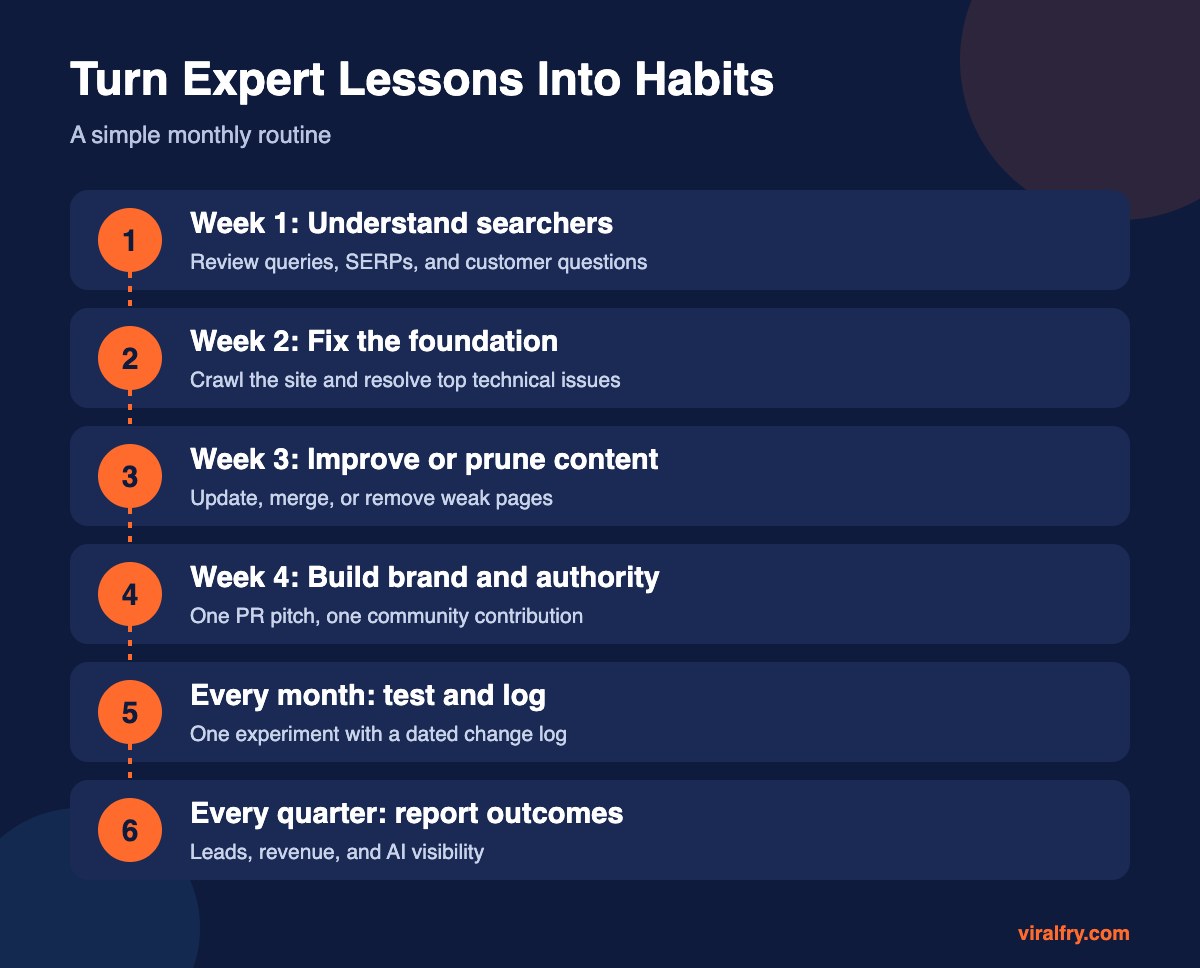
You do not need a large budget to follow these lessons. A small team can spend one hour a week reviewing Search Console, one day a month improving or pruning content, and one afternoon a quarter planning brand and PR activities. The key is consistency. Experts rarely succeed through one brilliant idea; they succeed by doing the fundamentals well, repeatedly, and learning from each result.
Which Lesson Should You Start With?
If you are unsure, start with the searcher. Pick your ten most important pages, search their target keywords, and honestly compare your page with the top results. That single exercise usually reveals intent gaps, missing information, and weak openings that are holding you back. Fixing those often produces faster gains than any new tactic. If a page still will not move, our guide on why websites do not rank walks through the next checks.
What Do the Best SEOs Have in Common?
Look past their different specialties and a few habits repeat. They stay curious about how search systems actually work instead of relying on folklore. They write down what they test and share what they learn. They are comfortable saying “it depends” and then explaining exactly what it depends on. And they care about the person searching, not just the algorithm. Those habits are available to anyone, whatever the size of the site or budget.
Key Takeaways
- Searcher intent and fundamentals outlast every trend.
- Test ideas on your own site and keep a change log.
- Brand, experience, and sitewide quality matter more than ever.
- Keep technical SEO healthy with regular checks.
- Measure SEO by business outcomes and share what you learn.
Frequently Asked Questions
What is the most important SEO lesson?
Start with what the searcher needs. Content that genuinely satisfies search intent is the foundation of every successful SEO strategy.
Do SEO best practices still work with AI search?
Yes. AI search tools rely on indexed, trustworthy content, so fundamentals like intent matching, technical health, and authority still matter, alongside clear answers and original information.
How do SEO experts stay up to date?
They read official documentation, follow algorithm update analysis, run their own experiments, and share findings through newsletters, talks, and communities.
Should I follow every SEO expert’s advice?
No. Treat advice as a hypothesis and test it on your own site. Experts sometimes disagree, and results vary by industry and site.
Add as Preferred Source