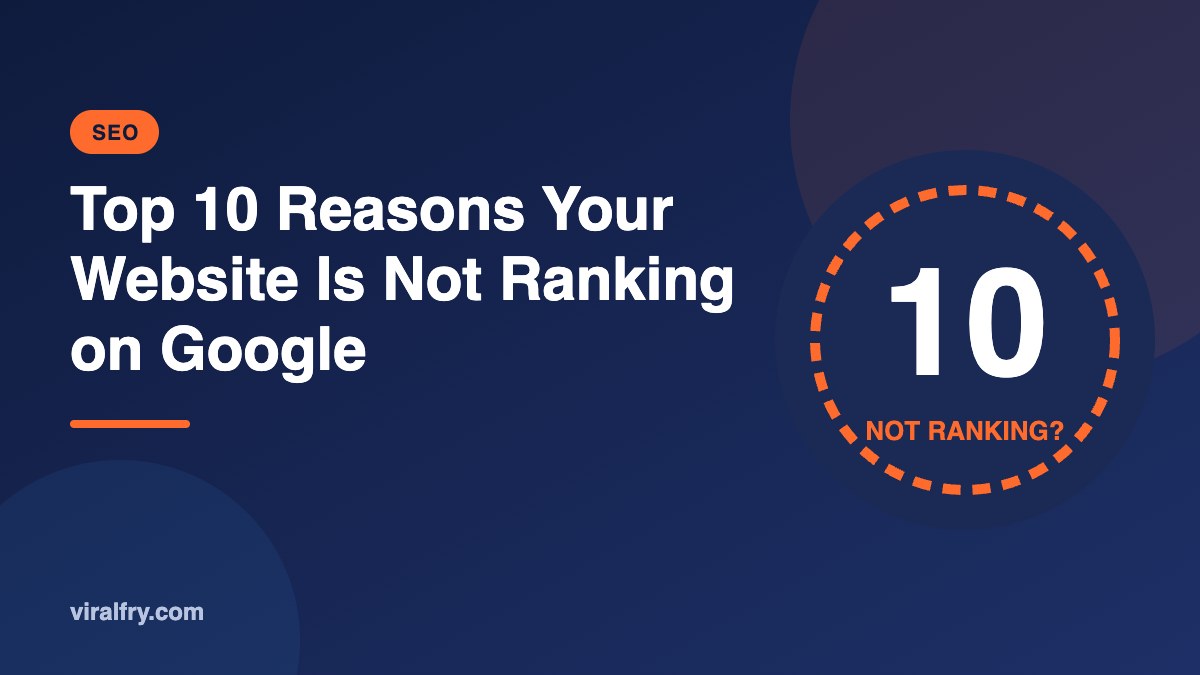
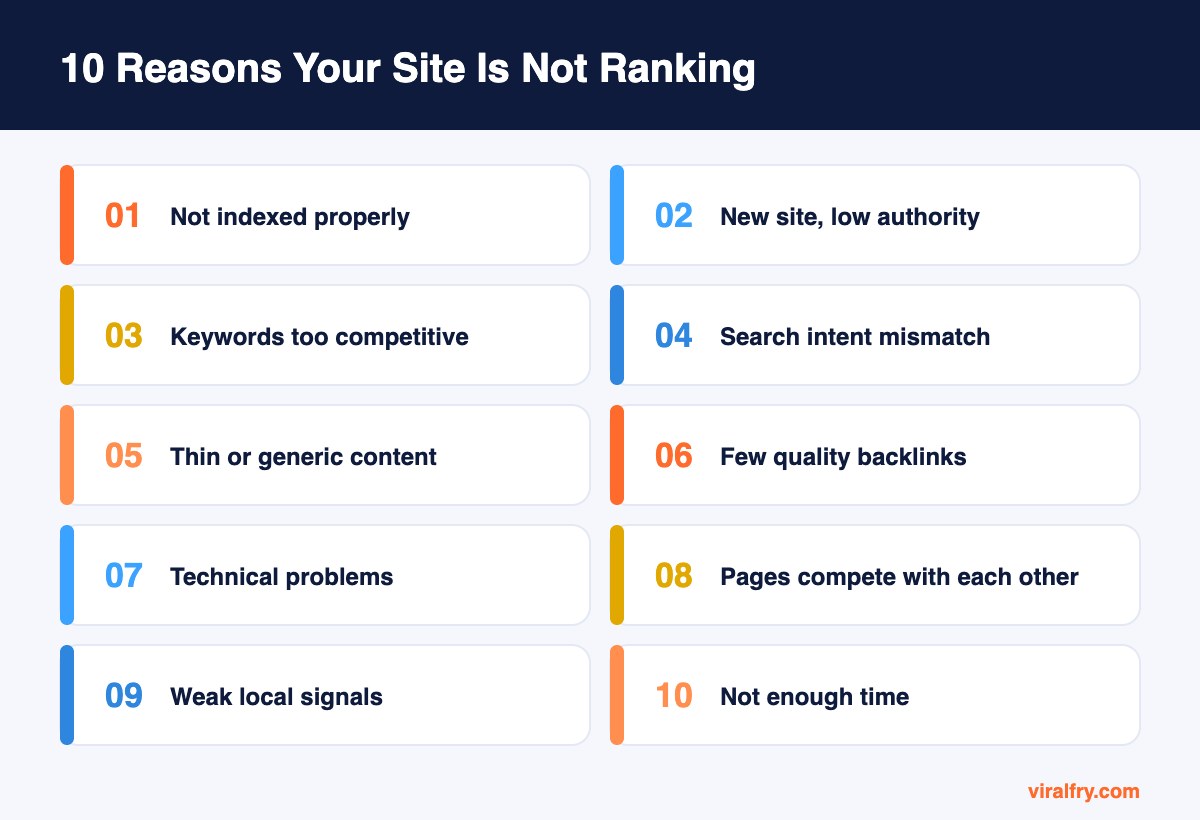
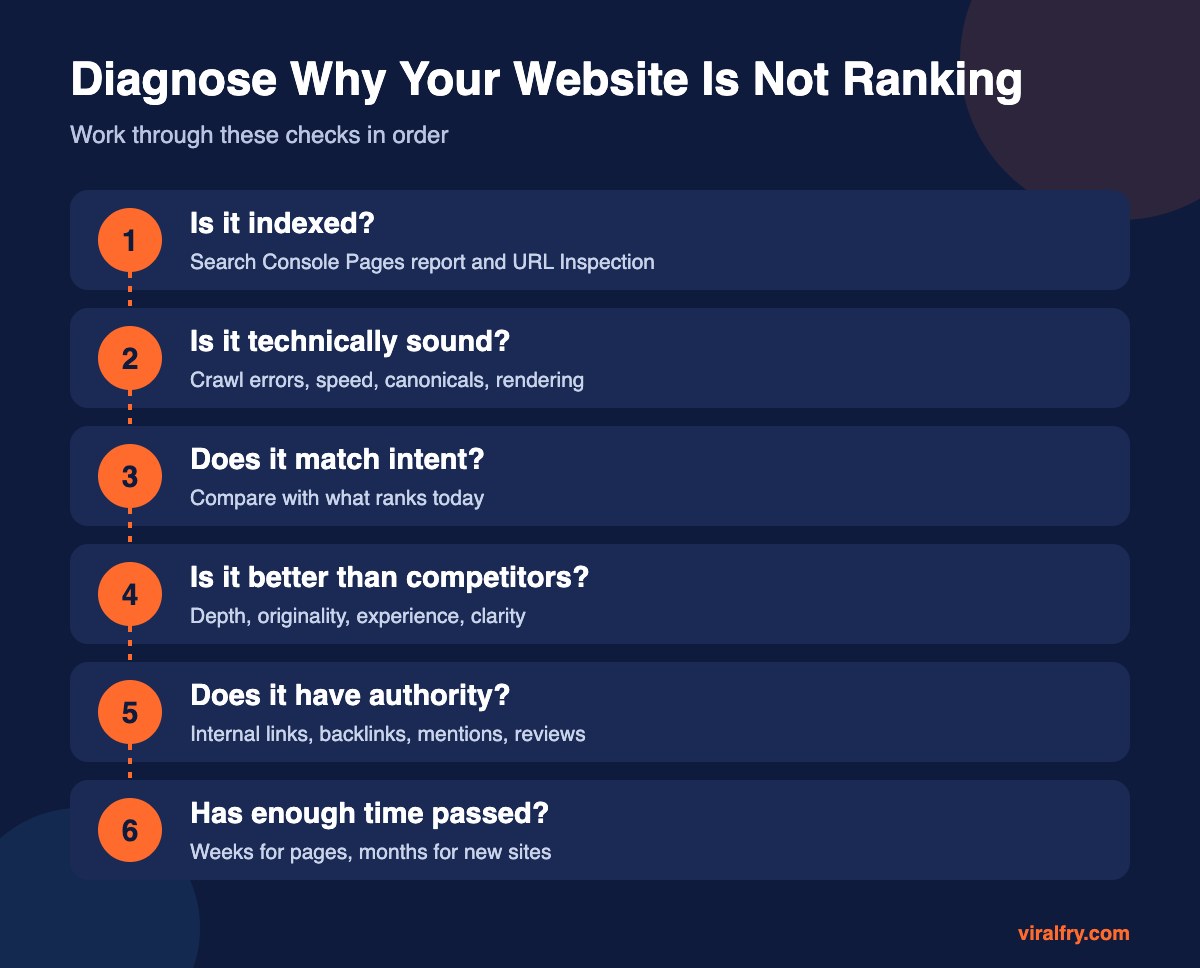
A website usually is not ranking on Google because its pages are not properly indexed, the site is new with little authority, it targets keywords that are too competitive, its content does not match search intent or is too generic, it lacks quality backlinks, technical problems hold it back, pages compete with each other, local signals are weak, or it simply has not had enough time. Check them in that order and you will usually find the cause.
This guide looks at your whole website. If one specific page refuses to move, our guide on why a keyword is not ranking despite the title tag goes deeper on page-level diagnosis.
Why Is My Website Not Ranking on Google?
1. Google has not indexed your site properly
If Google cannot find or index your pages, nothing else matters. New sites often have only a handful of pages indexed for weeks.
Verify your site in Search Console, submit an XML sitemap, check the Pages report for exclusions, and use URL Inspection on your most important pages. Make sure nothing is blocked by robots.txt or a stray noindex tag.
2. Your site is new and has little authority
Brand-new domains rarely rank for competitive terms quickly. Google needs time and signals, such as links and mentions, before it trusts a site.
Start with specific, low-competition long-tail topics where you can genuinely be the best answer, and build authority from there.
3. You are targeting keywords that are too competitive
Trying to rank a small site for “best CRM” against the world’s biggest publishers is a long road. Difficulty is about who already ranks, not just how many people search.
Look at the sites in the top ten. If they are household names with thousands of links, choose narrower keywords first.
4. Your content does not match search intent
If searchers want a comparison and you offer a sales page, or they want a quick answer and you offer a 5,000-word essay, Google will prefer pages that fit.
Study the current results and match their format and angle, then add something better.
5. Your content is thin or generic
Pages that repeat what already ranks, with no original insight, rarely earn a place on page one. This is even more true after Google’s helpful content and core updates.
Add first-hand experience, examples, data, and clear answers that other pages do not offer.
6. You have few quality backlinks
Links from relevant, trusted sites remain one of the strongest signals for competitive terms. Many small sites have almost none.
Earn links with useful resources, original research, partnerships, and digital PR. Avoid buying links.
7. Technical problems are holding you back
Slow pages, broken internal links, wrong canonicals, and JavaScript-only content quietly limit rankings.
Run through our technical SEO issues guide to find and fix the biggest problems.
8. Your pages compete with each other
Several pages targeting the same keyword split signals and confuse Google about which to rank.
Merge overlapping pages or give each a distinct purpose, and link them together clearly.
9. Your local signals are weak
For local businesses, rankings depend heavily on your Google Business Profile, reviews, proximity, and consistent business information across the web.
Complete your profile, collect reviews steadily, and keep your name, address, and phone number identical everywhere.
10. You have not given it enough time
SEO compounds slowly. New pages on established sites often need weeks to settle, and new sites can take three to six months or more to see meaningful traffic.
Keep publishing and improving consistently, and judge progress over quarters, not days.
How Do You Check Whether Google Has Indexed Your Site?
Search site:yourdomain.com on Google for a rough count, then rely on Search Console for the accurate picture. The Pages report shows which URLs are indexed and why others are not. URL Inspection tells you whether a specific page is on Google, which canonical Google chose, and when it was last crawled. If important pages are missing, fix that before anything else.
How Long Does It Take a New Website to Rank?
| Situation | Typical timeline |
|---|---|
| New page on an established site | A few weeks to a few months |
| New site, low-competition topics | Three to six months |
| New site, competitive industry | Six to twelve months or more |
| Local business with a complete profile | Weeks to a few months in the map pack |
These are ranges, not promises. Consistent publishing, technical health, and earning links shorten them.
What Should You Do This Month to Start Ranking?
- Verify Search Console and Bing Webmaster Tools and submit sitemaps.
- Fix any indexing blockers and major technical errors.
- Pick ten long-tail keywords you can realistically win and match their intent.
- Publish or improve one strong page per week with original insight.
- Add internal links from your homepage and top pages to new content.
- Start one link-earning activity, such as a resource or digital PR pitch.
When Should You Get Professional SEO Help?
If you have worked through these checks for three to six months without progress, or if you rely on organic traffic for revenue and cannot afford long experiments, an experienced SEO can save a lot of time. Look for someone who starts with an audit and asks about your business goals before promising results. Our guide on hiring a freelance SEO expert covers what to ask.
What Does a Typical Ranking Diagnosis Reveal?
Here is a common pattern from audits. A services business publishes twenty blog posts over a year and still gets almost no organic traffic. Search Console shows that only eight of the posts are indexed. The rest are marked “Crawled, currently not indexed” because they cover the same broad topics as thousands of other sites with nothing new to add.
At the same time, the service pages target national keywords dominated by large directories, even though the business only serves one metro area. The homepage has a single backlink, from the web designer.
The fix was not more content. It was fewer, better pages focused on local service keywords, a complete Google Business Profile, a steady review process, and a handful of local partnerships that earned genuine links. Traffic and calls grew within one quarter.
Key Takeaways
- Indexing problems come first; check Search Console.
- New sites should target narrow, low-competition topics first.
- Match search intent and add original value.
- Build authority with links, mentions, and reviews.
- Give SEO enough time, and track progress over quarters.
Frequently Asked Questions
Why is my website not showing up on Google?
The most common reason is that Google has not indexed it yet, or something like a noindex tag or robots.txt rule is blocking it. Check the Pages report in Google Search Console.
How do I get my website to rank on Google?
Make sure it is indexed and technically sound, target realistic keywords that match search intent, publish genuinely helpful content, build internal links, and earn quality backlinks over time.
Can I pay Google to rank higher?
No. You can pay for Google Ads placements, but organic rankings cannot be bought from Google.
Why did my rankings suddenly drop?
Common causes include technical changes such as an accidental noindex, a Google core update, a competitor improving their content, or new search features like AI Overviews taking clicks.
Add as Preferred Source