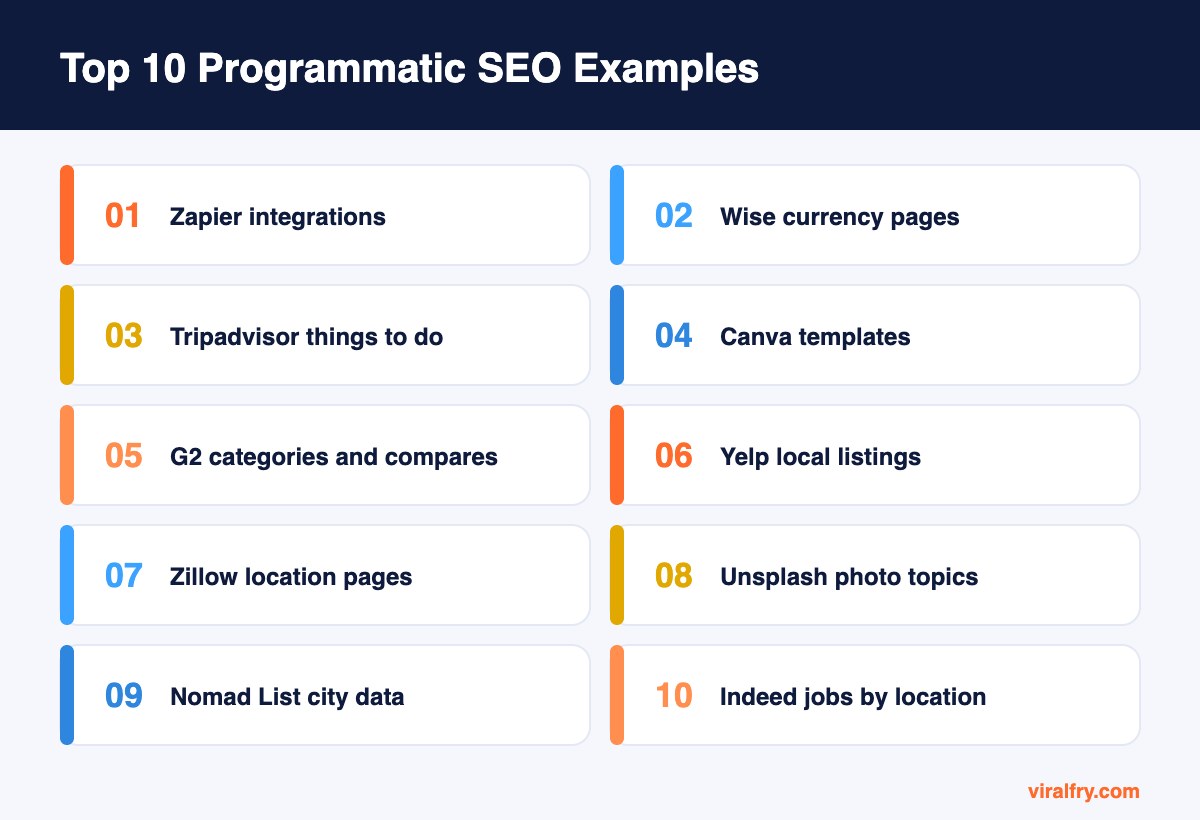
The best programmatic SEO examples include Zapier’s app integration pages, Wise’s currency converter pages, Tripadvisor’s destination pages, Canva’s template pages, G2’s software category and comparison pages, Yelp’s local listings, Zillow’s location pages, Unsplash’s photo topics, Nomad List’s city data, and Indeed’s job pages. Each succeeds because a repeatable search pattern is matched with unique, useful data on every page.
Programmatic SEO means creating many pages from a template and a dataset, each targeting a variation of a search pattern. Done well, it captures thousands of long-tail searches. Done badly, it creates thin pages that Google’s scaled content policies are designed to catch. The examples below show the difference.
What Are the Best Programmatic SEO Examples?
1. Zapier: app integration pages
Zapier creates pages for individual apps and for pairs of apps, such as “Connect Gmail and Slack.” Each page targets a specific integration search and is filled with real data: supported triggers, actions, and popular workflows.
Lesson: the template works because every page answers a real task-based query with useful, product-specific information, not just a swapped name.
2. Wise: currency converter pages
Wise publishes conversion pages for currency pairs (for example, USD to INR) with live rates, historical charts, fee comparisons, and a working converter. Searchers get the answer and a reason to use the product.
Lesson: live, accurate data plus a tool makes each page genuinely useful and hard to copy.
3. Tripadvisor: destination and “things to do” pages
Tripadvisor generates pages for cities, attractions, hotels, and restaurants, powered by listings and millions of reviews. “Things to do in Lisbon” pages rank because they aggregate real traveler content.
Lesson: user-generated content can make programmatic pages unique at scale.
4. Canva: template category pages
Canva has pages for templates by type and use case, such as resumes, Instagram posts, or wedding invitations. Each page shows real, usable templates that match the search.
Lesson: when your product inventory maps to search demand, programmatic pages become a natural storefront.
5. G2: software category and comparison pages
G2 builds category pages (“best CRM software”) and comparison pages (“Tool A vs Tool B”) from structured product data and verified reviews.
Lesson: comparison templates fed by trustworthy data capture high-intent B2B searches. These pages also appear often in AI answers about software choices.
6. Yelp: local business listing pages
Yelp creates pages for business types in specific places, such as “best tacos in Austin,” filled with listings, photos, and reviews.
Lesson: local intent multiplied by categories creates huge search coverage, but only works with real, local data behind each page.
7. Zillow: location and property pages
Zillow publishes pages for cities, neighborhoods, ZIP codes, and individual properties with listings, price trends, and local information.
Lesson: structured data at different geographic levels supports both broad and specific queries.
8. Unsplash: free photo topic pages
Unsplash has pages for photo topics like “office background” or “mountain wallpaper,” each showing relevant images from its library.
Lesson: a large media library can map directly to long-tail search demand.
9. Nomad List: city data pages
Nomad List created pages for cities with data on cost of living, internet speed, safety, and weather for remote workers. It is a classic example from a small team.
Lesson: you do not need a giant company; you need a unique dataset your audience cares about.
10. Indeed: job title and location pages
Indeed generates pages for job titles in locations (“marketing manager jobs in Bangalore”) and salary pages built from its own data.
Lesson: combining two variables that people naturally search for, such as role and city, creates scalable demand.
What Do Successful Programmatic SEO Sites Have in Common?
| Common trait | Why it matters |
|---|---|
| A repeatable search pattern | Proves demand exists across many variations |
| Unique data on every page | Prevents thin, duplicate content |
| A useful template | Answers the query quickly and fully |
| Strong internal linking | Helps discovery and distributes authority |
| Ongoing quality control | Removes pages that add no value |
Is Programmatic SEO Risky?
It can be. Google’s spam policies target scaled content created mainly to manipulate rankings, especially pages that swap a city or keyword into otherwise identical text. The examples above avoid that by offering real data, listings, reviews, or tools on each page. Before launching, ask: would this page be useful if search engines did not exist? If not, do not build it.
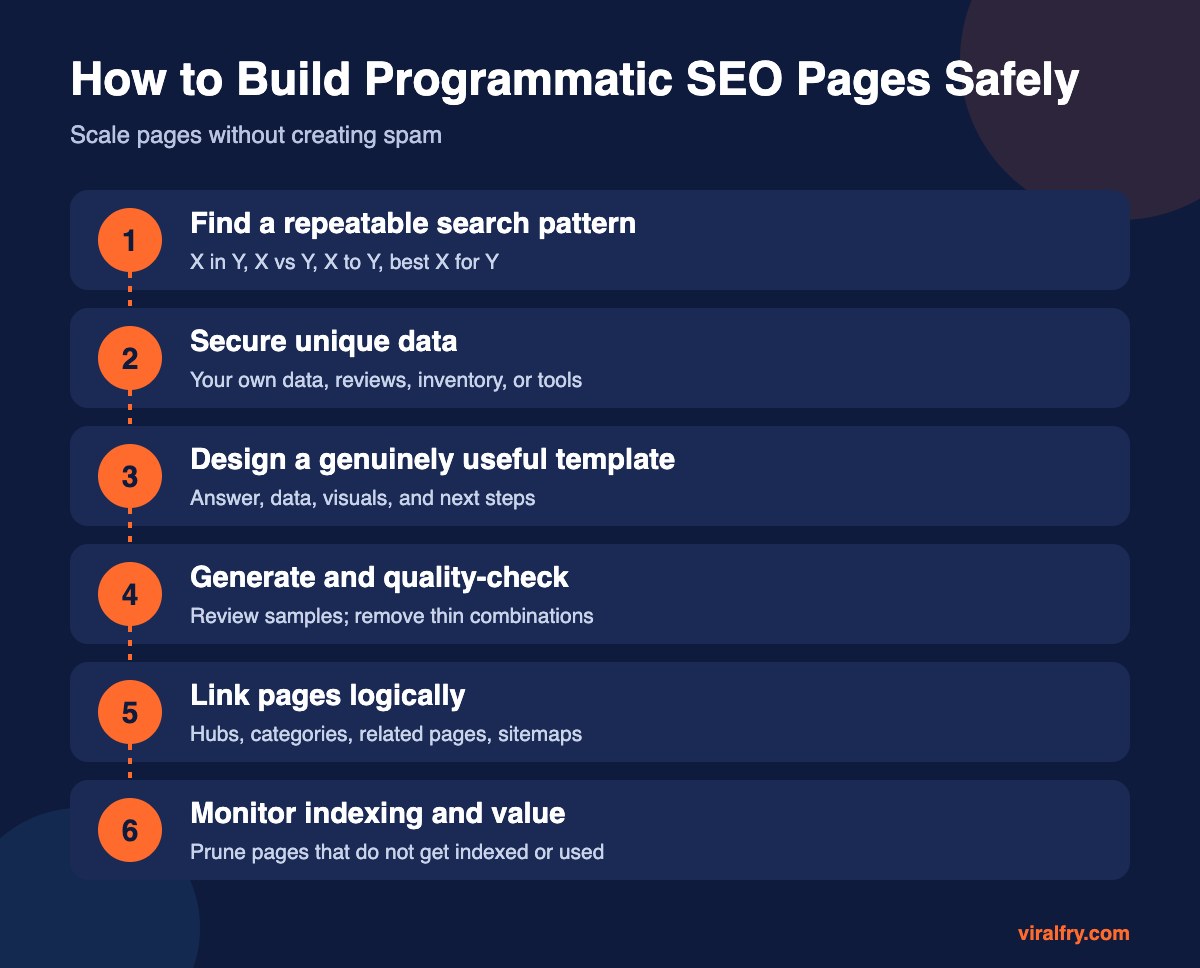
How Do You Start a Programmatic SEO Project?
- Find a pattern in your keyword research, such as “[tool] integration,” “[service] in [city],” or “[A] vs [B].”
- Check that you have unique data for each variation.
- Design one excellent page by hand first and make sure it ranks or at least gets indexed.
- Build the template from that page and generate a small batch.
- Monitor indexing, traffic, and engagement before scaling further.
If you work in B2B SaaS, read our SEO strategies for SaaS companies for how integration and comparison pages fit a wider plan.
Does Programmatic SEO Work for AI Search?
It can. Data-rich pages such as comparisons, specifications, and local listings are exactly what AI answers often cite. The same rule applies: unique, accurate data wins; templated filler does not. Use clear tables and structured data so each page is easy to extract.
What Programmatic SEO Mistakes Should You Avoid?
- Generating pages for combinations nobody searches
- Publishing thousands of pages at once without testing
- Using AI to write near-identical paragraphs on every page
- Ignoring crawl budget and indexing reports
- Forgetting internal links, leaving pages orphaned
What Could Programmatic SEO Look Like for a Small Business?
You do not need millions of pages. A digital marketing agency could build pages for “SEO services for [industry]” across the ten industries it actually serves, each with a real case study, industry-specific challenges, and relevant FAQs. A software company could publish “[Your tool] + [integration]” pages for its 40 real integrations, each with setup steps and use cases.
A local service business could create pages for each neighborhood it covers, but only if every page includes genuine local details: jobs completed there, photos, reviews from local customers, and area-specific advice.
In every case the rule is the same. The template saves time, but the data and real-world detail are what make each page worth ranking.
Key Takeaways
- Programmatic SEO pairs a search pattern with a dataset and a template.
- Unique, useful data on every page is non-negotiable.
- Start with one great manual page, then scale gradually.
- Watch indexing and prune pages that add no value.
- Data-rich programmatic pages can also earn AI citations.
Frequently Asked Questions
What is programmatic SEO?
Programmatic SEO is the practice of creating many search-optimized pages from a template and a structured dataset, each targeting a different variation of a common search pattern.
Is programmatic SEO against Google’s guidelines?
Not by itself. It becomes a problem when pages are thin, duplicated, or created mainly to manipulate rankings. Pages with unique, useful data are fine.
What tools are used for programmatic SEO?
Teams often use a database or spreadsheet for data, a CMS like Webflow or WordPress with custom templates, and scripts or no-code tools to generate pages.
How many pages should a programmatic SEO project start with?
Start small, often with a few dozen to a few hundred pages, and scale only after confirming they get indexed and attract traffic.
Add as Preferred Source