
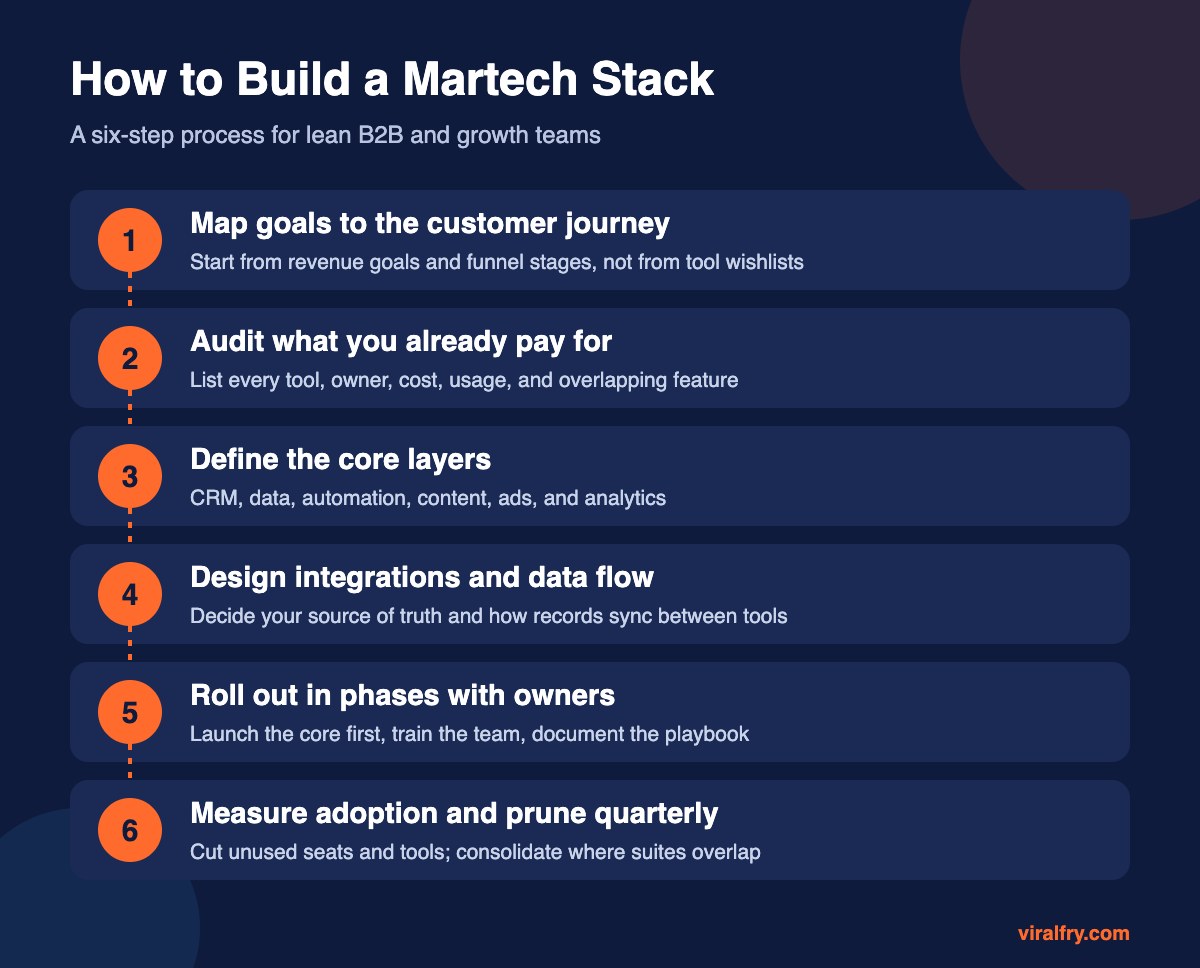
Short answer: to build a martech stack, start from your revenue goals and customer journey, audit the tools you already pay for, choose one system of record (usually your CRM), add only the layers each funnel stage truly needs, connect them so data flows one way, roll out in phases with clear owners, and review usage every quarter. The best stack is the smallest one your team actually uses.
Most teams do not have a tooling problem. They have a sprawl problem: overlapping subscriptions, data that does not sync, and features nobody was trained on. Industry surveys have repeatedly found that marketers use only a fraction of the capabilities they pay for. This guide gives you a practical, step-by-step way to build or rebuild a stack that fits your team size and budget. If you need the basics first, start with our guide to what a martech stack is.
What Should You Do Before Buying Any Martech Tool?
Write down what the stack must achieve. Tie it to numbers you already report on: pipeline, qualified leads, customer acquisition cost, retention, or revenue. Then map your customer journey from first touch to renewal and note where the team loses time or visibility today.
This step prevents the most expensive mistake: buying a tool because a competitor uses it or because a demo looked impressive. Every tool you add should solve a named problem at a named stage of the journey.
How Do You Audit Your Current Marketing Tools?
Pull a list of every marketing and sales tool from finance, expense reports, and SSO logs. For each one, record:
- Owner and main users
- Annual cost and renewal date
- Number of paid seats versus active users
- Core job it does and which funnel stage it serves
- Integrations it relies on
- Features that overlap with another tool
You will almost always find duplicates, for example two form builders, an email tool alongside a CRM that already sends email, or three analytics dashboards nobody reconciles. Mark each tool as keep, consolidate, replace, or cut.
What Are the Core Layers of a Martech Stack?
Think in layers, not logos. A modern stack for most B2B and growth teams covers these six:
| Layer | What it does | Example tools |
|---|---|---|
| CRM (system of record) | Stores contacts, companies, deals, and the full customer timeline | HubSpot, Salesforce, Pipedrive, Zoho CRM |
| Data and CDP | Collects behavioral data and unifies customer profiles | Segment, RudderStack, HubSpot Data Hub |
| Marketing automation and email | Nurture flows, lead scoring, lifecycle emails | HubSpot, Marketo, ActiveCampaign, Customer.io |
| Content, SEO, and website | CMS, SEO research, on-page optimization | WordPress, Webflow, Semrush, Ahrefs, Yoast |
| Ads and social | Paid acquisition, retargeting, scheduling, listening | Google Ads, LinkedIn Ads, Meta Business Suite, Buffer |
| Analytics and attribution | Traffic, conversion, and revenue reporting | GA4, Looker Studio, Mixpanel, HockeyStack |
Small teams can often cover four of these six layers with one all-in-one platform and add specialists only where they hit a real limit. Larger teams usually move toward best-of-breed tools connected through a CDP or data warehouse.
Should You Choose an All-in-One Suite or Best-of-Breed Tools?
It depends on team size, technical resources, and how specialized your channels are.
- All-in-one suite: faster setup, one login, built-in reporting, less integration work. Best for startups and teams without a marketing operations person.
- Best-of-breed: deeper features per channel and more flexibility, but you pay for it with integration, data hygiene, and admin time. Best for teams with a dedicated ops or RevOps owner.
- Hybrid: a suite for CRM and automation plus specialist tools for SEO, ads, or product analytics. This is where most growing companies land.
How Do You Connect Your Martech Tools So Data Flows Cleanly?
Decide which tool is the source of truth for each type of data. Contact and deal data should live in the CRM. Website behavior typically flows from your analytics or CDP into the CRM. Ad platforms receive audiences and conversions back from the CRM.
- Use native integrations first. They are maintained by the vendor and break less often.
- Use an integration platform such as Zapier or Make for simple gaps.
- Agree on naming conventions and UTM rules before launch, so campaign data stays clean across tools.
- Document every sync: direction, frequency, fields, and owner.
If you also use automation for SEO tasks, see our roundup of workflow automation tools for SEO and our guide to email marketing automation.
How Should You Roll Out a New Martech Stack?
Launch in phases. Start with the CRM and the data foundations, then automation, then channel tools. For each phase:
- Assign one accountable owner per tool
- Migrate and clean data before turning on automations
- Train users on the three or four workflows they need daily, not every feature
- Write a short internal playbook with screenshots
- Set a 30-day check-in to fix friction early
How Do You Measure Whether Your Martech Stack Is Working?
Track both business results and adoption. A tool that nobody logs into cannot move revenue.
- Adoption: active users versus paid seats, and feature usage per tool
- Data health: duplicate records, missing fields, sync errors
- Efficiency: time to launch a campaign, time to build a report
- Outcomes: pipeline and revenue influenced, cost per qualified lead, stack cost as a share of marketing budget
Review these every quarter and prune. Cancel unused seats, consolidate overlapping features into tools you already own, and only then consider adding something new.
What Does a Lean Martech Stack Look Like for a Small B2B Team?
For a startup or small B2B SaaS team, a practical starting stack is:
- A CRM with built-in email and basic automation
- WordPress or Webflow for the website, with an SEO plugin
- One SEO research tool
- GA4 plus Looker Studio for reporting
- Native ad platforms (Google Ads, LinkedIn Ads) with conversion tracking connected to the CRM
- A scheduling tool for social
That is often six or seven tools, which is plenty until you have the people and data volume to justify more.
What Mistakes Should You Avoid When Building a Martech Stack?
- Buying tools before defining goals and the customer journey
- Running two systems of record for contacts
- Skipping data cleanup before migration
- Underinvesting in training and documentation
- Letting tools renew automatically without a usage review
- Adding AI features everywhere without a clear use case or data policy
Key Takeaways
- Start from revenue goals and the customer journey, not from tool lists.
- Audit and consolidate before you buy anything new.
- Pick one system of record, usually the CRM, and design data flow around it.
- Roll out in phases with owners, training, and a written playbook.
- Measure adoption and prune every quarter; the smallest stack your team uses well wins.
Frequently Asked Questions
What is the first tool in a martech stack?
For most teams it is the CRM, because it acts as the system of record for contacts, companies, and deals. Every other tool should send data to it or read data from it.
How many tools should a martech stack have?
There is no fixed number. Small teams often run well on six to ten tools, while enterprises may use many more. The right number is the smallest set that covers your funnel stages and that your team actively uses.
How much does a martech stack cost?
Costs range from a few hundred dollars a month for a lean startup stack to six or seven figures a year for enterprise suites. Budget for implementation, integrations, and training, not just licenses.
How often should you review your martech stack?
Review usage and spend every quarter, and do a deeper audit once a year or before major renewals.
What is the difference between a martech stack and an adtech stack?
A martech stack manages owned and earned marketing such as CRM, email, content, and analytics. An adtech stack manages paid media buying, targeting, and ad delivery. Most modern teams connect the two through shared audience and conversion data.
Add as Preferred Source