AI is reshaping PR budgets by automating routine work such as monitoring, clipping, and first drafts, and shifting money toward work that earns attention: original data, expert visibility, relationships with trusted outlets, and measurement of AI search presence. As buyers increasingly ask AI assistants for recommendations, PR now influences not only what journalists write but how AI tools describe a brand.
PR leaders are under pressure from two directions. AI makes many routine tasks cheaper, so executives expect efficiency. At the same time, AI answers raise the stakes on reputation, because a few trusted sources can shape what millions of people hear about your company. The result is not smaller PR budgets so much as different ones.
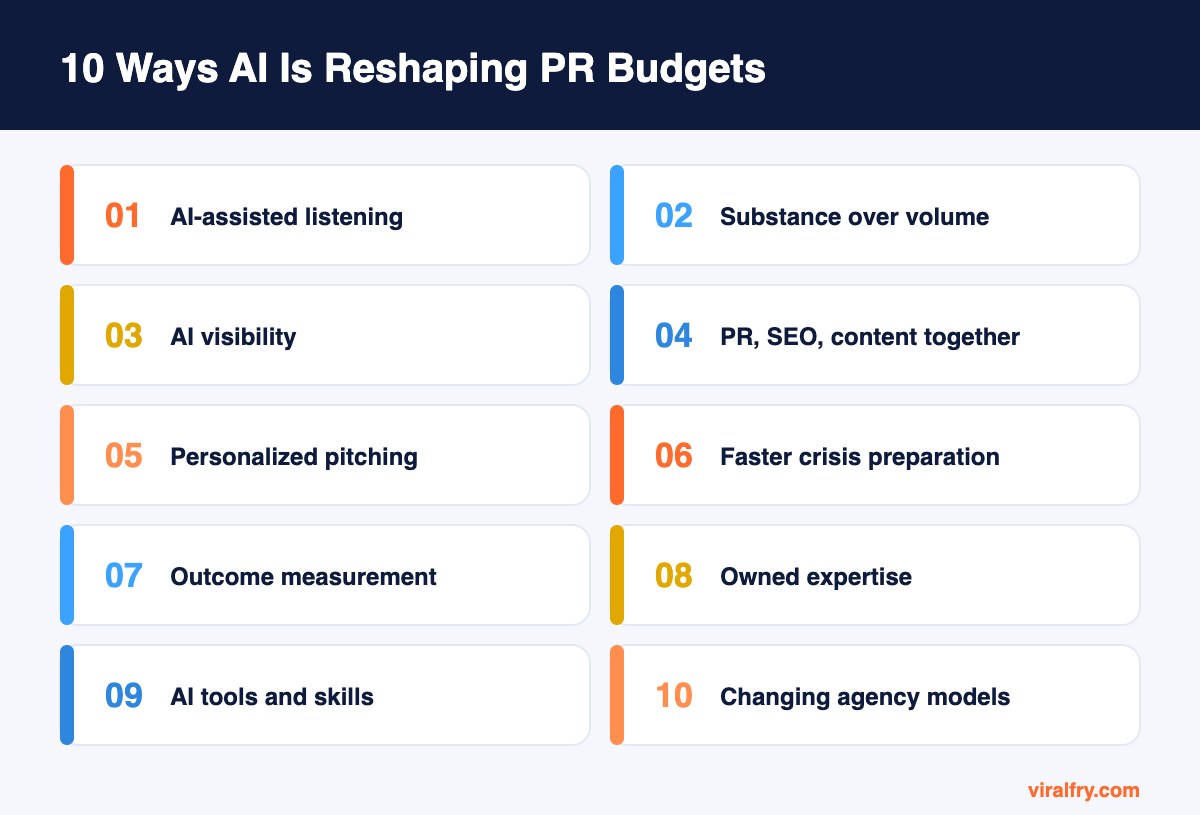
How Is AI Changing Where PR Budgets Go?
1. From manual monitoring to AI-assisted listening
Media monitoring, clipping, and sentiment tracking used to take hours of analyst time. AI tools now summarize coverage, flag trends, and detect sentiment shifts in minutes.
The saving does not disappear; most teams move that budget into strategy and storytelling rather than headcount for routine reports.
2. From press release volume to newsworthy substance
AI makes it easy to produce press releases, which means journalists receive more generic pitches than ever. The PR teams getting coverage invest in substance: original data, expert access, and genuinely new stories.
Budget is moving from distribution wires toward research and data projects that earn attention on merit.
3. From vanity coverage to AI visibility
When buyers ask ChatGPT, Perplexity, or Google AI Overviews for recommendations, answers draw on trusted publications, reviews, and discussions. Coverage in those sources now shapes how AI describes your brand.
PR teams increasingly prioritize outlets and formats that AI systems cite, not just those with the biggest audiences. Our guide on getting cited in AI answers explains why.
4. From separate silos to PR, SEO, and content together
Digital PR earns the links and mentions SEO needs, and content teams produce the research PR pitches. AI search rewards all three working together.
More companies now run joint budgets and shared calendars for PR, SEO, and content rather than separate programs.
5. From generic outreach to personalized pitching
AI can help research journalists’ recent work and draft tailored pitches, but sending more pitches is not the goal. Relevance is.
Smart teams use AI to prepare better, then keep the final pitch personal and human. Mass AI outreach damages relationships quickly.
6. From reactive crisis response to faster preparation
AI-driven monitoring spots emerging issues earlier, and AI tools help prepare draft statements and Q&A documents quickly. That shifts budget toward preparation and spokesperson training.
Human judgment remains essential in any crisis; AI speeds up the groundwork.
7. From output reports to outcome measurement
Clip counts and advertising value equivalents are giving way to measures that link PR to business: referral traffic, branded search growth, share of voice in AI answers, and influence on pipeline.
Budget follows measurement. Teams that can show impact keep their funding.
8. More investment in owned expertise
AI summaries reward credible, named experts. PR budgets increasingly fund executive visibility: bylined articles, podcasts, LinkedIn content, and speaking.
These assets build the authority signals that both journalists and AI systems look for.
9. New spending on AI tools and skills
Budgets now include AI tools for monitoring, research, drafting, and analytics, plus training so teams use them responsibly.
The cost of tools is usually small compared with the time saved, but governance and fact-checking processes need investment too.
10. Agency relationships are changing
Clients expect agencies to deliver more strategy and fewer manual tasks. Retainers are being renegotiated around outcomes, data stories, and AI visibility rather than hours spent on clipping and distribution.
For guidance on choosing partners, see our article on choosing a content marketing agency.
Which PR Activities Are Growing and Which Are Shrinking?
| Growing | Shrinking |
|---|---|
| Original research and data stories | Manual clipping and monitoring |
| Executive and expert visibility | Mass press release distribution |
| Digital PR tied to SEO and AI search | Generic, high-volume pitching |
| Outcome-based measurement | Advertising value equivalents |
| AI tools and training | Routine report production by hand |
Why Does PR Matter More in AI Search?
AI assistants do not just list links; they summarize what the web says about a topic or brand. Mentions in respected publications, expert quotes, reviews, and community discussions all feed that summary. Strong PR increases the chance your brand is described accurately and recommended. Weak or missing coverage leaves AI tools to rely on competitors and third parties. For the strategy behind this, read our GEO strategies guide.
What Risks Should PR Teams Watch?
- AI-written pitches that sound generic and damage journalist relationships
- Factual errors in AI-assisted drafts reaching the public
- Over-reliance on automated sentiment analysis for nuanced issues
- Disclosure and ethics questions around AI-generated content
- Measuring AI visibility with tools that are still immature
Every AI-assisted output that reaches media or the public still needs human review.
How Should Small Businesses Think About PR and AI?
Small businesses rarely have a PR budget at all, which makes AI tools especially useful. A founder can use AI to research relevant journalists and podcasts, prepare talking points, and draft pitches, then spend their limited time on a few personal, high-quality approaches. Combine that with one original data point a quarter, such as a survey of customers, and consistent expert content on LinkedIn, and you can build meaningful visibility without an agency. See our link building strategies for tactics that overlap with PR.
What Does a Rebalanced PR Budget Look Like?
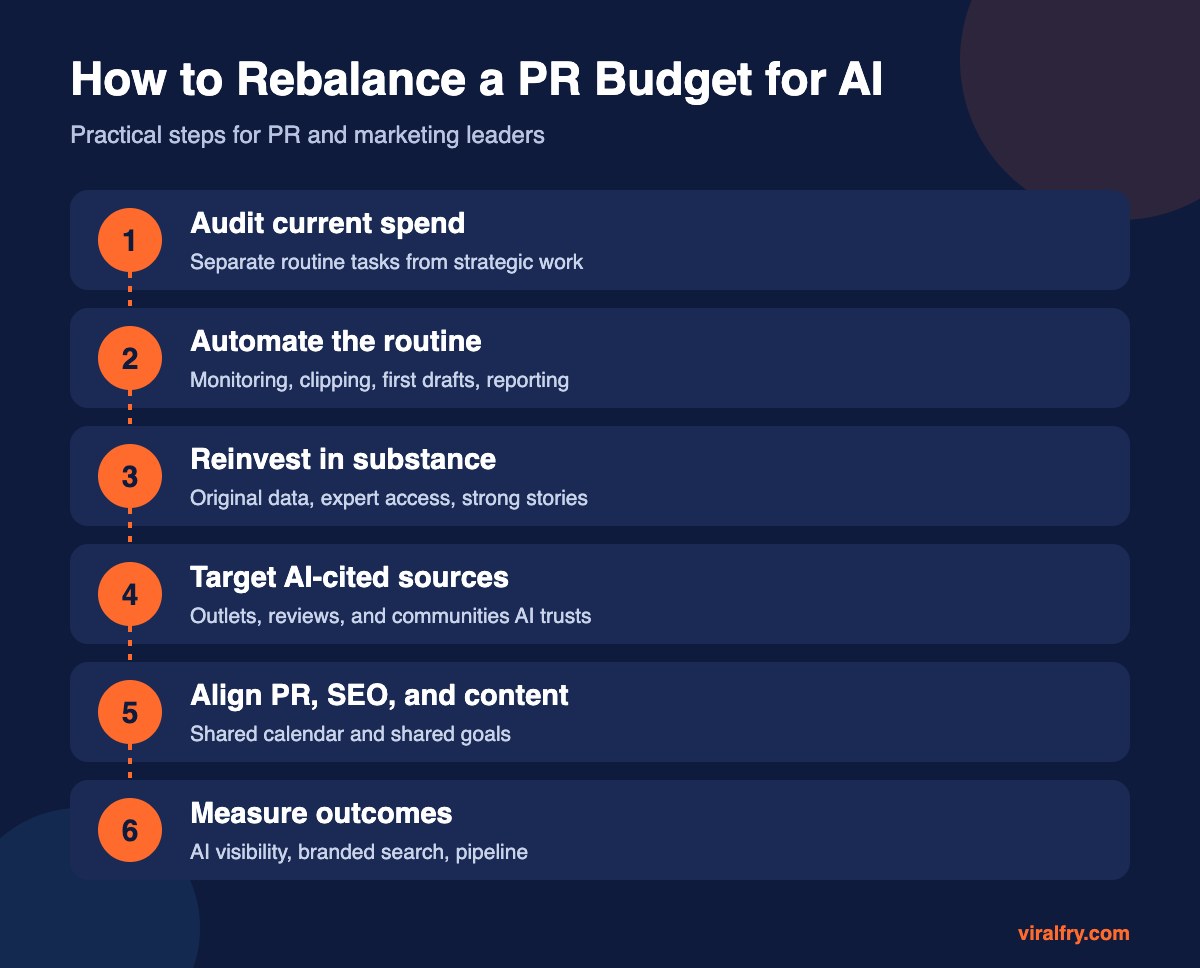
Imagine a B2B software company that used to spend most of its PR budget on agency hours for monitoring, release writing, and wire distribution. After adopting AI tools for monitoring and drafting, it keeps the same total budget but changes the mix.
A larger share now funds an annual customer survey that produces three or four data stories a year, plus design work to visualize the findings. Another portion supports the CEO and two product leaders with podcast appearances and bylined articles. A smaller share covers AI visibility tracking and a quarterly report linking coverage to branded search and demo requests.
The agency still plays a role, but its work shifts from routine output to strategy, relationships, and storytelling. Coverage volume may stay similar, yet the quality and business impact improve noticeably.
Key Takeaways
- AI automates routine PR tasks and frees budget for strategy.
- Money is moving toward original data, expert visibility, and trusted outlets.
- PR now shapes how AI assistants describe and recommend brands.
- PR, SEO, and content work best with shared goals.
- Measure outcomes such as AI visibility, branded search, and pipeline.
Frequently Asked Questions
How is AI changing public relations?
AI is automating monitoring, research, drafting, and reporting, while raising the importance of earned media because AI assistants rely on trusted sources when describing brands.
Will AI reduce PR budgets?
AI reduces the cost of routine tasks, but many organizations reinvest the savings in research, expert visibility, and measurement rather than cutting PR overall.
Should PR teams use AI to write press releases?
AI can help with first drafts and research, but releases and pitches should be edited by people for accuracy, tone, and newsworthiness.
How do you measure PR in the age of AI?
Track coverage quality, referral traffic, branded search growth, share of voice in AI-generated answers, and influence on leads and pipeline.
Add as Preferred Source