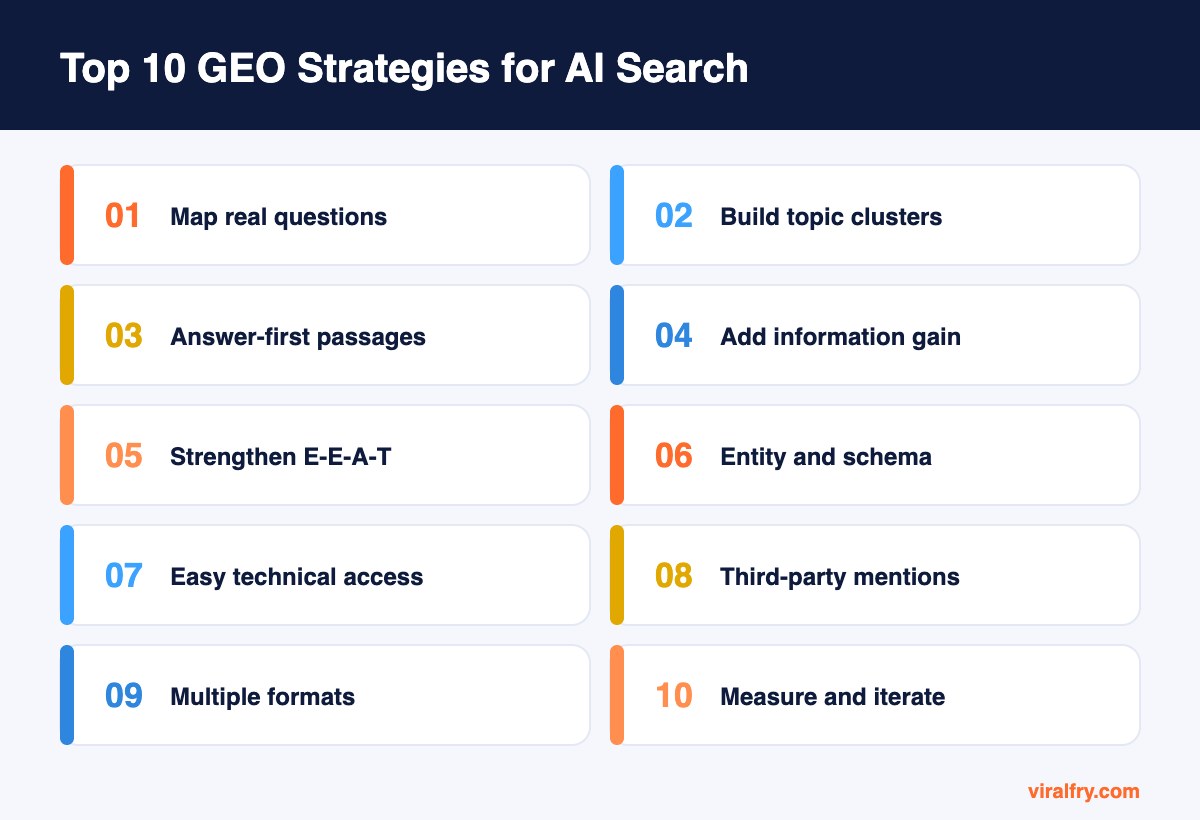
The most effective GEO strategies are mapping real buyer questions, building topic clusters, writing answer-first passages, adding original information, strengthening E-E-A-T, optimizing your brand entity and schema, making content easy for AI crawlers to access, earning third-party mentions, publishing in multiple formats, and tracking AI visibility monthly. Together they make your content easy for AI search engines to find, trust, and quote.
Generative engine optimization (GEO) is the practice of earning visibility inside AI-generated answers. It builds on SEO rather than replacing it. If you need the basics first, start with what GEO is. If you already have them, the strategies below are what we prioritize for clients.
What Are the Best GEO Strategies for AI Search?
1. Map the questions behind your topics
AI search runs on questions, not keywords. Collect the real questions buyers ask from sales calls, support tickets, People Also Ask, AlsoAsked, Reddit, and your own Search Console queries.
Group them by stage: learning, comparing, and deciding. That map becomes your GEO content plan, and it usually reveals gaps that keyword tools miss entirely.
2. Build topic clusters, not isolated posts
AI systems look for sources that cover a subject in depth. A pillar page supported by focused articles on each sub-question, all interlinked, signals expertise far more clearly than scattered one-off posts.
Keep one page per intent so your own pages do not compete, and link related pieces with descriptive anchor text.
3. Write answer-first, extractable passages
Every section should start with a direct answer that would make sense if quoted alone. Follow it with evidence, examples, and nuance.
This is the single most practical GEO change for most sites, and it also helps featured snippets and voice search.
4. Add information gain
If your page says the same thing as the ten pages already ranking, an AI model has no reason to cite you. Add something new: original data, a tested process, real screenshots, pricing breakdowns, or expert commentary.
A useful test before publishing: what can a reader learn here that they cannot learn anywhere else?
5. Strengthen E-E-A-T signals
Show who wrote the content and why they are qualified. Use bylines, author pages with credentials, references to primary sources, and clear company information.
Trust signals help Google rank you, and they help AI systems decide which sources to rely on.
6. Optimize your entity and schema
Use Organization, Person, Article, Product, and FAQ schema where it accurately describes the page. Keep names, descriptions, and links consistent across your site and official profiles.
Entity clarity helps AI systems connect your brand to the topics you want to be known for. See how knowledge panels work.
7. Make technical access easy
Allow search crawlers from Google, Bing, OpenAI, and Perplexity. Server-render important content, keep pages fast, and avoid hiding key text in tabs that load on click.
Bing matters more than many marketers think, since its index supports Microsoft Copilot. Set up Bing Webmaster Tools and IndexNow.
8. Earn third-party mentions and reviews
AI answers often reflect what the wider web says about a brand. Reviews on G2, Capterra, Trustpilot, or Google; mentions in industry publications; podcast appearances; and helpful community participation all feed that picture.
Focus on places your buyers already trust rather than chasing any mention at all.
9. Use multiple formats
YouTube videos, podcasts, and transcripts can be cited too, and Google surfaces video heavily for how-to queries. Repurpose your best articles into short videos and publish transcripts.
Different AI platforms favor different source types, so a multi-format presence spreads your chances.
10. Measure, test, and iterate
Track a fixed set of prompts monthly across ChatGPT, Perplexity, Gemini, Copilot, and Google AI Overviews. Log mentions, citations, and which competitor pages get cited instead.
Then study the cited pages, improve yours, and check again. GEO is still young, so a disciplined test-and-learn loop beats any checklist.
Which GEO Strategies Should You Prioritize First?
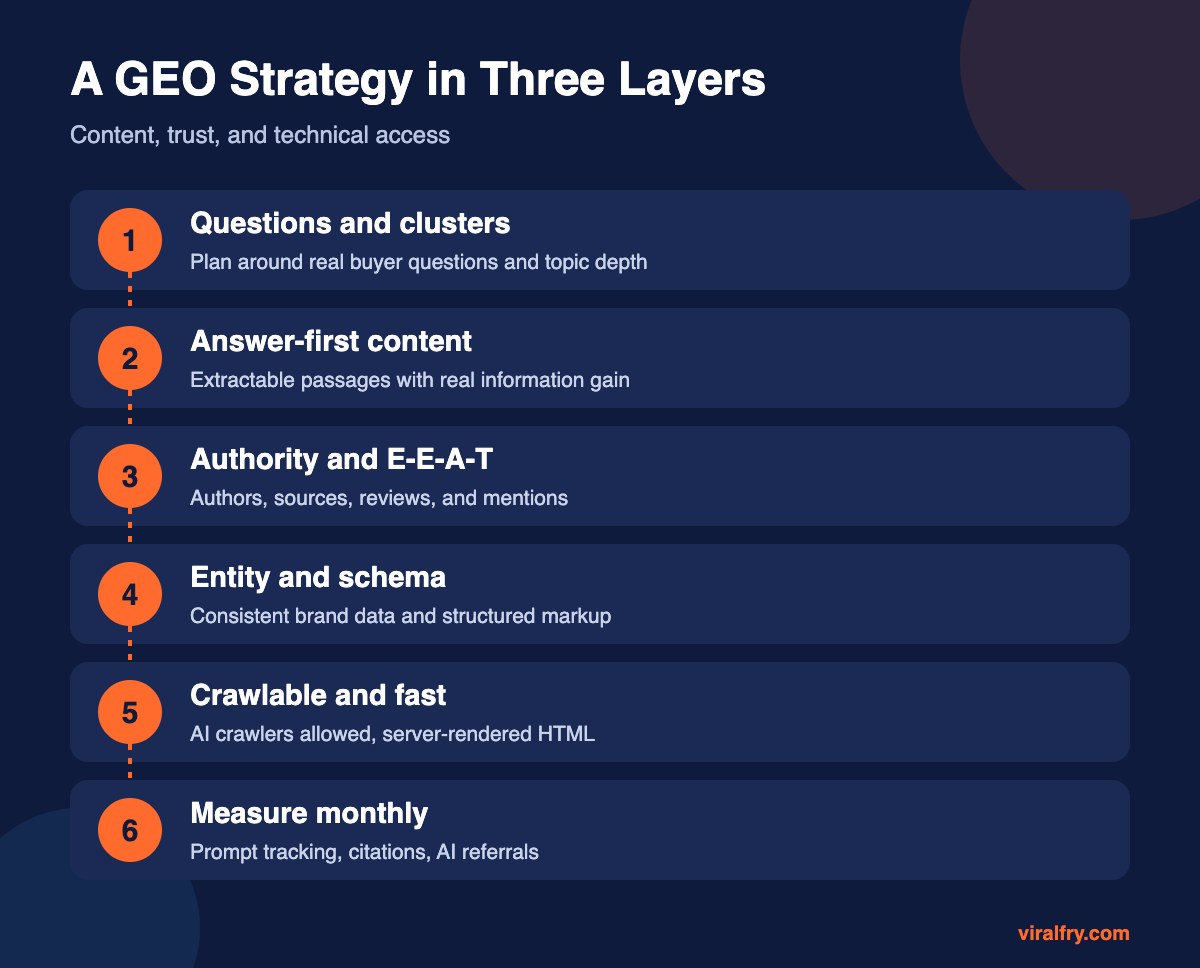
| Priority | Strategy | Why |
|---|---|---|
| 1 | Answer-first passages on top pages | Fast to implement, quick impact |
| 2 | Technical access for AI crawlers | Without it, nothing else counts |
| 3 | Information gain on key topics | The main reason AI cites one page over another |
| 4 | Entity and schema cleanup | One-time work with lasting benefit |
| 5 | Third-party mentions | Slower, but compounds over time |
How Is GEO Different From AEO and SEO?
SEO wins rankings and clicks. AEO wins direct answers such as featured snippets and voice responses. GEO wins mentions and citations inside AI-generated answers across many platforms. They share foundations, which is why the best programs run them together. Our comparison of GEO vs AEO vs SEO breaks down the differences.
What GEO Mistakes Should You Avoid?
- Publishing high volumes of generic AI content with no new information
- Neglecting SEO basics while chasing AI tactics
- Optimizing for one AI platform and ignoring the others
- Measuring only traffic, when many AI mentions do not produce a click
- Assuming a “GEO hack” exists; consistency is the strategy
How Do You Report GEO Results to Stakeholders?
Use a simple scorecard: share of AI answers that mention your brand for your tracked prompts, number of citations linking to your pages, AI referral sessions and conversions in GA4, and branded search volume over time. Show these alongside classic SEO metrics so leadership sees one picture of search visibility, not two competing programs.
What Does a GEO-Optimized Page Look Like?
Picture a B2B software comparison page that gets cited regularly. It opens with a two-sentence verdict that names the best option for each type of buyer. Below that, a table compares pricing models, key features, and ideal company size. Each H2 is a question a buyer actually asks, such as “Which tool is best for a five-person sales team?”, followed by a short, direct answer.
The page is written by a named author with relevant experience, links to the vendors’ own documentation for facts, and includes screenshots from hands-on testing. It shows a visible “last updated” date, uses Article and Organization schema, and loads quickly with all content in the HTML.
Off the page, the same brand is discussed in relevant Reddit threads, reviewed on G2, and quoted in an industry newsletter. None of these elements is unusual on its own. The combination is what makes the page the obvious source to cite.
Key Takeaways
- GEO builds on SEO; strong rankings remain the foundation.
- Plan around real questions and topic clusters.
- Answer-first passages with original information get cited most.
- Entities, schema, and mentions build trust with AI systems.
- Measure monthly across several AI platforms and iterate.
Frequently Asked Questions
What is a GEO strategy?
A GEO strategy is a plan to increase how often a brand is mentioned or cited in AI-generated answers from tools like ChatGPT, Perplexity, Gemini, and Google AI Overviews.
Does GEO replace SEO?
No. GEO builds on SEO because many AI search tools retrieve and cite pages that already rank in search engines.
How long does GEO take to show results?
Restructuring pages that already rank can show results within weeks. Building authority through mentions and original research usually takes several months.
What tools help with GEO?
Search Console, Bing Webmaster Tools, GA4 for AI referrals, question tools like AlsoAsked, and AI visibility trackers that monitor mentions across AI platforms.
Add as Preferred Source