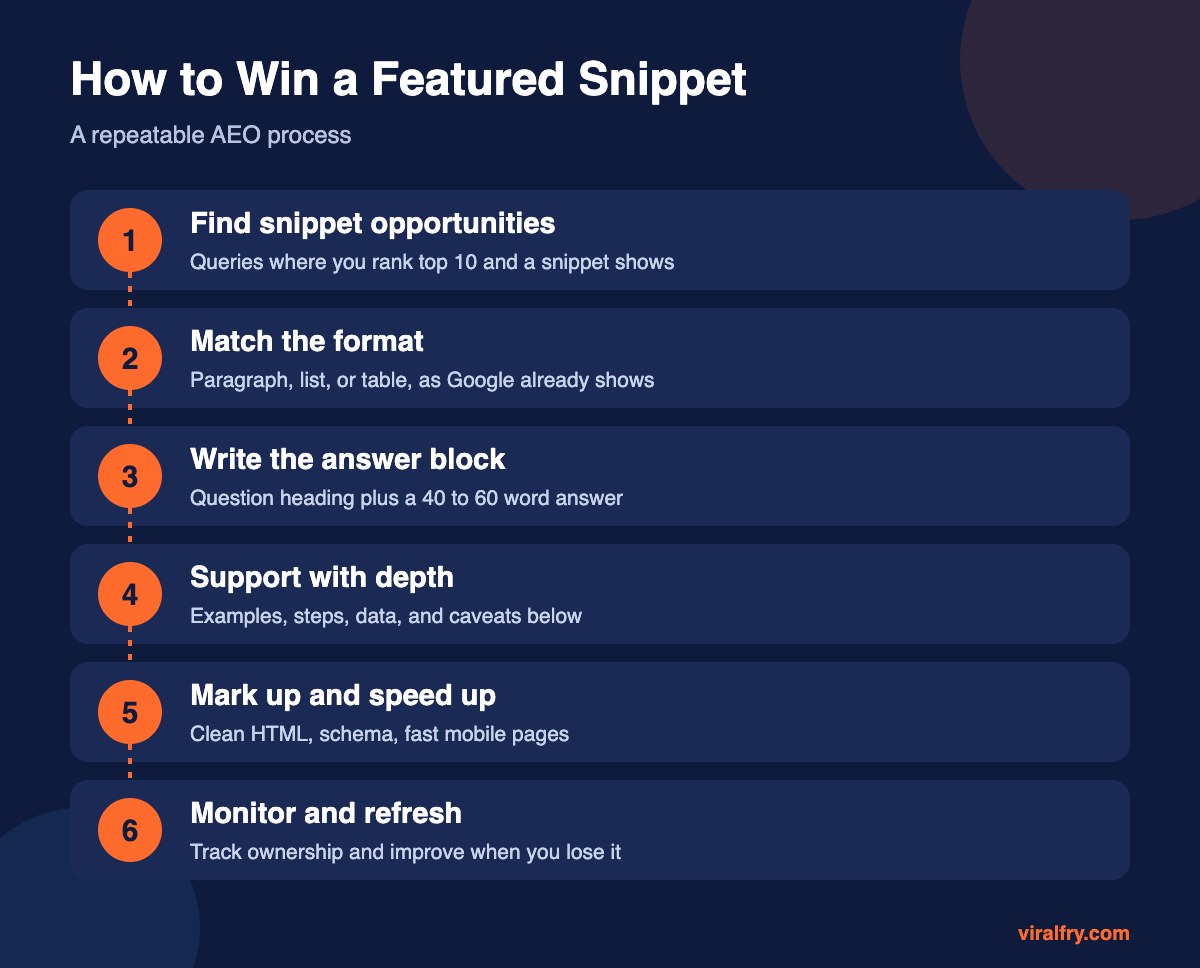
To win featured snippets and voice search results, target questions where you already rank on page one, answer each in 40 to 60 words directly under a question-style heading, match the format Google already shows (paragraph, list, or table), use clean HTML, add an FAQ section, keep business details accurate, and keep pages fast. Then monitor which snippets you own and refresh answers when you lose them.
Answer engine optimization (AEO) is about being the answer, not just a result. Featured snippets, People Also Ask boxes, voice assistants, and AI Overviews all reward the same habit: clear, direct, well-structured answers from a trusted page.
What Are the Best AEO Tips for Featured Snippets and Voice Search?
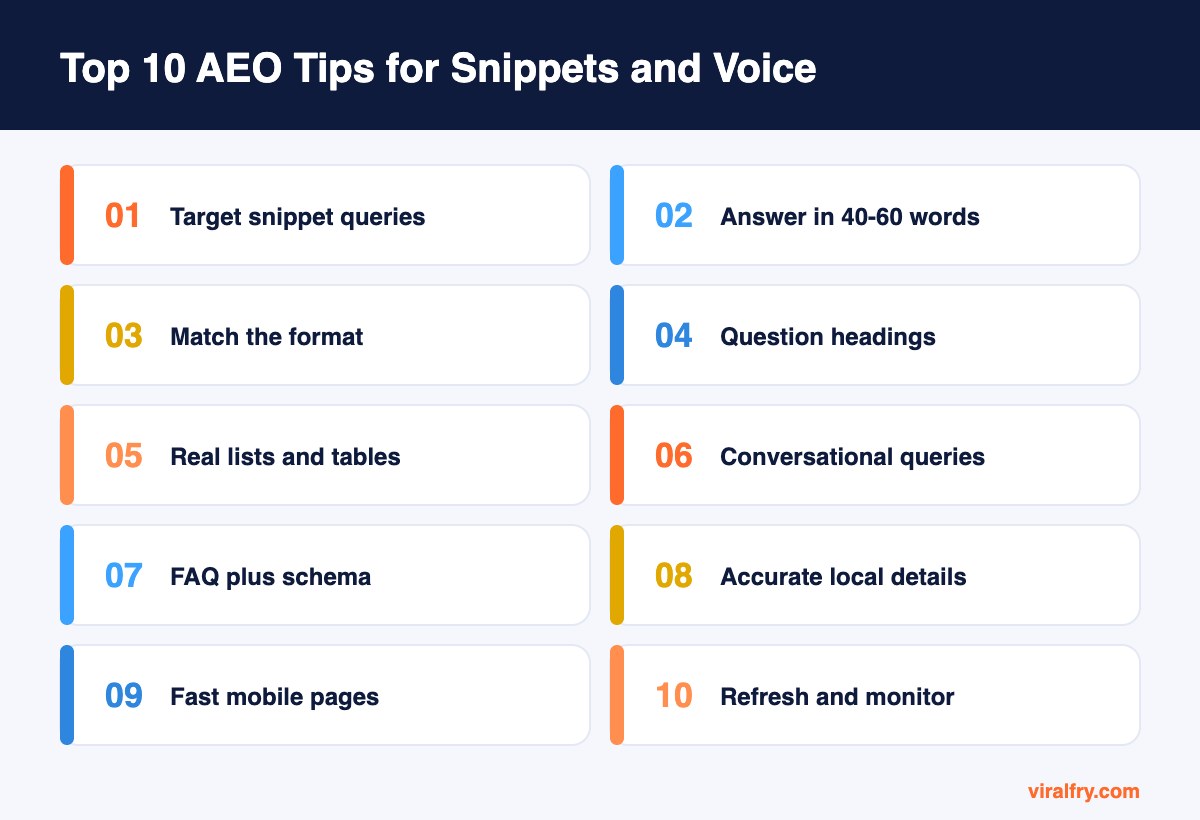
1. Target questions that already show a snippet
Search your keywords and note which ones show a featured snippet, a People Also Ask box, or an AI Overview. Those are the queries where a direct answer can win.
Prioritize questions where you already rank on page one. Google usually pulls snippets from pages ranking in the top results, so you rarely win one from page three.
2. Answer in 40 to 60 words right under the heading
Paragraph snippets tend to be short. Write a complete, standalone answer of about 40 to 60 words immediately below a heading that matches the question.
Start with the subject of the question (“A content audit is…”) so the answer reads naturally when quoted or spoken aloud.
3. Use the right format for the question
Match the format Google already shows. “What is” questions usually get paragraphs. “How to” questions get numbered steps. “Best” and “types of” questions get bulleted lists. Comparisons and specifications get tables.
If the current snippet is a list, a paragraph will not replace it, however good it is.
4. Write question-based headings
Turn H2s and H3s into the exact questions people ask, using wording from People Also Ask and AlsoAsked. This helps search engines match your section to the query.
Our guide on heading structure for AEO walks through examples.
5. Use real HTML lists and tables
Google reads list and table markup directly. Use proper <ol>, <ul>, and <table> elements rather than styled paragraphs or images of tables.
Keep list items short and parallel, and give tables clear header rows.
6. Optimize for conversational, voice-style queries
Voice searches are longer and phrased like speech: “How long should I boil an egg for a soft yolk?” Include natural language versions of questions in your headings and FAQs.
Voice assistants usually read a single short answer, so clarity and brevity matter more than ever.
7. Add an FAQ section with matching schema
A short FAQ section at the end of a page captures related questions. FAQPage schema describes it clearly to machines, even though Google now shows FAQ rich results mainly for authoritative government and health sites.
Read FAQ schema for AEO for the current rules.
8. Keep local and business details accurate
Many voice searches are local: “Where is the nearest…” or “Is … open now?” Keep your Google Business Profile, hours, phone number, and address consistent everywhere.
Assistants rely on those structured listings to answer local questions.
9. Make pages fast and mobile friendly
Voice and mobile searchers expect instant answers. Fast, mobile-friendly pages make a better experience and support stronger rankings.
Check Core Web Vitals in PageSpeed Insights and fix the biggest issues on your answer pages first.
10. Refresh and monitor your snippets
Featured snippets change hands often. Track which snippets you own in your rank tracker, and check them after algorithm updates.
When you lose one, compare your answer with the new winner. Often a tighter definition, a cleaner list, or a fresher statistic wins it back.
Which Snippet Format Fits Which Question?
| Question type | Example | Best format |
|---|---|---|
| Definition | What is a content audit? | Paragraph, 40 to 60 words |
| Process | How to submit a sitemap | Numbered list |
| Options | Best free SEO tools | Bulleted list |
| Comparison | SEO vs PPC | Table |
| Specification | Instagram post size | Table or short list |
| Yes or no | Is SEO dead? | One-sentence answer, then explanation |
What Does a Strong Answer Block Look Like?
Here is the pattern we use. The heading is the question: “How long does SEO take to work?” The first sentence answers it plainly: “Most websites see early SEO results in three to six months, with stronger gains after six to twelve months.” The next sentence adds the key condition: “Timelines depend on competition, site history, and how consistently you publish and build links.” Only then does the section expand with examples and detail.
That structure works for a featured snippet, a voice assistant reading one answer aloud, and an AI Overview quoting a passage. It also helps human readers who skim.
How Is AEO Different From GEO?
AEO focuses on direct answers in search features and voice assistants. GEO focuses on mentions and citations inside AI-generated answers from tools like ChatGPT and Perplexity. The writing habits overlap almost entirely, which is why we treat them as one workflow. Read GEO vs AEO vs SEO for the details.
What AEO Mistakes Should You Avoid?
- Burying the answer after a long introduction
- Using a paragraph when Google shows a list, or vice versa
- Writing answers that only make sense with surrounding context
- Stuffing FAQ sections with dozens of thin questions
- Forgetting to update statistics and dates
How Do You Find Featured Snippet Opportunities Quickly?
- Export queries from Google Search Console where your average position is between 1 and 10.
- Filter for question words: what, how, why, which, can, does, is, and best.
- Check those queries in a rank tracker or manually to see which show a featured snippet you do not own.
- Sort by impressions so you work on the biggest opportunities first.
- Rewrite the relevant section using the answer block pattern above, then request indexing in Search Console.
Most sites find a few dozen realistic opportunities this way within an hour. Work through ten at a time and check results after two to four weeks.
Key Takeaways
- Target questions where a snippet exists and you already rank on page one.
- Answer in 40 to 60 words directly under a question heading.
- Match the format Google already shows.
- Use clean HTML lists and tables plus a short FAQ section.
- Monitor snippet ownership and refresh answers regularly.
Frequently Asked Questions
What is AEO in SEO?
AEO, or answer engine optimization, is the practice of structuring content so search engines and assistants can use it as a direct answer in featured snippets, voice results, and AI summaries.
How long should a featured snippet answer be?
Paragraph snippets are usually short. Aim for a complete answer of about 40 to 60 words, then expand below it.
Can I win a featured snippet if I am not on page one?
It is rare. Google usually selects snippets from pages already ranking on the first page for that query.
Does voice search use featured snippets?
Voice assistants often read a single concise answer, and featured snippets are a common source. Clear, short answers and accurate business listings help.
Add as Preferred Source