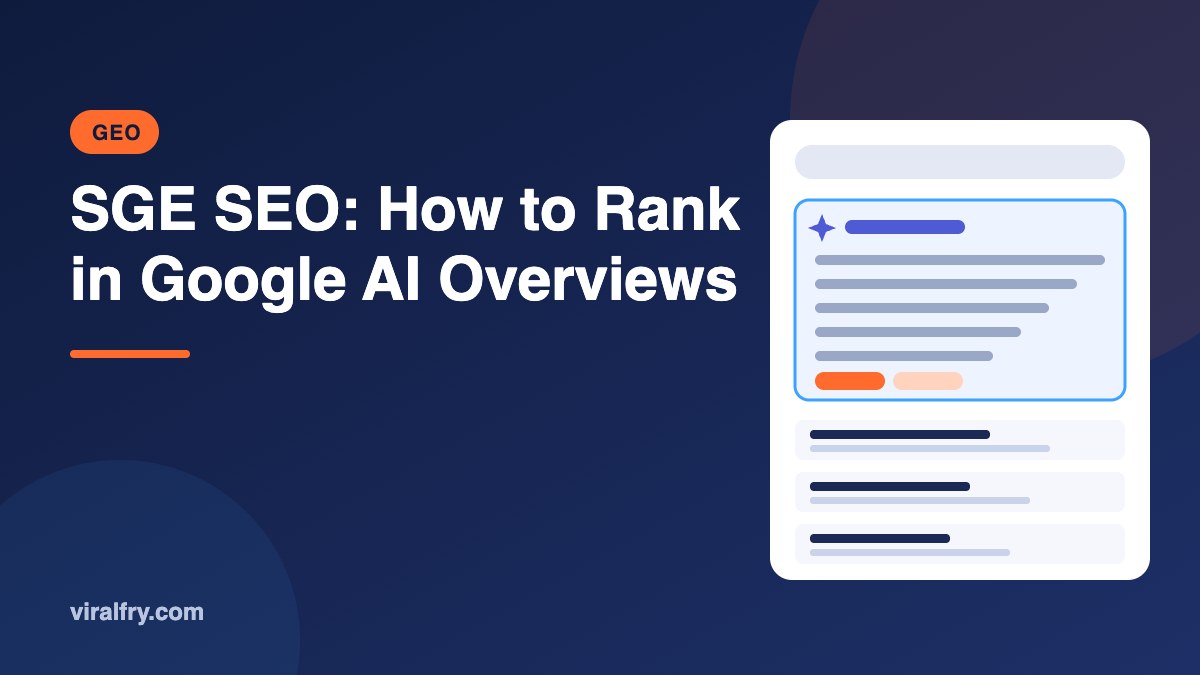
Short answer: SGE SEO means optimizing content so Google’s AI-generated answers cite it. SGE (Search Generative Experience) was Google’s experimental name; the feature launched publicly as AI Overviews in 2024, and Google later added the conversational AI Mode. To appear in these answers, rank well organically, answer questions directly near the top, structure content in lists and tables, show real expertise, use accurate schema, and track citations alongside clicks.
Many people still search for “SGE SEO” even though the name has changed. The goal is the same: be one of the sources Google’s AI cites when it answers a query in your space.
What Is SGE and What Happened to It?
Search Generative Experience was announced in 2023 as a Search Labs experiment that placed AI-written summaries above traditional results. In May 2024 Google rolled it out broadly under the name AI Overviews. In 2025 Google introduced AI Mode, a separate tab for longer, conversational AI search. Our guide to Google AI Mode and SEO strategy covers that experience in depth.
How Do AI Overviews Choose Which Sources to Cite?
Google has not published an exact formula, but its guidance is clear that the same fundamentals behind ranking apply: helpful, reliable, people-first content that is crawlable and indexable. In practice, pages cited in AI Overviews usually:
- Already rank on page one, or rank for closely related sub-questions
- Answer the specific question clearly and concisely
- Are well structured so a passage can stand on its own
- Come from sources with demonstrated experience and authority on the topic
- Are technically accessible: indexable, fast, and not blocked by robots rules
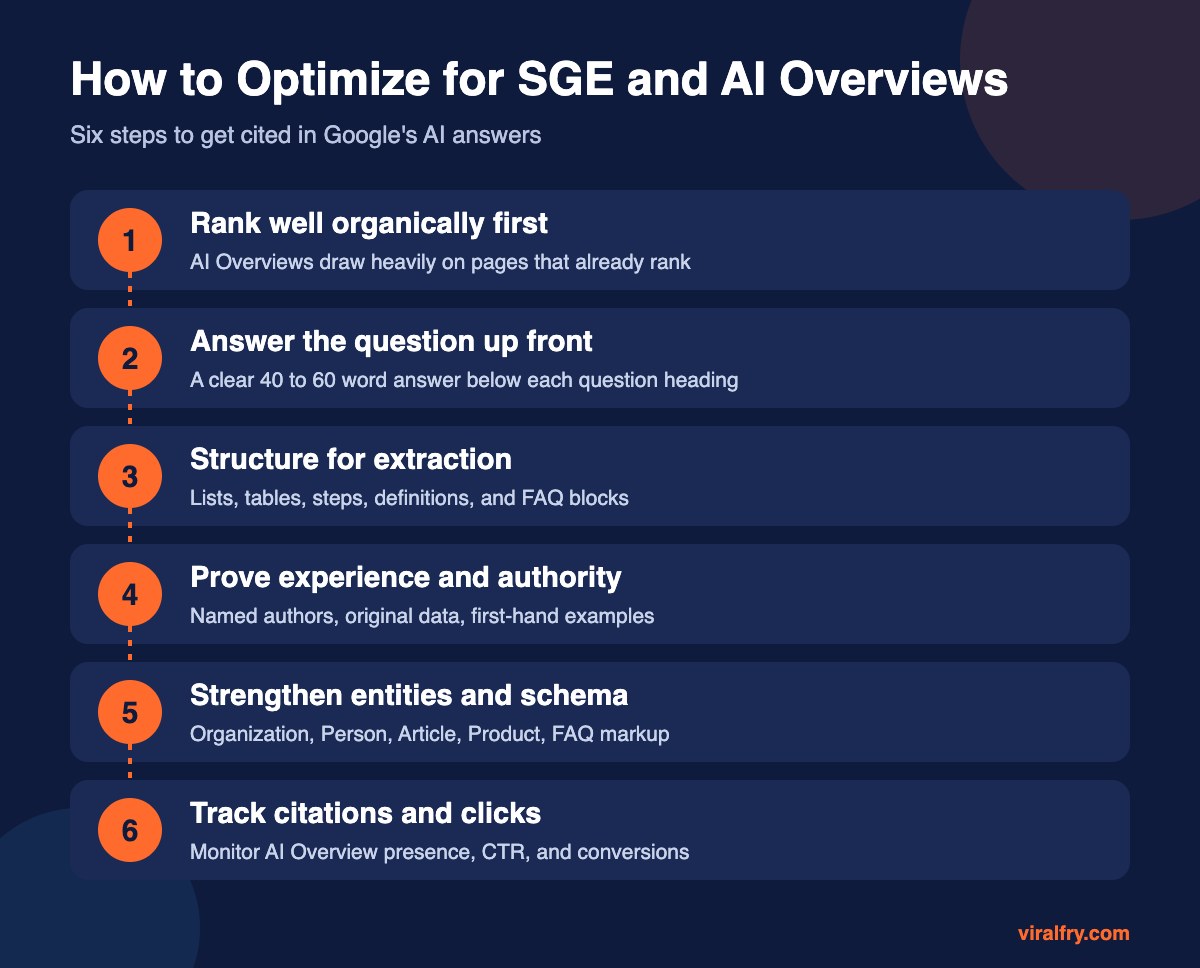
How Do You Optimize Content for SGE and AI Overviews?
Start With Strong Organic Rankings
There is no separate AI Overview index to submit to. If a page does not rank well for the core query or its sub-questions, it is unlikely to be cited. Classic SEO work remains the foundation.
Answer the Question in the First Lines
Under each question-based heading, give a direct answer in roughly 40 to 60 words before you add nuance. This mirrors how AI systems extract passages.
Structure Content So Passages Stand Alone
- Use descriptive H2 and H3 headings that match real questions
- Use numbered steps for processes and tables for comparisons
- Define terms in one clear sentence
- Keep paragraphs short and avoid burying answers in long introductions
Show Experience, Expertise, and Original Value
AI summaries compress commodity information. What gets cited tends to add something: original data, tested examples, specific numbers, or expert judgment. Add named authors with relevant credentials and cite primary sources.
Use Schema and Clear Entities
Structured data does not guarantee a citation, but it helps search engines understand who you are and what a page covers. Use Organization, Person, Article, Product, and FAQ markup where they accurately describe the content, and keep your brand information consistent across the web.
Does SGE SEO Differ From GEO and AEO?
| Term | Focus |
|---|---|
| SEO | Ranking in traditional search results |
| SGE SEO / AI Overview optimization | Being cited in Google’s AI answers specifically |
| AEO (Answer Engine Optimization) | Being the direct answer in snippets, voice, and answer boxes |
| GEO (Generative Engine Optimization) | Being cited across generative engines such as ChatGPT, Perplexity, Gemini, and Google AI |
Think of SGE SEO as the Google-specific slice of GEO. For the bigger picture, read what generative engine optimization is and GEO vs AEO vs SEO.
How Do AI Overviews Affect Organic Traffic?
For many informational queries, AI Overviews answer the question on the results page, which can reduce clicks to websites. Clicks that do come through are often from users who want more depth or are closer to acting. That shifts strategy toward:
- Earning citations for brand visibility, even when clicks fall
- Creating content with depth, tools, or data an AI summary cannot replace
- Targeting commercial and transactional queries where users still click through
- Measuring conversions and assisted conversions, not just sessions
How Do You Track SGE and AI Overview Performance?
- Search Console includes AI Overview and AI Mode traffic within overall Web search performance; watch impressions and CTR trends on affected queries
- Use rank trackers that report AI Overview presence and whether your domain is cited
- Manually check priority queries in an incognito window and log citations monthly
- Compare organic conversions, not only clicks, before and after AI Overview changes
What SGE SEO Mistakes Should You Avoid?
- Producing mass AI-written pages with no original value, which falls under Google’s scaled content abuse policy
- Blocking Googlebot or important resources, which removes pages from AI features too
- Writing long introductions that delay the answer
- Chasing AI citations while ignoring the organic rankings that feed them
Key Takeaways
- SGE is now AI Overviews, with AI Mode as a separate conversational experience.
- Strong organic rankings are the foundation for AI citations.
- Answer questions directly, structure content for extraction, and show real expertise.
- Use accurate schema and consistent entity information.
- Track citations and conversions, not just clicks.
Frequently Asked Questions
Is SGE still a thing?
The SGE name is retired. Google launched the feature publicly as AI Overviews in 2024, and later added AI Mode. People still search for “SGE SEO” when they mean optimizing for these AI features.
How do I get my website into Google AI Overviews?
Make sure the page is indexable and ranks well, answer the target question directly near the top, structure content with clear headings, lists, and tables, demonstrate expertise, and use accurate structured data. There is no way to opt in or pay for placement.
Do AI Overviews reduce website traffic?
They can reduce clicks for simple informational queries because the answer appears on the results page. Visits that still come through are often more engaged, so track conversions as well as clicks.
Is SGE SEO different from GEO?
SGE SEO focuses on Google’s AI answers. GEO is broader and covers being cited by all generative engines, including ChatGPT, Perplexity, and Gemini.
Add as Preferred Source