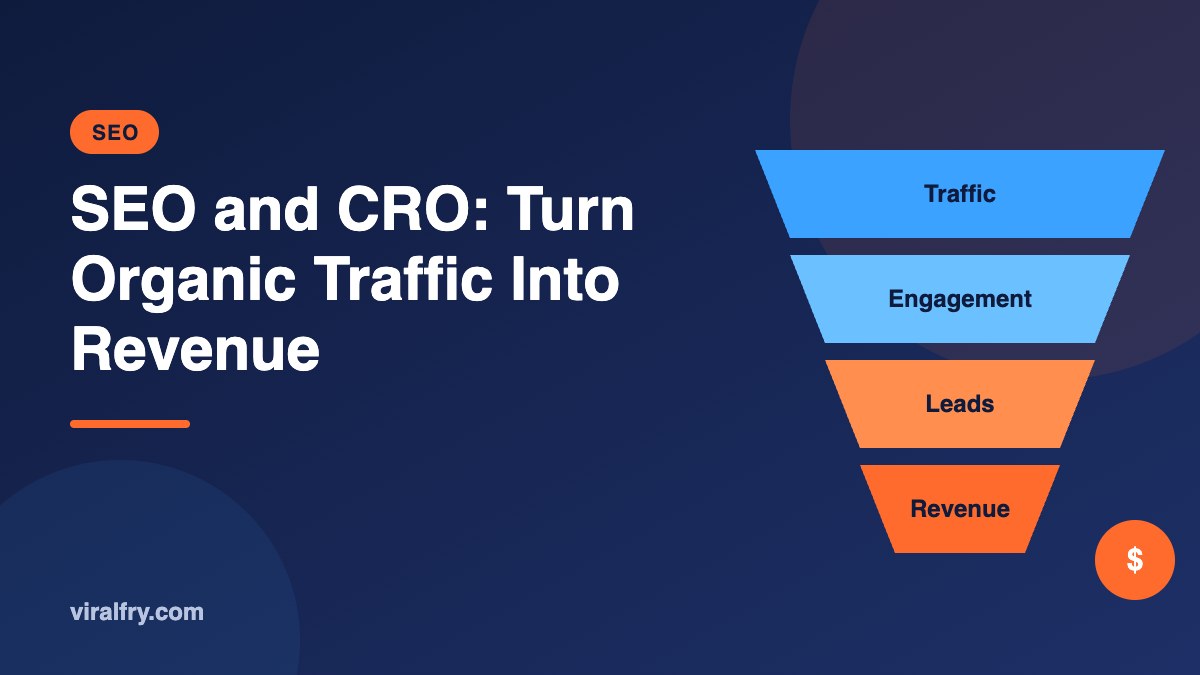
Short answer: SEO brings qualified visitors to your site and CRO (conversion rate optimization) turns more of them into leads or customers. Combining them means choosing keywords with buying intent, matching pages to that intent, removing friction such as slow load times and confusing layouts, and testing changes in ways that do not hurt rankings. The result is more revenue from the same organic traffic.
Many teams run SEO and CRO separately: one chases rankings, the other tweaks buttons. That split leaves money on the table. Here is how to make them work as one system.
What Is the Difference Between SEO and CRO?
| SEO | CRO | |
|---|---|---|
| Goal | More qualified organic visitors | More conversions from existing visitors |
| Main metrics | Rankings, impressions, clicks, organic sessions | Conversion rate, revenue per visitor, lead quality |
| Typical work | Keywords, content, technical health, links | UX research, copy, design, A/B testing |
| Tools | Search Console, rank trackers, crawlers | GA4, heatmaps, session recordings, testing tools |
Why Should SEO and CRO Work Together?
- Traffic without conversions is a cost. Ranking for the wrong intent brings visitors who never buy.
- Many CRO improvements also help SEO. Faster pages, clearer answers, and better structure support rankings and user satisfaction.
- Doubling conversion rate can matter as much as doubling traffic, and it is often faster and cheaper to achieve on pages that already rank.
How Do You Find Pages With the Biggest SEO and CRO Opportunity?
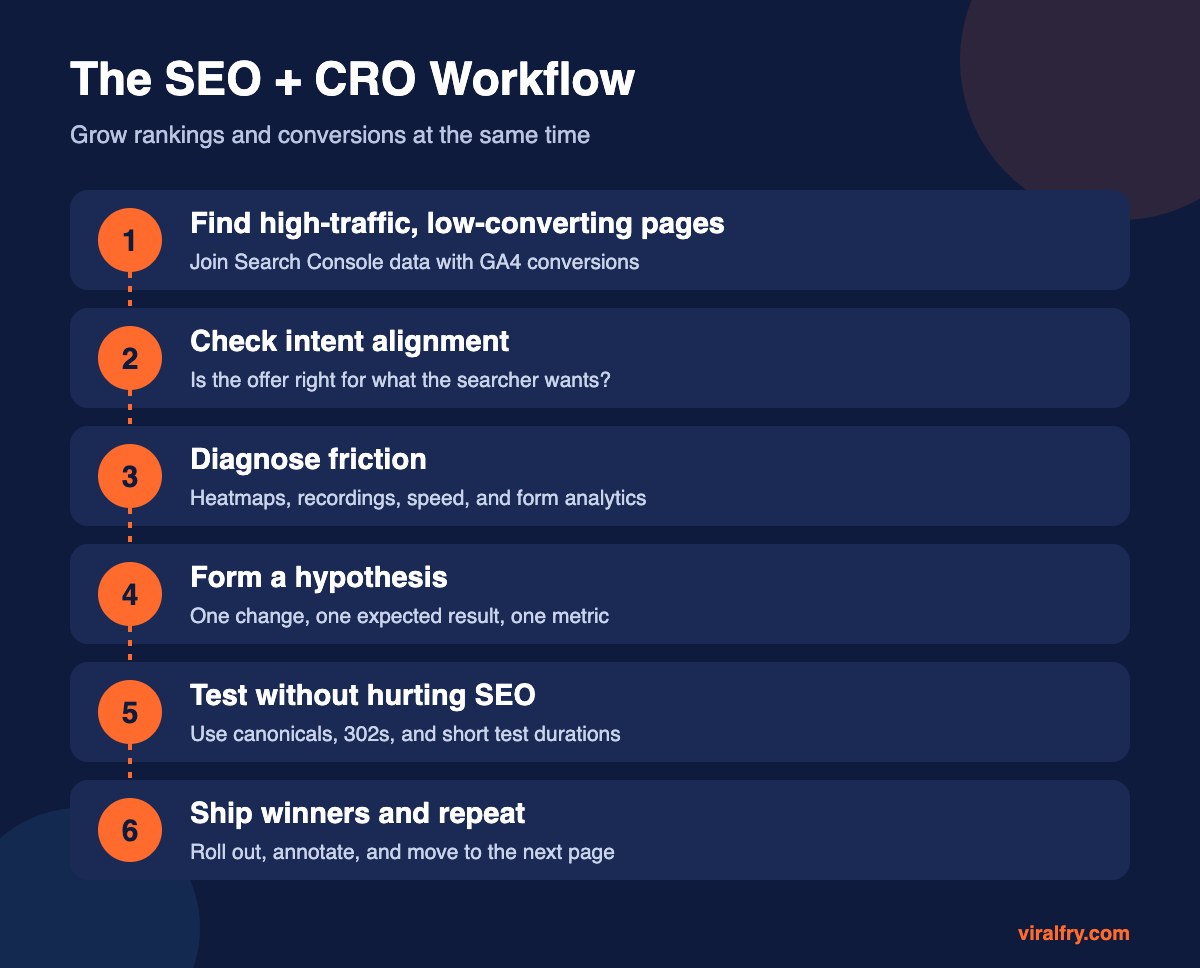
Export landing page data from Google Search Console and join it with GA4 conversions. Sort for pages that have:
- High organic traffic and a below-average conversion rate
- High impressions but low CTR, where a better title can lift clicks
- Commercial keywords in positions 4 to 10, where better content and UX can lift both rankings and conversions
These pages give you the fastest return because they already have demand.
How Does Search Intent Affect Conversion Rate?
Conversion problems are often intent problems. Someone searching “what is a martech stack” wants to learn; someone searching “martech consultant pricing” wants to buy. Match the offer to the stage:
| Intent | Example query | Best conversion goal |
|---|---|---|
| Informational | how to choose keywords for SEO | Newsletter sign-up, checklist download |
| Commercial investigation | best SEO agencies for SaaS | Case study, comparison guide, consultation |
| Transactional | hire SEO consultant | Booking form, pricing, quote request |
For keyword selection by intent, see how to choose keywords for SEO.
Which On-Page Changes Improve Both SEO and Conversions?
- Answer first. A clear summary at the top satisfies searchers and AI answers and reduces bounces.
- Write titles and meta descriptions that promise the right outcome, lifting CTR from the same position.
- Improve page speed and Core Web Vitals, especially on mobile.
- Place one clear call to action after you have delivered value, and repeat it near the end.
- Add trust signals: reviews, client logos, case studies, author credentials.
- Simplify forms: ask only for what you need.
- Use internal links to guide readers from informational posts to service or product pages.
If you are building landing pages for organic and paid traffic, our guide to high-converting landing pages goes deeper.
How Do You Run A/B Tests Without Hurting SEO?
Google supports website testing if you follow a few rules:
- Do not show search engines different content from users (cloaking).
- If test variants live on separate URLs, add a rel=”canonical” to the original.
- Use 302 temporary redirects, not 301s, when redirecting test traffic.
- End tests once you have a result and roll out the winner.
For low-traffic pages, sequential before-and-after tests with annotations can work when classic A/B testing would take too long.
Which SEO and CRO Metrics Should You Track Together?
- Organic conversion rate by landing page
- Organic revenue or pipeline per landing page
- CTR from search by query and page
- Engagement rate and scroll depth
- Page speed and Core Web Vitals
- Lead quality from organic, measured in your CRM
What SEO and CRO Mistakes Should You Avoid?
- Stripping helpful content from a page to make it “cleaner,” which can drop rankings
- Aggressive pop-ups that block content on mobile
- Hiding key content in tabs or scripts that do not render well
- Optimizing for conversion rate alone while ignoring lead quality
- Changing many elements at once so you cannot tell what worked
Key Takeaways
- SEO brings visitors; CRO converts them. Treat them as one system.
- Start with pages that already rank and get traffic but convert poorly.
- Match the offer to search intent before tweaking design.
- Choose improvements that help both, such as speed, clarity, and trust.
- Test safely with canonicals, 302s, and short test periods.
Frequently Asked Questions
What does CRO mean in SEO?
CRO stands for conversion rate optimization. In an SEO context, it means improving organic landing pages so a larger share of search visitors become leads or customers.
Does CRO affect SEO rankings?
Indirectly, yes. Many CRO changes, such as faster load times, clearer answers, and better page experience, also support rankings. Changes that remove helpful content can hurt rankings, so test carefully.
Can A/B testing hurt SEO?
Not if you follow Google’s guidance: avoid cloaking, use rel=”canonical” on variant URLs, use 302 redirects for test traffic, and end tests once they reach a result.
Which comes first, SEO or CRO?
Use both together. If a page has little traffic, SEO comes first. If a page already gets meaningful organic traffic but converts poorly, CRO usually gives the faster return.
Add as Preferred Source