Short answer: ecommerce link building means earning links from relevant, trusted websites to your store, especially to category and product pages. The most reliable tactics are supplier and manufacturer links, reclaiming unlinked brand mentions, product reviews, original data, linkable buying guides, digital PR, broken link replacement, and strong internal linking from content to money pages. Avoid buying links or joining link schemes, which violate Google’s spam policies.
Online stores have a specific challenge: few people link to a product page on their own. This guide focuses on tactics that work for ecommerce, how to get authority flowing to the pages that make money, and what to avoid.
Why Is Link Building Harder for Ecommerce Sites?
- Product and category pages are commercial, so editors rarely link to them naturally
- Large catalogs spread authority thinly across thousands of URLs
- Products go out of stock or get discontinued, breaking earned links
- Competitors include marketplaces with enormous authority
The fix is to earn links to assets people do want to reference, then pass that authority to commercial pages through smart internal linking.
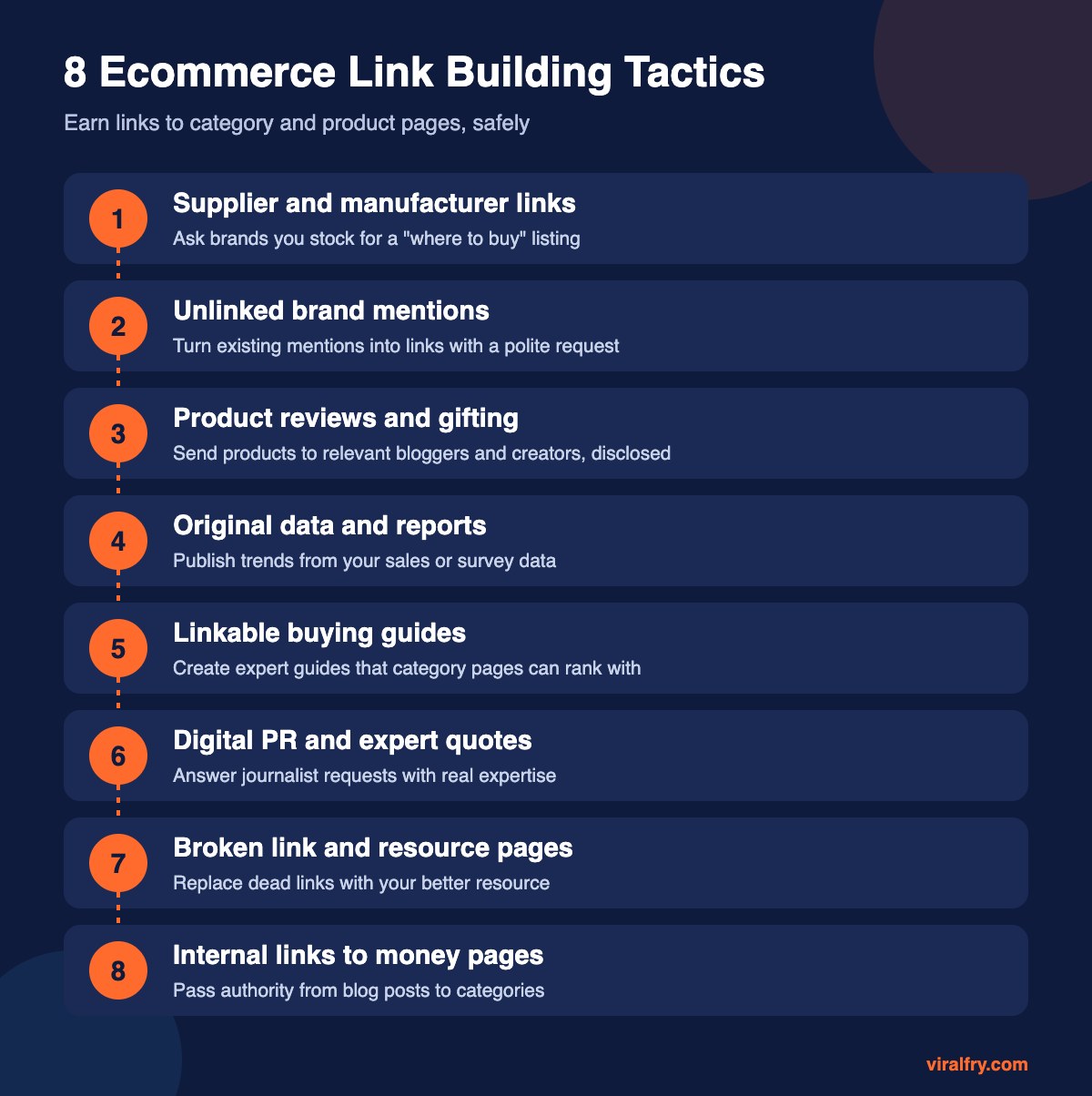
What Are the Best Ecommerce Link Building Strategies?
1. Get Links From Suppliers and Manufacturers
If you stock other brands, many have “where to buy” or “stockists” pages. Ask to be listed with a link. These are relevant, easy wins.
2. Reclaim Unlinked Brand Mentions
Search for your brand and product names in news, blogs, and forums. When someone mentions you without a link, a short friendly email asking them to add one often works.
3. Run Product Review and Gifting Outreach
Send products to relevant bloggers, YouTubers, and creators for honest reviews. Do not require a followed link in exchange for free products; Google treats that as a link scheme. Ask for disclosure and accept whatever link type the reviewer chooses.
4. Publish Original Data
Your sales and search data can reveal trends journalists love, such as the fastest-growing product categories by region or seasonal buying patterns. Package them in a short report with charts and pitch it.
5. Create Linkable Buying Guides
Expert guides such as “how to choose running shoes for flat feet” attract links from forums, blogs, and resource pages. Link from the guide to the relevant category pages.
6. Use Digital PR and Expert Commentary
Respond to journalist requests through platforms that connect reporters and sources, and offer founder or product expert quotes on industry trends.
7. Replace Broken Links and Join Resource Pages
Find dead links on niche resource pages that pointed to discontinued products or closed stores, and suggest your relevant page as a replacement.
8. Build Internal Links to Money Pages
Internal links are the link building you fully control. Link from blog posts and guides to categories, from categories to top products, and use descriptive anchor text.
Which Pages Should Ecommerce Link Building Target?
| Page type | Link building approach |
|---|---|
| Homepage | Brand mentions, PR, partnerships |
| Category pages | Buying guides, internal links, supplier links, resource pages |
| Product pages | Reviews, influencer content, product launches |
| Guides and research | Digital PR, outreach, broken link building |
Category pages usually deliver the best return because they target high-volume commercial keywords. See our article on what your ecommerce store actually needs from SEO.
What Ecommerce Link Building Tactics Should You Avoid?
- Buying links or paying for “guest posts” with guaranteed followed links
- Private blog networks (PBNs)
- Exchanging free products for required followed links
- Mass directory submissions and spammy comments
- Over-optimized exact-match anchor text
These can trigger manual actions or simply be ignored by Google’s spam systems. Read our breakdown of Google’s August 2026 spam update for context.
How Do You Handle Links to Out-of-Stock or Discontinued Products?
- Temporarily out of stock: keep the page live, show availability dates, and suggest alternatives
- Permanently discontinued with a close replacement: 301 redirect to the replacement product
- Discontinued with no replacement: 301 redirect to the most relevant category
This preserves the authority you worked hard to earn.
How Do You Measure Ecommerce Link Building Results?
- Number of new referring domains, and how relevant they are
- Rankings and organic traffic for the target category and product pages
- Organic revenue and conversions from those pages in GA4
- Referral traffic and sales from linking sites
Key Takeaways
- Earn links to assets people want to cite, then pass authority to money pages internally.
- Supplier links and unlinked mentions are the fastest wins for most stores.
- Prioritize category pages for commercial impact.
- Never buy links or require followed links in exchange for products.
- Redirect discontinued product URLs to preserve link equity.
Frequently Asked Questions
What is ecommerce link building?
It is the process of earning links from other websites to an online store’s pages, especially category and product pages, to improve rankings and organic sales.
How do I get backlinks to product pages?
Product reviews from relevant creators, supplier and stockist listings, product launch coverage, and internal links from buying guides are the most reliable ways to earn links to product pages.
Is it safe to buy backlinks for an ecommerce site?
No. Buying links that pass ranking signals violates Google’s spam policies and can lead to ranking losses or manual actions.
How many backlinks does an ecommerce site need?
There is no fixed number. It depends on how competitive your categories are. Compare the referring domains of pages ranking in the top five for your target keywords to set a realistic goal.
Add as Preferred Source