Google AI Mode is pushing search away from short keywords and toward long, conversational questions, and SEOs who only optimize for keyword lists will lose ground to those who optimize for the whole user journey. Traditional SEO still matters. What changes is how you read intent, plan content and judge success.
For years, most of us built our work around keywords, rankings, backlinks and organic traffic. That model isn’t broken, but it’s no longer the full picture. People now type paragraph-length questions, upload photos, ask by voice and keep the conversation going with follow-ups.
Google shared some numbers in May 2026 that are worth knowing:
- AI Mode queries have more than doubled every quarter since launch.
- The average AI Mode query is about three times longer than a traditional Google query.
- More than one in six AI Mode searches in the US are multimodal.
- Planning-related queries have grown 80% faster than overall AI Mode queries over the last six months.
- Brainstorming-related queries have grown 30% faster than overall AI Mode queries since launch.
So people aren’t just searching differently. They expect something different from search. Here’s what I think that means for your strategy.
How Is Google AI Mode Changing the Way People Search?
People are describing exactly what they want instead of guessing which two or three keywords will get them there.
Think about how we used to search. “Best SUV.” “CRM software.” “Restaurants in Bangalore.” “Best laptops under ₹50,000.” Google gave us ten blue links and we clicked around until we found an answer.
AI Mode lets people say the whole thing. Compare these:
Old way: “Best family SUV”
AI Mode way: “Which is the best family SUV in India with a third row, good mileage, advanced safety features and a budget under ₹20 lakh?”
Or this one:
Old way: “Restaurants in Bangalore”
AI Mode way: “Find family-friendly restaurants in Bangalore with outdoor seating, vegetarian options and a budget of ₹1,000 for two.”
The second version carries preferences, constraints and expectations all in one go. That’s a lot more information than a head term ever gave us.
What does this mean for keyword research?
It means you have to look past the keyword and into the situation behind it. If you run an automotive site, “best SUVs in India” and “SUV price in India” are still worth targeting. But you’ll also want content for the messier, more specific questions people actually have:
- Best seven-seater SUV for a family of six
- Safest SUV under ₹15 lakh in India
- Petrol vs diesel SUV for long-distance driving
- Best SUV for city driving with low maintenance costs
Write for the full need, not just the phrase.
Why Are Search Queries Becoming More Conversational and Multimodal?
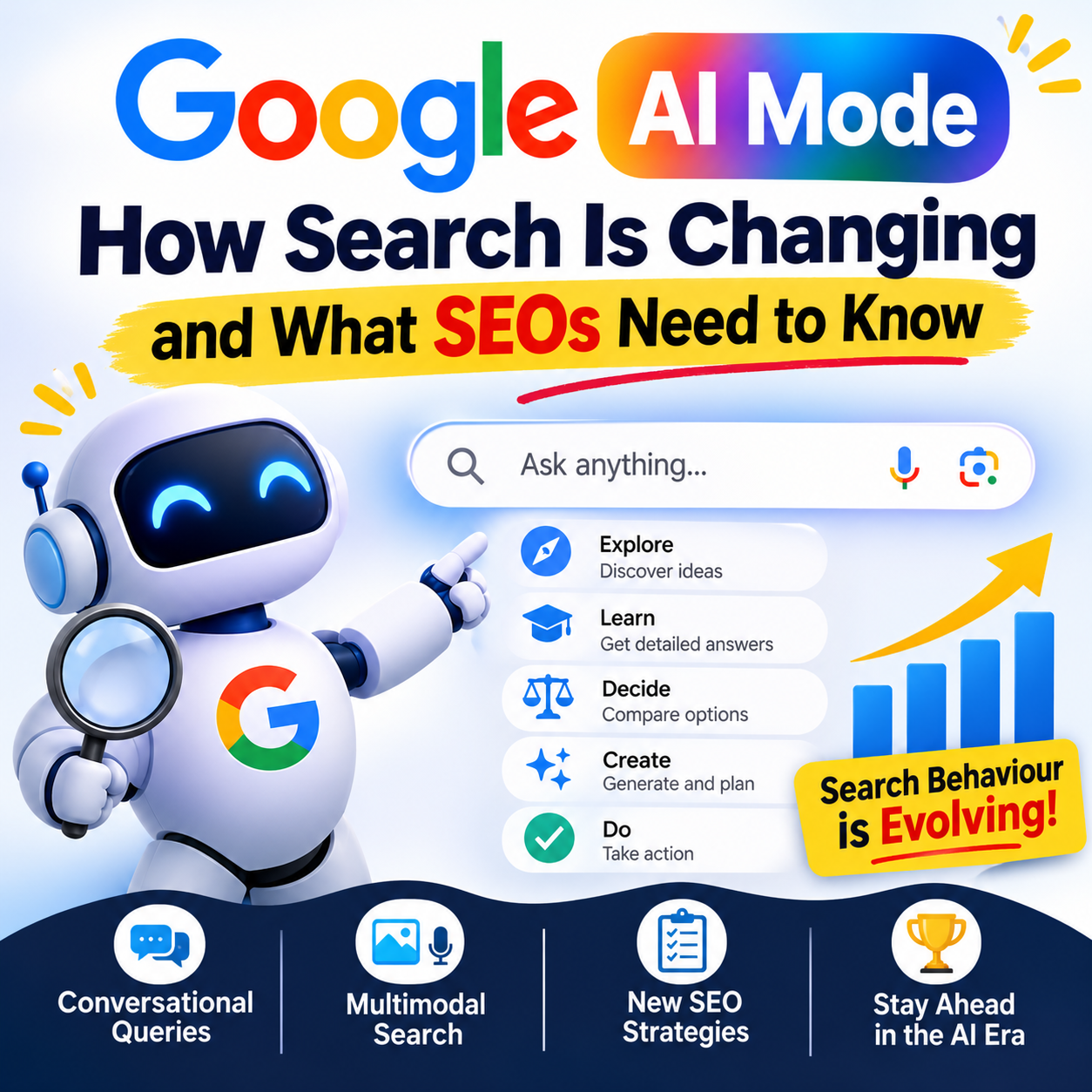
Because AI Mode treats search as a back-and-forth conversation, and it accepts text, voice and images as inputs.
Search used to be simple. You typed something, scanned the results and tweaked your query if it wasn’t right. Now you can talk to Google, show it a photo, and keep refining. Google’s research points to two shifts in particular.
Are follow-up questions really that common?
Yes, and they’re growing. Google’s US data shows follow-up queries in AI Mode rising by more than 40% on average every month.
Picture someone shopping for a laptop. Their session might go like this:
- Which laptop is best for video editing under ₹80,000?
- Which one has the best processor?
- How does its battery life compare with the others?
- Is it good enough for professional editing?
- Where can I buy it at the lowest price?
That used to be five separate searches, maybe on five different sites. Now it’s one conversation.
For us, the takeaway is straightforward. Answer the main question, then answer the three or four questions that naturally come next. A laptop comparison shouldn’t stop at specs. It should cover battery life, real performance, price, who each model suits and what the alternatives are.
Why does multimodal search matter for SEO?
Because a growing share of searches don’t start with typed words. Google reported that more than one in six AI Mode searches in the US use non-text input like voice or images, and image-based searches were growing by more than 40% month over month.
Typical examples: snapping a photo to identify a product, asking a question out loud, or sharing a picture to find something similar. If you work in ecommerce, automotive, fashion, travel or local search, this is already relevant to you.
Visual SEO deserves a real place in your plan:
- Descriptive image filenames
- Accurate alt text
- High-quality original images
- Compressed, fast-loading files
- Consistent product imagery
- Relevant structured data
- Images placed where they actually support the content
One caution. Alt text isn’t a spot to stuff keywords. The image should honestly show what the page is about, and the text should describe it plainly.
What Are the Five Types of Search Intent in AI Mode?
Google’s research groups AI Mode activity into five buckets: Explore, Learn, Decide, Create and Do. They’re a handy way to think about where someone sits in their journey, so let me go through each with examples and what I’d do about it.
Explore: What do people want when they’re looking for ideas?
They want options. These are the “where should I travel in December” and “business ideas to try” and “ideas for a small home office” searches. Google noted that brainstorming queries grew 30% faster than overall AI Mode queries, and phrases like “where to,” “where should I” and “ideas for” are on the rise.
What to do: Publish discovery content that introduces people to your brand early. A travel site might run pieces like best weekend getaways near Bangalore, where to go in India during winter, budget international trips for couples, or things to do in Coorg on a first visit. Don’t build everything around transactional terms. Some of your best traffic starts before anyone is ready to buy.
Learn: How do people use AI Mode to understand a topic?
They use it as a tutor. Think “explain technical SEO with examples,” “how does programmatic SEO work,” or “create a study guide for digital marketing.”
What to do: Go deep. Step-by-step guides, tutorials, FAQs, case studies and industry-specific examples all work here. If you’re targeting “technical SEO,” a two-paragraph definition won’t cut it. Cover crawling, indexing, rendering, canonicalization, structured data, Core Web Vitals and how to actually run an audit. You want to be the page someone can learn the subject from.
Decide: How are people comparing options before they buy?
They’re asking AI Mode to do the comparison for them. “Which CRM is best for startups?” “HubSpot vs Salesforce for a small business.” “Best health insurance for families.” Google also pointed to growth in decision-style questions that begin with “which.”
What to do: Build content that helps someone choose. Product and service comparisons, pricing breakdowns, pros and cons, alternatives pages and proper buying guides. A SaaS company shouldn’t stop at “best CRM software.” Back it up with HubSpot vs Zoho, best CRM for small businesses, free vs paid CRM, pricing comparisons and a guide to choosing a CRM as a startup. And keep it honest. Readers can tell when a comparison is just rewritten feature lists.
Create: What are people trying to make with AI Mode?
They’re drafting, generating and planning. A marketing strategy, a business logo, a professional email, a presentation, a content calendar, a study quiz. Search is turning into a place where work gets started, not only where information gets found.
What to do: Give people tools and templates. Downloadable templates, strategy frameworks, content calendars, planning guides, free calculators and interactive tools all help someone go from “I understand this” to “I’ve done it,” and that’s a strong place for your brand to show up.
Do: How are people using AI Mode to get things done?
They’re finishing tasks. “Find a restaurant near me.” “Plan a seven-day trip to Japan.” “Schedule an appointment.” “Find a car service centre nearby.” Planning queries grew 80% faster than overall AI Mode queries over the previous six months, which should get the attention of anyone who lives on leads, bookings or enquiries.
What to do: Remove friction. Location-specific landing pages, clear service details, upfront pricing, real availability, easy booking, simple lead forms and visible reviews. The shorter the gap between finding you and acting, the better.
Why Isn’t Keyword-Only SEO Enough Anymore?
Because keywords describe a moment in the journey, and people now move through the whole journey in a single session.
Take someone looking for a digital marketing course. The classic keyword set looks like this: digital marketing course, training, institute, course fees. All useful. But that same person is also wondering:
- Is digital marketing a good career?
- What skills do I need?
- Which course is best for a beginner?
- Is online training better than classroom?
- What does a course typically cost?
- Will I actually get a job afterwards?
If your site only targets the main commercial term, you’re missing the research and evaluation phase, which is exactly where people form opinions about who to trust.
A better approach is a connected set of content that follows the journey:
- Awareness: What is digital marketing, career opportunities, skills required
- Consideration: Best courses, online vs offline, syllabus
- Decision: Course fees, institute comparison, reviews
- Action: Enrol, book a counselling session, download the brochure
One page can’t carry all of that. A well-linked cluster can.
How Should SEOs Adapt Their Strategy for Google AI Mode?
Focus on three things: intent-led content, decision-support content, and a solid technical and brand foundation. Understanding the shift is the easy part. Here’s how I’d put it into practice.
Strategy 1: How do you create question-based, intent-focused content?
Start from real questions and build pages that answer them together. Rather than spinning up a separate page for every small keyword variation, ask which questions belong in one thorough resource.
An article on “best CRM software for startups” could naturally answer: What is a CRM? Why do startups need one? Which is best for small teams? What features matter? How much does it cost? Is a free CRM enough?
A workable process:
- Mine Google Search Console query data.
- Check People Also Ask and search suggestions.
- Ask your sales and support teams what customers keep asking.
- Group related questions by intent.
- Turn them into logical sections.
- Give the direct answer first, then expand.
One rule: don’t add a question just to pad keyword coverage. If a section doesn’t help the reader, cut it.
Strategy 2: How do you build comparison and decision-support content?
People want help weighing their options, so give them content that’s actually worth trusting. An ecommerce site might publish product A vs B, best products under ₹10,000, premium vs budget picks and alternatives. A SaaS site might do HubSpot vs Salesforce, best CRM for startups and best marketing automation platforms.
Good comparison content covers features, pricing, pros and cons, limitations, ideal use cases, real examples and a clear recommendation. Wherever you can, back it with your own testing, first-hand experience and facts someone can verify. Skip the generic roundups that just paraphrase vendor pages. They don’t help anybody decide.
Strategy 3: Why do technical SEO and brand entity signals still matter?
Because great content can’t make up for a site that search engines struggle to crawl, index or understand.
Technical basics: Keep important pages crawlable. Fix indexing and canonical problems. Maintain logical internal linking. Watch site speed. Keep sitemaps relevant. Clean up broken links and redirect chains. Make sure the site works well on mobile and that key content is accessible to search engines.
Structured data: Use Schema.org markup where it fits, such as Organization, Article, Product, BreadcrumbList, LocalBusiness and Course. It helps search engines understand your pages and entities. It does not guarantee AI Mode citations, AI Overview visibility or better rankings, so don’t sell it to a client as a shortcut.
Brand entity signals: Make it easy for search engines and people to understand who you are and why you can be trusted. Keep company details consistent across platforms. Publish original research. Earn mentions and citations in your industry. Keep author information consistent. Build proper About and Contact pages. Collect genuine reviews and editorial references. And create content tied to what your brand actually knows.
What Is the Difference Between AEO and GEO?
AEO is about being easy to extract as an answer, and GEO is about being discovered, understood and cited by generative AI. People often use the two terms interchangeably, but they aim at slightly different things.
Answer Engine Optimization (AEO) makes your content easy to understand and pull from when an engine answers a specific question. That means concise answers, meaningful headings, direct responses to real questions, relevant structured data and clear explanations.
Generative Engine Optimization (GEO) improves the odds that your brand or content gets referenced by generative AI experiences. That means original research, topical authority, factual and verifiable information, expert-led content, earned brand mentions, consistent entity information and credible sources behind your claims.
Be wary of anyone who promises a formula for getting cited by AI platforms. There isn’t one. Treat AEO and GEO as additions to your SEO work, not replacements for technical SEO, content quality, authority building or user experience.
How Do You Measure SEO Performance in the AI Search Era?
Keep tracking the classics, then add AI visibility and business outcomes on top. Traditional metrics still matter, they just don’t tell the whole story anymore.
- Organic traffic: Sessions, landing page traffic and acquisition across key sections of your site.
- Search visibility: Impressions, clicks, CTR and average position in Google Search Console.
- Search intent coverage: Are you serving informational, commercial, transactional and navigational needs?
- AI search visibility: How often your brand and content show up in AI-generated answers. You can run structured prompt tests using questions your audience would really ask.
- Referral traffic: Visits from AI platforms and other referrers, tracked in GA4.
- Conversions: Leads, enquiries, purchases, sign-ups and revenue. Not just rankings and sessions.
- Brand search demand: Branded impressions, clicks and overall interest.
A word of caution on AI visibility tracking. It isn’t a perfect measure. Different users can get different answers, and third-party tools won’t capture every interaction. Use those signals alongside your usual SEO and business numbers, not instead of them.
What Does a Practical SEO Checklist for Google AI Mode Look Like?
Here’s a quick reference you can work through if you’re an SEO manager, consultant or content strategist.
| SEO Area | Recommended Action |
|---|---|
| Keyword Research | Identify conversational and question-based queries |
| Search Intent | Map content to Explore, Learn, Decide, Create and Do |
| Content Strategy | Create comprehensive, intent-focused resources |
| Comparisons | Publish useful product and service comparisons |
| Content Quality | Include original insights, examples and expertise |
| Internal Linking | Connect related pages across the user journey |
| Technical SEO | Improve crawlability, indexability and performance |
| Structured Data | Implement relevant and accurate schema |
| Entity SEO | Maintain consistent brand and author information |
| Image SEO | Optimize images, filenames and alt text |
| AEO | Structure content to answer relevant questions clearly |
| GEO | Build authority through original and credible information |
| Analytics | Monitor traffic, visibility, leads and conversions |
| AI Visibility | Track relevant brand mentions and citations |
So Where Does SEO Go From Here?
SEO isn’t dead, but the question we ask has to get bigger. Keyword research, technical SEO, quality content, internal linking, structured data and authority building all still count. We just can’t stop at “which keywords should we rank for?”
We also need to ask:
- What is the person actually trying to get done?
- What will they ask next?
- What do they need to know to make a decision?
- How does our brand become a source they trust?
- Is our content useful at every step, not only the first one?
The SEOs who start asking those questions now will be in a much better spot as search keeps changing. The real opportunity isn’t ranking for more keywords. It’s being genuinely useful from the first question to the final decision.
Frequently Asked Questions
What is Google AI Mode?
Google AI Mode is an AI-powered search experience where people can ask complex questions, explore topics, compare options and keep going with follow-up queries. It works with text and with multimodal input like voice and images.
How is Google AI Mode different from traditional Google Search?
Traditional search shows a list of relevant webpages for a query. AI Mode gives an AI-generated response that helps people dig into complex topics, ask follow-ups and find relevant information through linked sources.
Does Google AI Mode affect traditional SEO rankings?
It changes how people discover information, but it doesn’t make traditional ranking signals or organic optimization irrelevant. Keep investing in technical SEO, helpful content and overall search visibility.
How can websites improve their visibility in Google AI Mode?
Publish helpful, accurate content, answer real questions, show genuine expertise, keep your site technically accessible, use appropriate structured data and build a credible brand. No single tactic guarantees inclusion in AI Mode responses.
What is the difference between AEO and GEO?
AEO is about giving clear answers in answer-driven search experiences. GEO is about improving brand and content visibility in generative AI experiences. Both complement traditional SEO.
Is keyword research still important for AI SEO?
Yes. Just go beyond search volume and keyword difficulty. Understanding conversational queries, user questions, intent and the whole customer journey is becoming more valuable.
What are the five search behaviour categories in Google’s AI Mode research?
Explore, Learn, Decide, Create and Do. They describe how people find ideas, learn, evaluate options, make things and complete tasks.
References and Further Reading
- Google: How AI Mode Is Changing the Way People Search in the U.S.
- Google: AI Mode in Search: How It Works
- Search Engine Journal: Google Reveals First AI Mode Usage Numbers After One Year