
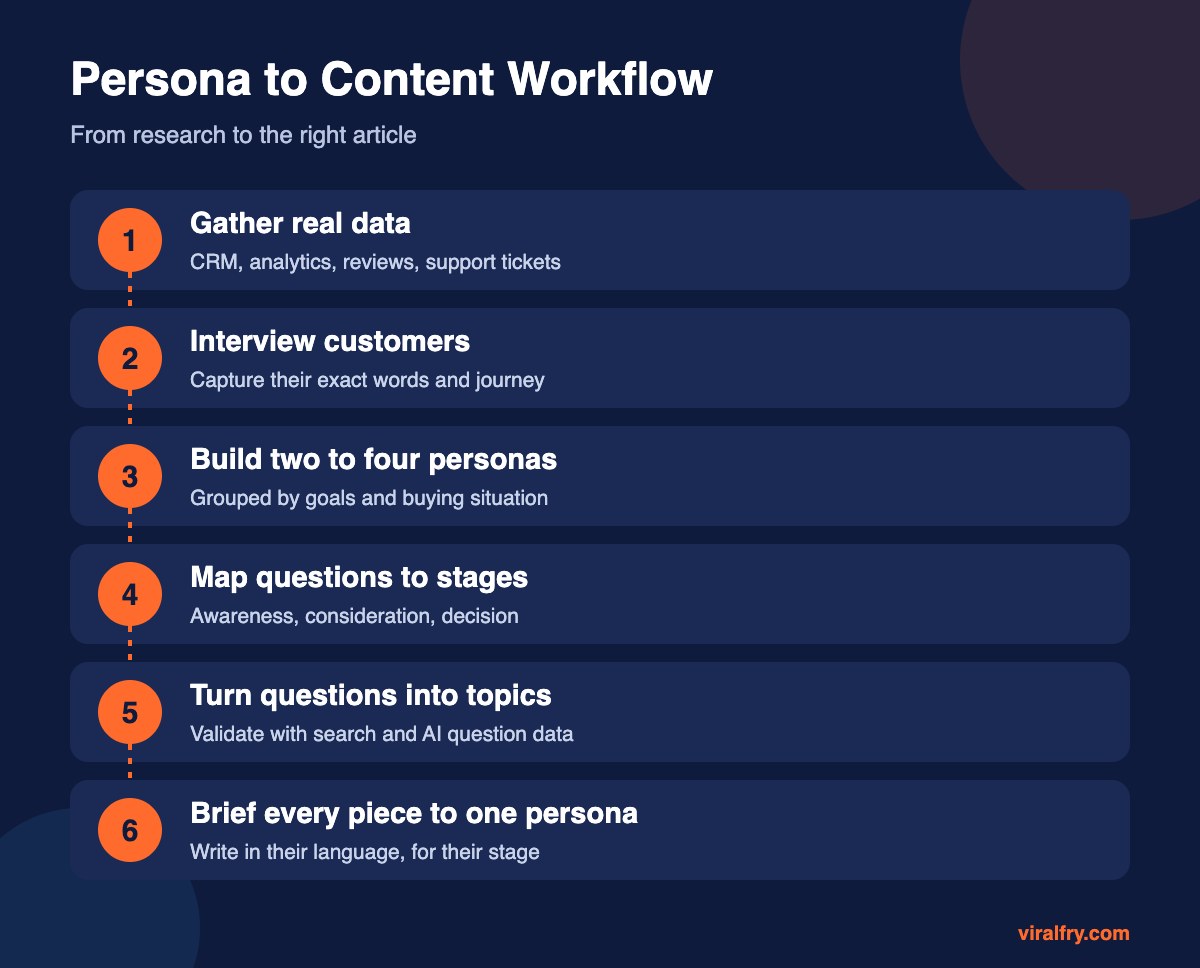
To create personas for content, start with real customer data, interview customers and prospects, ask sales and support for common questions, group what you learn into two to four personas based on goals and buying situations, and document their challenges, questions, objections, and language. Then map their questions to each stage of the buying journey, turn them into topics, and write every piece for one persona at a time.
Personas get a bad reputation because many are fiction: a stock photo, a made-up name, and a list of hobbies that never affect a single decision. Useful personas are different. They capture the questions and words real customers use, which is exactly what content needs to rank, convert, and get quoted by AI answers.
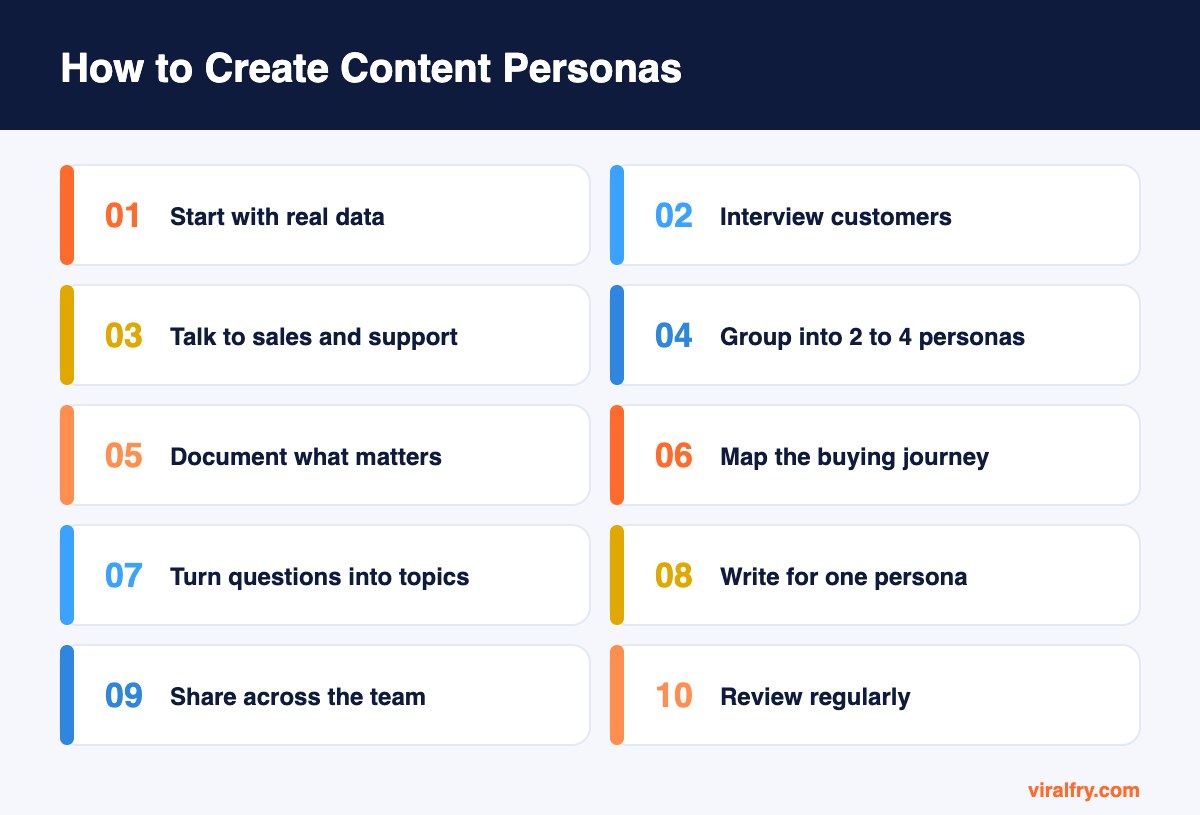
How Do You Create Personas for Content Step by Step?
1. Start with real data, not assumptions
Pull what you already know: CRM records, customer lists, analytics demographics, Search Console queries, support tickets, sales call notes, and reviews. Look for patterns in job titles, company size, industries, and the problems people describe.
Personas built only in a brainstorm usually describe the customer you wish you had, not the one you actually serve.
2. Interview customers and prospects
Talk to five to ten real customers, ideally a mix of new, long-term, and lost ones. Ask how they first noticed the problem, what they searched for, which options they compared, what almost stopped them buying, and what words they use to describe the result.
Record the calls (with permission) and capture exact phrases. Those phrases become headlines, H2s, and keywords.
3. Talk to sales and support
Sales teams hear objections daily, and support teams hear frustrations. Ask both for the ten questions they answer most often. Those questions are some of the best content ideas you will ever get.
They also reveal which customer types are most profitable and easiest to serve.
4. Group findings into two to four personas
Cluster people by goals, problems, and buying situation, not by age or gender alone. Most businesses need only two to four primary personas. More than that becomes hard to use.
Give each persona a simple name and a one-line summary, such as “Growth-stage SaaS marketing lead who needs pipeline from SEO.”
5. Document what matters for content
For each persona, write down their role and context, main goals, biggest challenges, questions at each buying stage, objections, preferred content formats, where they spend time online, and the words they use.
Skip details that never change a content decision, such as invented hobbies.
6. Map questions to the buying journey
List what each persona asks when they first notice a problem, when they compare solutions, and when they are ready to decide. Early questions suit guides and explainers. Later questions suit comparisons, pricing pages, and case studies.
This map becomes your editorial calendar.
7. Turn questions into keywords and topics
Check how people search for those questions using Search Console, keyword tools, and question tools like AnswerThePublic. Our keyword research tools guide covers options.
Each core question becomes a page or a section, written in the persona’s own language.
8. Write for one persona at a time
Every piece of content should have a primary reader. Choose the persona before writing the brief, and keep their goals, knowledge level, and objections in mind throughout.
Content that tries to speak to everyone usually connects with no one.
9. Share personas across the team
Personas only help if people use them. Keep them short, put them in a shared document, and include the persona name in every content brief, ad brief, and campaign plan.
Writers, designers, salespeople, and agencies should all work from the same picture of the customer.
10. Review and update regularly
Markets change, products evolve, and new customer types appear. Revisit personas every six to twelve months with fresh interviews and data.
A persona that is two years old can quietly steer content in the wrong direction.
What Should a Content Persona Include?
| Section | Example for a B2B SaaS marketing lead |
|---|---|
| Role and context | Head of marketing at a 50-person SaaS company |
| Main goals | Grow qualified pipeline from organic search |
| Challenges | Small team, pressure to prove ROI, AI search uncertainty |
| Key questions | How long does SEO take? Agency or in-house? How do we show up in ChatGPT? |
| Objections | Past agency disappointments, long timelines |
| Preferred formats | Short guides, case studies, LinkedIn posts, webinars |
| Their words | “pipeline,” “MQLs,” “board wants numbers” |
Why Do Personas Matter for SEO, AEO, and GEO?
Search engines and AI assistants reward content that directly answers real questions in natural language. Personas give you those questions and that language. When you write a heading the way your customer would ask it and answer it clearly, you improve your chances in search results, featured snippets, and AI-generated answers. See our guide to AEO tips for how to structure those answers.
What Mistakes Make Personas Useless?
- Building them from assumptions instead of interviews and data
- Creating too many personas to use in practice
- Focusing on demographics that never affect content decisions
- Writing them once and never updating them
- Keeping them in a slide deck nobody opens
How Do Personas Fit Into Your Marketing Mix?
Personas inform more than content. They shape product decisions, pricing, channel choices, and promotion, the classic 4 Ps of marketing. They also guide which content marketing strategies make sense for your audience.
What Does a Persona-Driven Content Brief Look Like?
A good brief starts with the persona and stage, not the keyword. For example: “Persona: Growth-stage SaaS marketing lead. Stage: comparing options. Question: should we hire an SEO agency or build in-house?” Next comes what the reader already knows, what they are worried about, and the exact phrases they used in interviews, such as “we got burned by an agency before.”
The brief then lists the questions the article must answer, the proof it needs (a case study, a cost comparison, a quote from your head of SEO), and the next step for the reader. Only then does it add the target keyword and related queries.
Writers working from briefs like this produce content that sounds like it was written for one specific person, because it was. That is exactly the kind of content readers trust, and search engines and AI tools are more likely to surface.
Key Takeaways
- Build personas from real data and customer interviews.
- Keep to two to four personas focused on goals and questions.
- Capture the exact words customers use.
- Map questions to buying stages and turn them into topics.
- Write each piece for one persona and update personas regularly.
Frequently Asked Questions
What is a content persona?
A content persona is a research-based profile of a target reader that describes their role, goals, challenges, questions, objections, and language so content can be written specifically for them.
How many personas should a business have?
Most businesses need two to four primary personas. More than that tends to become hard to use consistently.
How do I create a persona without many customers?
Interview prospects, people in your target industry, and lost leads, study competitor reviews and online communities, and update the persona as you gain real customers.
What is the difference between a buyer persona and a content persona?
They overlap heavily. A content persona focuses specifically on the questions, formats, and language that shape what you publish.
Add as Preferred Source