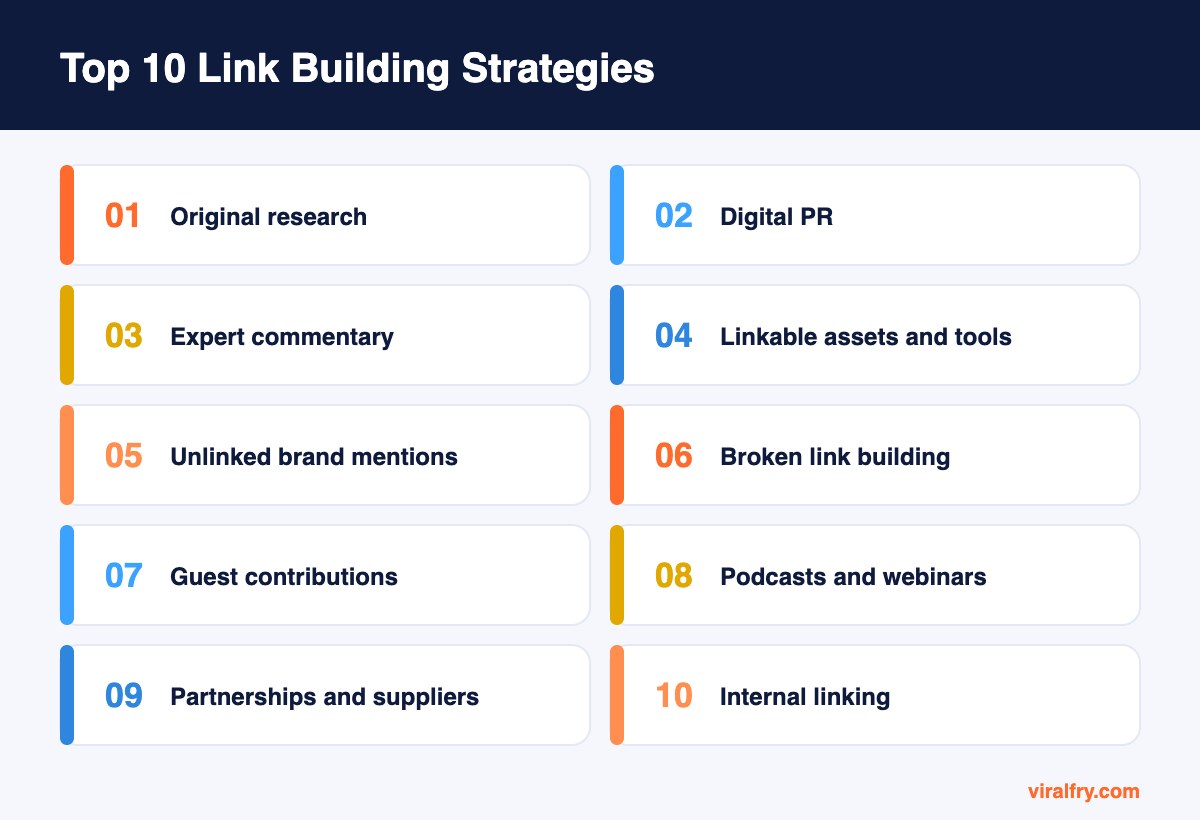
The link building strategies that still work are original research, digital PR, expert commentary for journalists, linkable assets and free tools, reclaiming unlinked brand mentions, broken link building, guest contributions on respected sites, podcast and webinar appearances, partnerships and supplier listings, and strong internal linking. They all earn links by giving people a real reason to cite you, which is also what builds visibility in AI search.
Link building has a bad reputation because so much of it is spam. But links from relevant, trusted sites remain one of the strongest signals for competitive keywords. The difference between strategies that last and those that backfire is simple: are you earning attention, or buying it?
What Link Building Strategies Still Work?
1. Original research and data studies
Journalists, bloggers, and AI answers all need sources. Publishing original data, such as a survey of your customers, an analysis of your platform’s anonymized usage, or a benchmark report, gives them something to cite.
Keep the headline finding simple, visualize it clearly, and pitch it to writers who cover your industry. One strong study can earn links for years.
2. Digital PR
Digital PR turns stories into coverage: trend commentary, newsworthy data, timely reactions to industry news, and creative campaigns. It earns links from high-authority publications that are hard to reach any other way.
The key is relevance. A modest story in your industry’s top trade publication often beats a viral stunt with no connection to what you sell.
3. Expert commentary for journalists
Reporters constantly look for qualified sources. Platforms that connect journalists with experts make it possible to earn quotes and links by answering relevant requests quickly and well.
Respond only where you have real expertise, keep answers short and quotable, and include your credentials.
4. Linkable assets and free tools
Calculators, templates, checklists, and free tools attract links naturally because people reference them when explaining something. Our own free tools are a good example of this approach.
Build assets that solve a specific problem your audience has repeatedly, then promote them where that audience gathers.
5. Unlinked brand mentions
Many sites mention your brand, product, or team without linking. These are the easiest links to win because the writer already knows you.
Set up alerts for your brand name, then send a short, friendly note asking if they would add a link for readers.
6. Broken link building
Find relevant resource pages with links to dead pages, then suggest your content as a replacement. You help the site owner fix a problem and earn a link in return.
It works best when your replacement genuinely matches what the dead page used to offer.
7. Guest contributions on respected sites
Writing genuinely useful articles for respected publications in your field still works when the goal is audience and authority, not just a link.
Avoid sites with “write for us” pages that accept anything for a fee. Google treats paid guest posts with followed links as link schemes.
8. Podcast and webinar appearances
Podcast hosts usually link to guests in show notes, and your appearance introduces you to a new audience. Co-hosted webinars with partners often produce links from both sides.
Pitch topics where you can share something specific and useful, not a product demo.
9. Partnerships, integrations, and suppliers
Partners, integration directories, suppliers, and customers often list the companies they work with. These links are relevant and trusted.
Ask partners to list you on their integration or partner pages, and make it easy with logo files and a ready-made description.
10. Internal linking to pages that need help
The link building you fully control is internal. Linking from your strongest pages to the pages you want to rank passes authority and helps search engines understand importance.
After every new external link, consider which internal links can pass that value to your commercial pages.
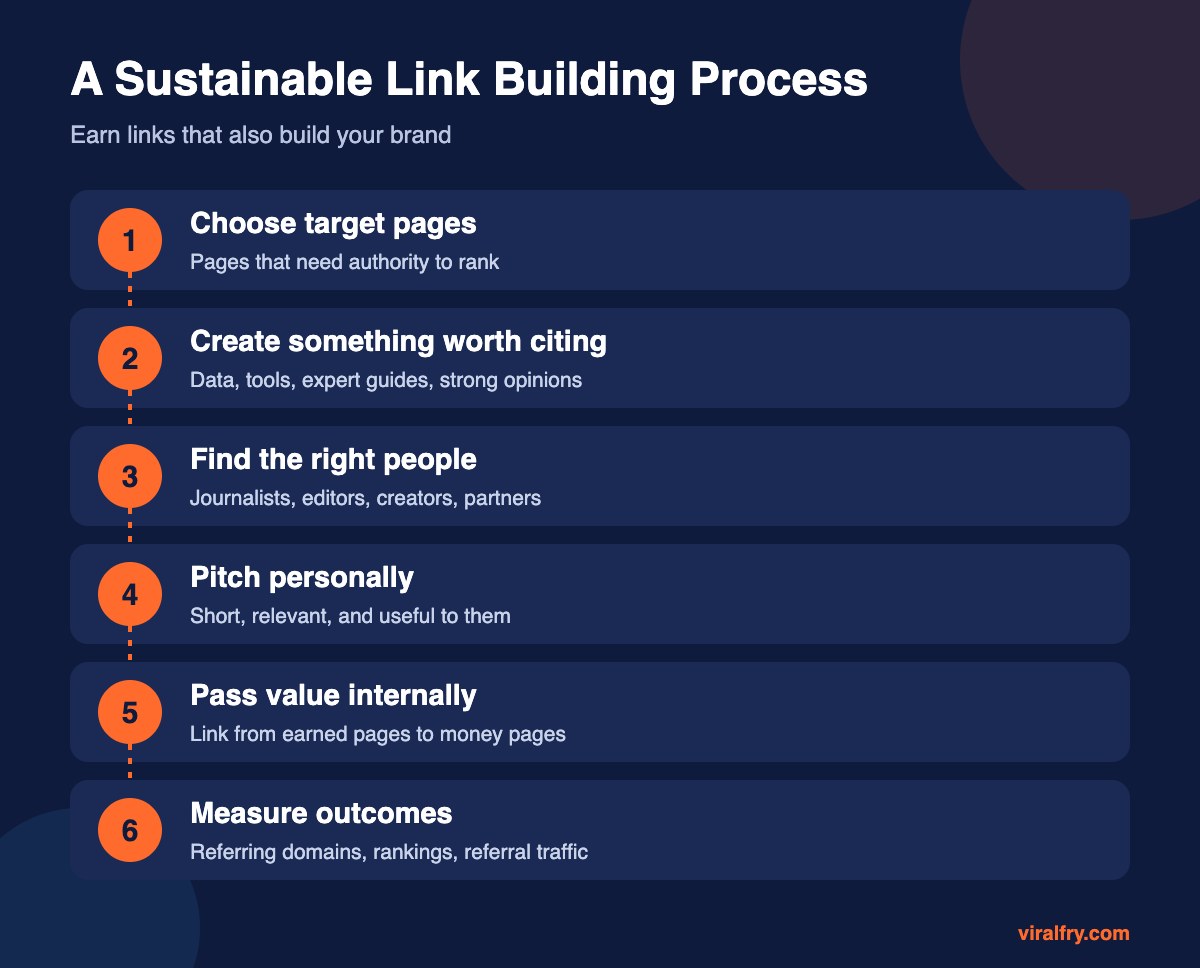
Which Link Building Tactics Should You Avoid?
| Tactic | Why to avoid it |
|---|---|
| Buying followed links | Violates Google’s spam policies |
| Private blog networks (PBNs) | Built only to manipulate rankings |
| Large-scale link exchanges | Treated as link schemes |
| Mass directory and comment spam | Ignored or harmful |
| Exact-match anchor text everywhere | Looks unnatural |
Do Links Still Matter in the Age of AI Search?
Yes, in two ways. Links still help pages rank in Google, and ranking pages are the ones AI Overviews and many AI assistants retrieve. Beyond links, brand mentions on trusted sites shape how AI tools describe your company, even without a hyperlink. The strategies above produce both. See how to get cited in AI answers for the GEO side.
How Many Links Do You Need?
There is no magic number. Compare the referring domains of the pages ranking in the top five for your target keyword. That gives you a realistic benchmark. A few highly relevant links often beat dozens of unrelated ones. For specific contexts, see our guides on ecommerce link building and hiring link building experts.
How Do You Measure Link Building Success?
- New referring domains from relevant sites
- Rankings for the pages receiving links
- Organic traffic and conversions on those pages
- Referral traffic from earned links
- Brand mentions and coverage
What Does a Good Outreach Email Look Like?
Most outreach fails because it is about you, not the person reading it. A good email is short, specific, and useful to them. Open with why you are writing to that person in particular, for example a recent article they wrote on the same topic. Then offer something concrete: a new data point they could add, an updated statistic to replace an outdated one, or an expert quote for an upcoming piece.
Keep it to five or six sentences, include one link, and make saying yes easy. Do not ask for a link in the first line, and never send the same template to hundreds of people.
Follow up once after a week. If there is no reply, move on. Writers remember respectful pitches, and many of the best links come from the second or third time you help the same journalist.
Track every pitch in a simple spreadsheet so you can see which angles get replies and which publications are worth building relationships with.
Key Takeaways
- Earn links by giving people a reason to cite you.
- Original research and digital PR earn the strongest links.
- Unlinked mentions and partnerships are quick wins.
- Never buy followed links or use networks.
- Links and mentions support both Google rankings and AI visibility.
Frequently Asked Questions
What is the best link building strategy?
Original research combined with digital PR tends to earn the highest-quality links, because journalists and writers need credible sources to cite.
Is link building still important for SEO?
Yes. Links from relevant, trusted websites remain an important ranking signal, especially for competitive keywords.
Are guest posts still good for link building?
Guest contributions on respected, relevant sites still help with authority and audience. Paid guest posts with followed links on low-quality sites violate Google’s policies.
How long does link building take to work?
Most campaigns need three to six months to show clear ranking gains, depending on competition and link quality.
Add as Preferred Source