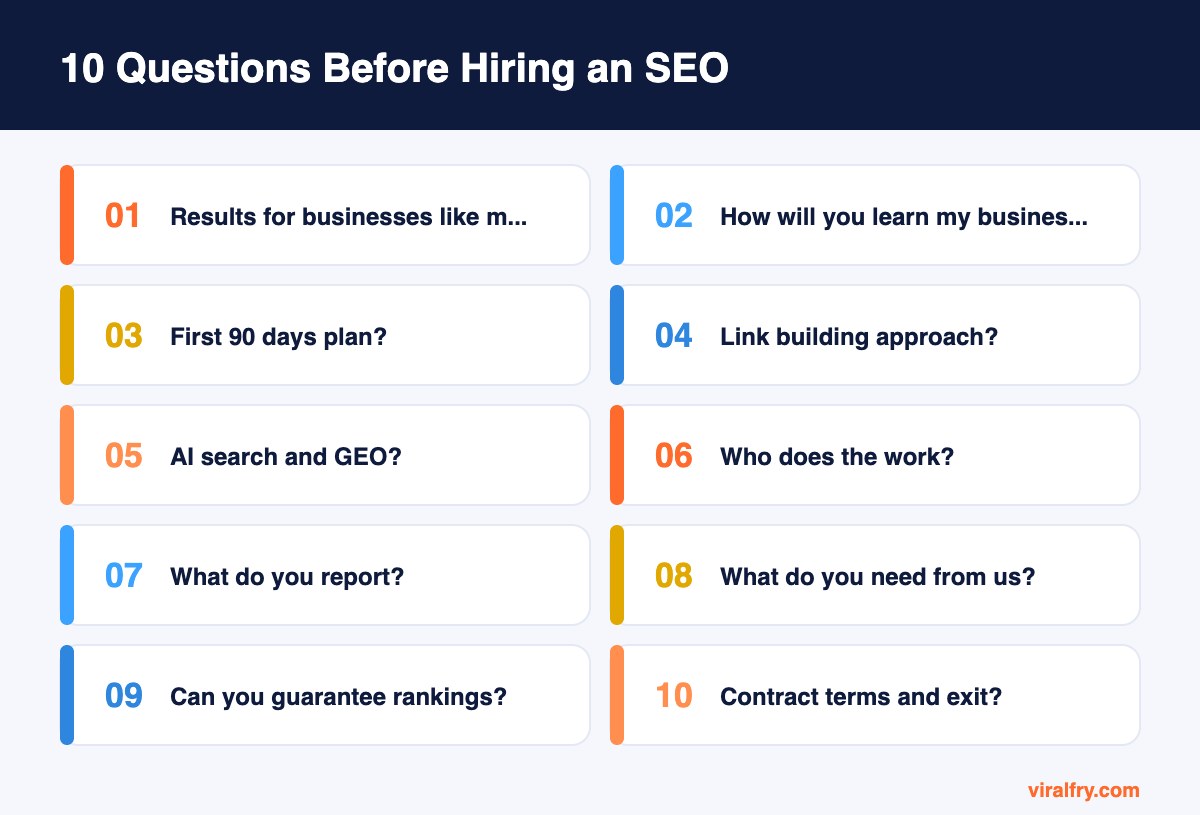
Before hiring an SEO expert, ask about results for similar businesses, how they will learn your business, their 90-day plan, their link building approach, how they handle AI search, who will do the work, what they report, what they need from you, whether they guarantee rankings, and the contract terms. Good experts give specific, honest answers. Vague answers, guarantees, and long lock-ins are red flags.
Hiring the wrong SEO can cost more than money. Risky tactics can damage rankings for months, and poor reporting can hide that nothing is happening. These questions help you separate genuine experts from good salespeople, whether you are hiring a freelancer or an agency.
What Should You Ask Before Hiring an SEO Expert?
1. What results have you achieved for businesses like mine?
Ask for two or three examples from your industry or business model, with before-and-after data: organic traffic, leads, or revenue, not just rankings. Ask what they did and how long it took.
Good answer: specific examples, honest timelines, and context about what was outside their control. Red flag: vague claims or screenshots with no explanation.
2. How will you learn about my business and customers?
SEO that ignores your customers targets the wrong keywords. A good expert will want to understand your products, margins, sales process, and the questions buyers ask.
Good answer: a discovery process with interviews and access to analytics. Red flag: jumping straight to a keyword list before asking anything.
3. What will you do in the first 90 days?
You want a clear plan: an audit, quick wins, priorities, and how they will measure progress. The first months often focus on technical fixes and improving pages that already rank.
Good answer: a phased plan with priorities tied to your goals. Red flag: a generic checklist identical for every client.
4. How do you approach link building?
This question reveals a lot about risk. Ethical link building earns links through content, PR, and relationships.
Good answer: outreach, digital PR, and partnerships, with full reporting of every link. Red flag: buying links, private networks, or “guaranteed DA” packages. See our guide to hiring link building experts.
5. How do you handle AI search and GEO?
In 2027, an SEO who ignores AI Overviews, ChatGPT, and Perplexity is missing part of the picture. Ask how they track AI visibility and adapt content for it.
Good answer: answer-first content, entity work, mentions, and monitoring AI citations, built on solid SEO. Red flag: either dismissing AI completely or selling it as a magic replacement for SEO.
6. Who will actually do the work?
With agencies, the person who sells is often not the person who delivers. Ask who will run your account, their experience, and how much time they will spend on it.
Good answer: named people you can meet. Red flag: “our team” with no specifics.
7. What will you report, and how often?
Reports should connect activity to outcomes: rankings, traffic, conversions, and revenue, plus what was done and what is next.
Good answer: monthly reports with clear commentary and access to the underlying data. Red flag: reports full of vanity metrics with no explanation.
8. What do you need from us?
SEO works best as a partnership. You may need to provide content approvals, developer time, subject matter experts, and access to tools.
Good answer: a clear list of responsibilities on both sides. Red flag: claiming you will not need to do anything at all.
9. Can you guarantee rankings?
This is a trick question. Nobody can guarantee rankings, because no one controls Google’s algorithm. Google itself warns against SEOs who guarantee number-one positions.
Good answer: “No, but here is how we will measure progress.” Red flag: any guarantee of a specific ranking or timeline.
10. What are the contract terms and how do we part ways?
Ask about contract length, notice periods, ownership of content and accounts, and what happens to links and assets if you stop working together.
Good answer: flexible terms after an initial period, and you own all content, data, and accounts. Red flag: long lock-ins or the provider owning your analytics or content.
What Are the Biggest Red Flags When Hiring an SEO?
| Red flag | Why it matters |
|---|---|
| Guaranteed rankings | Nobody controls Google’s algorithm |
| Cheap link packages | Usually paid or spammy links that violate guidelines |
| Secret methods | Good SEO is explainable |
| No access to your own data | You should own accounts and analytics |
| Long lock-in contracts | Removes accountability |
| Only reporting rankings | Hides whether SEO drives business results |
Should You Hire a Freelancer or an Agency?
Freelancers often bring deep expertise and direct communication at a lower cost, which suits smaller businesses or focused projects. Agencies offer a wider team covering technical SEO, content, links, and reporting, which suits larger sites or companies that need several skills at once. Our guides on hiring a freelance SEO expert and what expert SEO services include go deeper.
How Much Should You Expect to Pay?
Pricing varies widely by country, experience, and scope. Common models are monthly retainers, fixed-price projects such as audits, and hourly consulting. Be wary of prices far below the market; they often mean automated work or risky shortcuts. Compare what is included, such as strategy, content, technical work, and reporting, rather than the headline fee.
How Do You Evaluate the Answers?
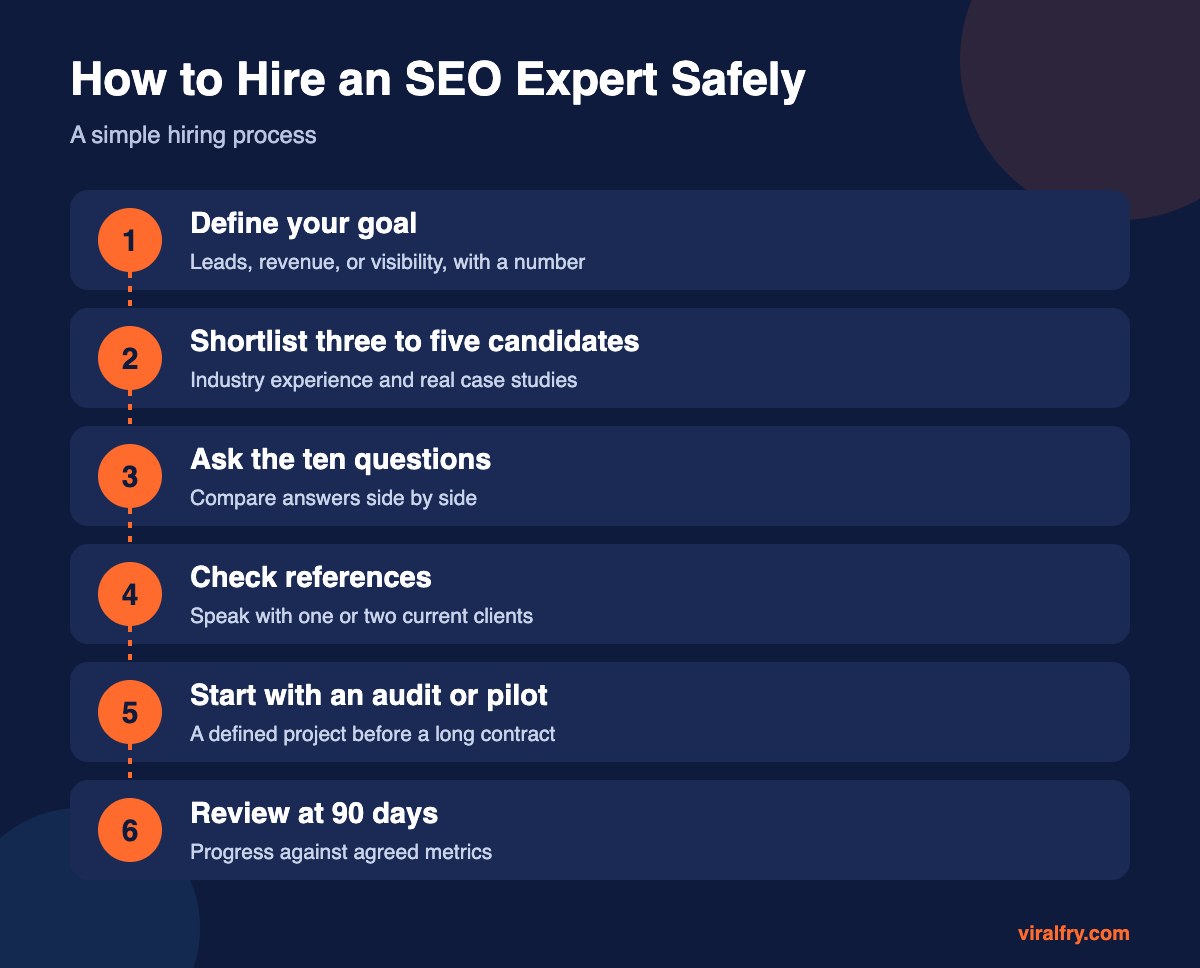
Write down each candidate’s answers to the ten questions in a simple table. Score each answer from one to three: vague, reasonable, or specific and convincing. Pay extra attention to the link building, guarantees, and contract questions, since weak answers there carry the most risk. The candidate with the highest score is not always the cheapest or the most confident in the meeting, but they are usually the one who will still be delivering results a year later.
What Should Happen in the First Month After Hiring?
A good SEO partner starts with access and understanding: Search Console, analytics, CMS, and a kickoff call with the people who know your customers. Within the first few weeks you should receive an audit with clear priorities, not a hundred-page export from a tool.
By the end of the first month, at least a few quick wins should be live, such as technical fixes or improvements to pages that already rank. You should also agree on the metrics and reporting format for the rest of the engagement. If a month passes with nothing but meetings, raise it early.
Key Takeaways
- Ask for specific results, a clear 90-day plan, and named team members.
- Probe link building and AI search approaches carefully.
- Expect transparent reporting tied to business outcomes.
- Never accept ranking guarantees or long lock-ins.
- Start with an audit or pilot before a long commitment.
Frequently Asked Questions
What should I ask an SEO expert before hiring?
Ask about relevant results, their discovery process, 90-day plan, link building methods, AI search approach, who does the work, reporting, what they need from you, guarantees, and contract terms.
Can an SEO expert guarantee first-page rankings?
No. No one controls Google’s rankings, and Google itself warns against anyone guaranteeing top positions.
How long before I see SEO results?
Most businesses see early improvements in three to six months, with stronger results in six to twelve months, depending on competition and site history.
Should I own my SEO accounts and content?
Yes. You should own your analytics, Search Console, content, and any accounts created for your business.
Add as Preferred Source