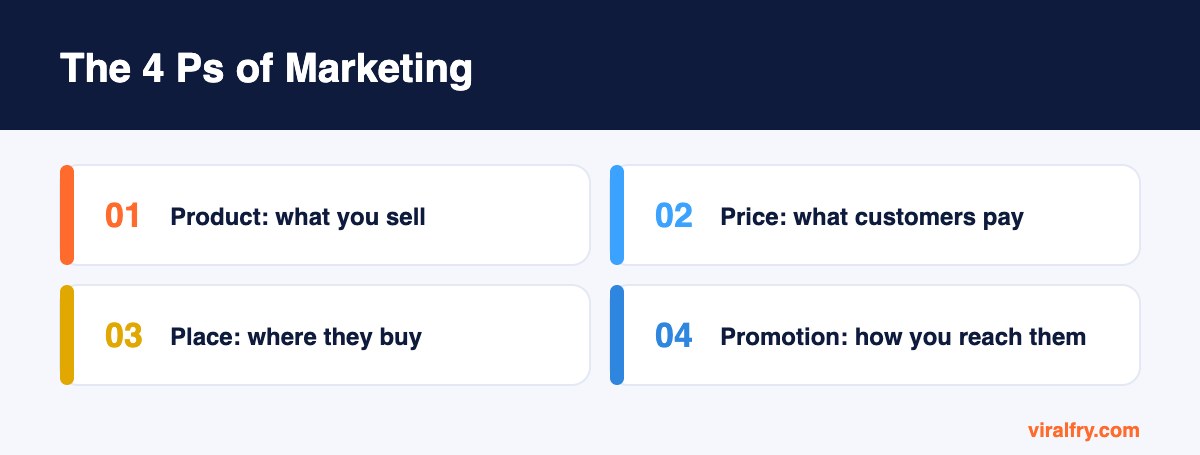
The 4 Ps of marketing are Product, Price, Place, and Promotion. Together they form the marketing mix: the main decisions a business makes to bring something to market. Product is what you sell, Price is what customers pay, Place is where and how they buy it, and Promotion is how you tell them about it. The framework was introduced by E. Jerome McCarthy in 1960 and popularized by Philip Kotler, and it is still one of the most useful planning tools in marketing.
It is easy to dismiss the 4 Ps as a textbook idea. In practice, most marketing problems we see trace back to one P being out of sync with the others: a premium product sold through a discount channel, or a great product nobody hears about. The model is simple precisely so you can spot those mismatches quickly.
What Are the 4 Ps of Marketing?
Product
Product is what you sell: a physical item, software, or a service. It covers features, quality, design, packaging, branding, variants, and the problem it solves. Every other P depends on getting this right.
Questions to ask: What problem does it solve? Who is it for? How is it different from alternatives? What do customers value most, and what would they happily live without?
Digital example: a SaaS company that interviews churned customers and removes confusing features to make onboarding faster is working on the Product P.
Price
Price is what customers pay and how they pay it: list price, discounts, payment terms, subscriptions, and bundles. Price signals positioning as much as it covers costs. A premium price tells a story about quality; a low price tells a story about value.
Questions to ask: What is the product worth to the customer? How do competitors price? Will you lead on value or on premium positioning? How does pricing affect perceived quality?
Digital example: offering a free plan, monthly and annual billing, and usage-based pricing are all Price decisions.
Place
Place is how and where customers find and buy your product: your website, marketplaces like Amazon, retail stores, distributors, app stores, or a sales team. It also covers logistics and availability.
Questions to ask: Where do your customers look for products like yours? Which channels give you the right margin and control? Is the buying process easy on every channel?
Digital example: deciding between selling directly on your store or through Amazon Vendor Central or Seller Central is a Place decision. So is making sure your product shows up when people ask an AI assistant for recommendations.
Promotion
Promotion is how you communicate with customers: advertising, SEO, content marketing, social media, email, PR, events, influencer partnerships, and sales outreach. It turns a good product at a fair price in the right place into something people know about and want.
Questions to ask: Where does your audience pay attention? What message will persuade them? Which channels bring the best return? How do they work together?
Digital example: a mix of content marketing, SEO, LinkedIn, and email nurturing is a modern Promotion strategy.
How Do the 4 Ps Work Together?
The Ps only work when they tell the same story. A luxury skincare brand needs a premium product, a premium price, selective places such as its own site and high-end retailers, and polished promotion. If it suddenly appears in bargain bins, every other P suffers. When planning, always check the four decisions against each other, not one at a time.
| Business | Product | Price | Place | Promotion |
|---|---|---|---|---|
| B2B SaaS tool | Software with onboarding support | Monthly subscription, annual discount | Own website, app marketplaces | SEO, LinkedIn, webinars, reviews |
| Local bakery | Fresh bread and cakes | Mid-range, daily specials | Shop, delivery apps | Google Business Profile, Instagram, word of mouth |
| Online fashion brand | Seasonal collections | Premium with occasional sales | Own store, select marketplaces | Influencers, Instagram, email |
What Are the 7 Ps of Marketing?
For services, marketers often extend the mix to seven Ps by adding three more:
- People: the staff who deliver the service and shape the experience
- Process: how the service is delivered, from booking to follow-up
- Physical evidence: tangible proof of quality, such as a website, office, reviews, or case studies
For agencies, consultants, and SaaS companies with heavy onboarding, these extra Ps often matter as much as the original four.
Are the 4 Ps Still Relevant in Digital Marketing?
Yes, though each P looks different online. Product now includes the user experience and updates after purchase. Price includes free trials, freemium plans, and dynamic pricing. Place includes search results, marketplaces, social commerce, and AI assistants that recommend products. Promotion spans SEO, content, paid ads, social media, email, and creators. The underlying questions remain the same: what are you offering, at what value, where, and how will people find out?
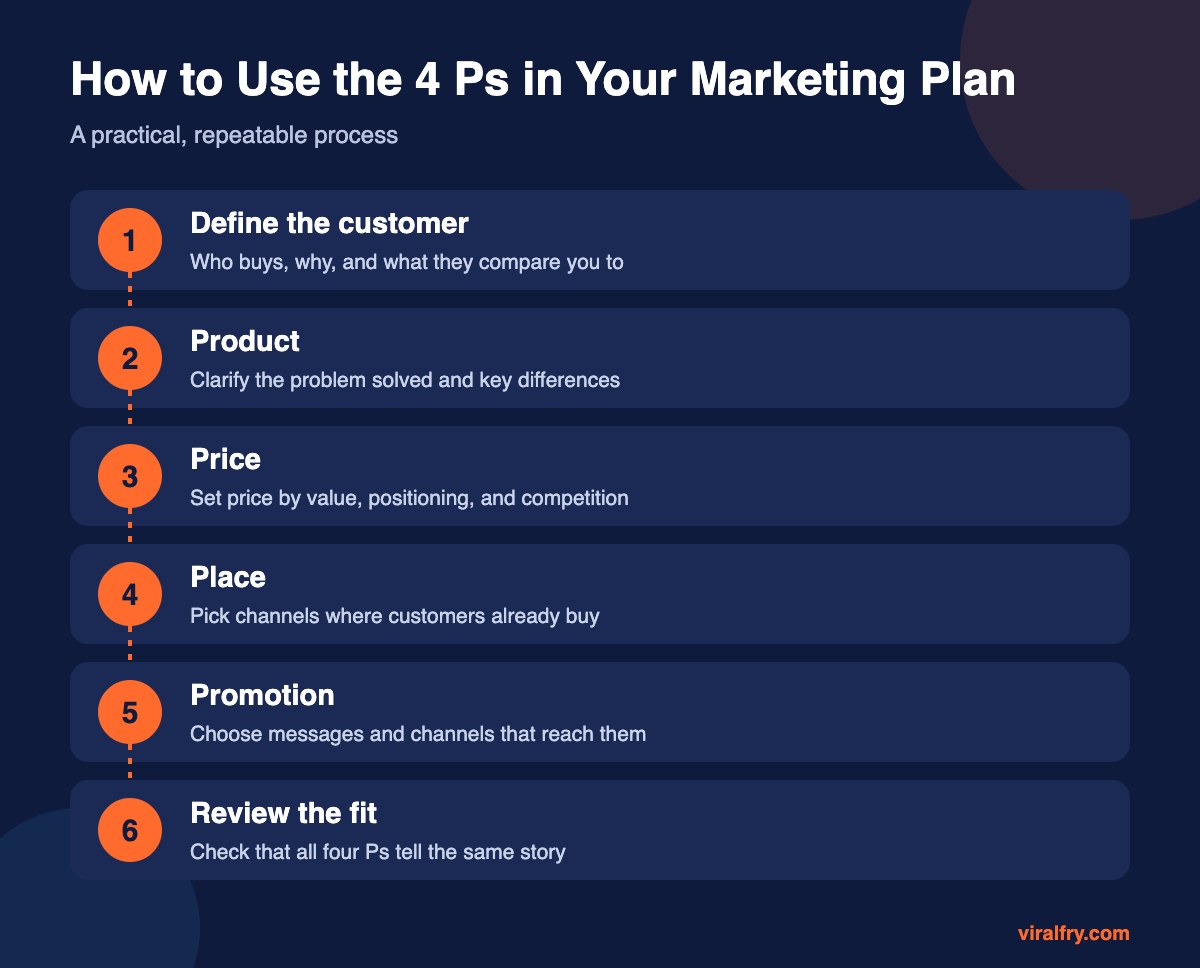
How Do You Use the 4 Ps in a Marketing Plan?
- Start with a clear customer profile; see our guide to creating personas.
- Write one or two sentences for each P describing your current approach.
- Compare each P with your top three competitors.
- Look for mismatches between the Ps and fix the biggest one first.
- Revisit the mix whenever you launch a product, enter a new market, or change pricing.
What Is a Simple 4 Ps Example for a Small Business?
Take a small digital marketing agency offering SEO to startups. Product: a monthly SEO program with an audit, technical fixes, two optimized pages a month, and reporting. Price: a fixed monthly retainer with a three-month minimum, positioned below large agencies but above freelancers. Place: the agency’s own website, LinkedIn, and referrals from startup accelerators. Promotion: helpful blog content, founder posts on LinkedIn, case studies, and talks at local startup events.
Now check the fit. If the agency promotes itself as “premium” but competes on price in proposals, Price and Promotion clash. If most leads come from referrals but the agency spends its time on cold ads, Place and Promotion are misaligned. Writing the four Ps on one page makes these gaps obvious in minutes.
What Are Common Mistakes With the 4 Ps?
The most common mistake is treating Promotion as the whole of marketing. Advertising cannot fix a product people do not want or a price they do not accept. Another is copying a competitor’s mix without understanding why it works for them. Your customers, costs, and strengths are different, so your mix should be too.
Key Takeaways
- The 4 Ps are Product, Price, Place, and Promotion.
- They form the marketing mix, introduced by McCarthy and popularized by Kotler.
- All four must tell a consistent story to work.
- Service businesses often use the 7 Ps, adding People, Process, and Physical evidence.
- The framework still applies online, with digital versions of each P.
Frequently Asked Questions
What are the 4 Ps of marketing?
The 4 Ps are Product, Price, Place, and Promotion. They describe the key decisions a business makes when bringing a product or service to market.
Who created the 4 Ps of marketing?
E. Jerome McCarthy introduced the 4 Ps in 1960, and Philip Kotler helped popularize the framework.
What is the difference between the 4 Ps and the 7 Ps?
The 7 Ps add People, Process, and Physical evidence to the original four, which makes the framework more useful for service businesses.
Are the 4 Ps still used today?
Yes. Marketers still use the 4 Ps for planning, though each element now includes digital channels and experiences.
Add as Preferred Source