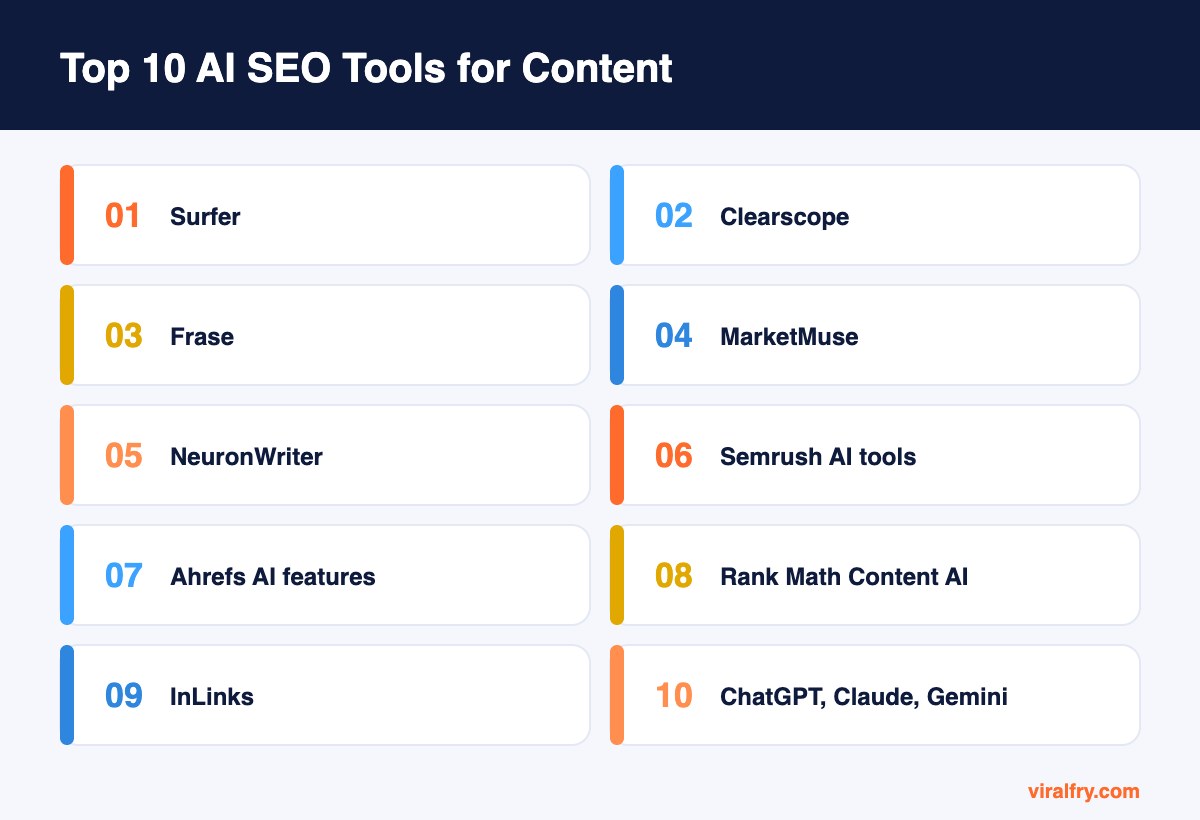
The best AI SEO tools for content optimization are Surfer, Clearscope, Frase, MarketMuse, NeuronWriter, the AI features inside Semrush and Ahrefs, Rank Math Content AI, InLinks, and general assistants like ChatGPT, Claude, and Gemini. They speed up research, briefs, and term coverage. None of them replace first-hand expertise, which is what ranks and gets cited in AI answers today.
AI tools have changed how content teams work, but they have also flooded the web with near-identical articles. Google’s guidance is clear that how content is produced matters less than whether it is helpful, original, and accurate. The tools below help you get there faster when a knowledgeable person stays in the loop.
What Are the Best AI SEO Tools for Content Optimization?
1. Surfer
Surfer analyzes the pages that rank for your keyword and turns their patterns into a content score: suggested terms, headings, length, and structure. Its editor gives live feedback as you write, which makes it popular with agencies running many writers.
Use the score as a guide, not a target. We have seen writers chase a perfect score and end up with stiff, repetitive copy. Aim for “good enough” coverage, then edit for the reader.
2. Clearscope
Clearscope is known for clean, simple content reports and strong term recommendations. It integrates with Google Docs and WordPress, so writers can see grades without leaving their editor.
It suits teams that care about editorial quality and want a tool that stays out of the way. It also helps with refreshing older posts by showing which topics they now miss.
3. Frase
Frase combines SERP research and content briefs with AI writing. Its strength is speed: in a few minutes you get an outline built from the headings and questions of top results, including People Also Ask.
That makes it handy for AEO work, since you can see the real questions searchers ask and answer them directly in your draft.
4. MarketMuse
MarketMuse goes beyond single articles. It models topic authority across your whole site and suggests which topics to cover next, which pages to update, and how deep each piece should go.
It is best for larger content teams planning topic clusters rather than individual writers optimizing one post at a time.
5. NeuronWriter
NeuronWriter offers NLP-based term suggestions, competitor analysis, and AI drafting at a price that smaller teams and freelancers can justify. It supports many languages, which helps for international sites.
It is a solid budget alternative to the bigger content optimization platforms.
6. Semrush AI content tools
Semrush has built AI writing and optimization features into its suite, connected to its keyword and competitor data. If your team already lives in Semrush, these tools keep research, briefs, and drafts in one place.
Check the current plan details, since Semrush regularly renames and repackages its content tools.
7. Ahrefs AI content features
Ahrefs has added AI helpers for drafting, rewriting, and content gap analysis on top of its keyword and backlink data. The value is that suggestions are grounded in data about what actually ranks and earns links.
As with Semrush, these work best for teams already paying for the main platform.
8. Rank Math Content AI
For WordPress users, Rank Math’s Content AI brings keyword suggestions, question ideas, and AI writing straight into the editor. It is convenient for small teams that want optimization help without another subscription.
Pair it with your own judgment on structure and accuracy; plugin suggestions are a starting point.
9. InLinks
InLinks focuses on entities, the people, places, products, and concepts search engines recognize. It maps the entities on your pages, recommends internal links, and can generate schema.
Entity clarity matters more as AI search grows, which makes this a useful niche tool for GEO as well as SEO.
10. General AI assistants (ChatGPT, Claude, Gemini)
You do not always need a specialist tool. General AI assistants are excellent for outlining, summarizing interviews, generating question lists, rewriting for clarity, and checking whether a draft actually answers the query.
Where they fall short is fact-checking and first-hand experience. Treat their output as a draft that a knowledgeable human must verify and improve.
How Do These AI SEO Tools Compare?
| Tool | Best for | Team size |
|---|---|---|
| Surfer | Live content scoring and term coverage | Agencies, content teams |
| Clearscope | Clean editorial reports, Docs integration | Editorial teams |
| Frase | Fast SERP-based briefs and questions | Freelancers, small teams |
| MarketMuse | Topic authority and content planning | Larger teams |
| NeuronWriter | Budget NLP optimization | Freelancers |
| Semrush AI tools | Research to draft in one suite | Existing Semrush users |
| Ahrefs AI features | Data-backed drafting and gaps | Existing Ahrefs users |
| Rank Math Content AI | Optimization inside WordPress | Small sites |
| InLinks | Entities, internal links, schema | SEO specialists |
| General AI assistants | Outlines, rewrites, summaries | Everyone |
Will AI-Written Content Rank on Google?
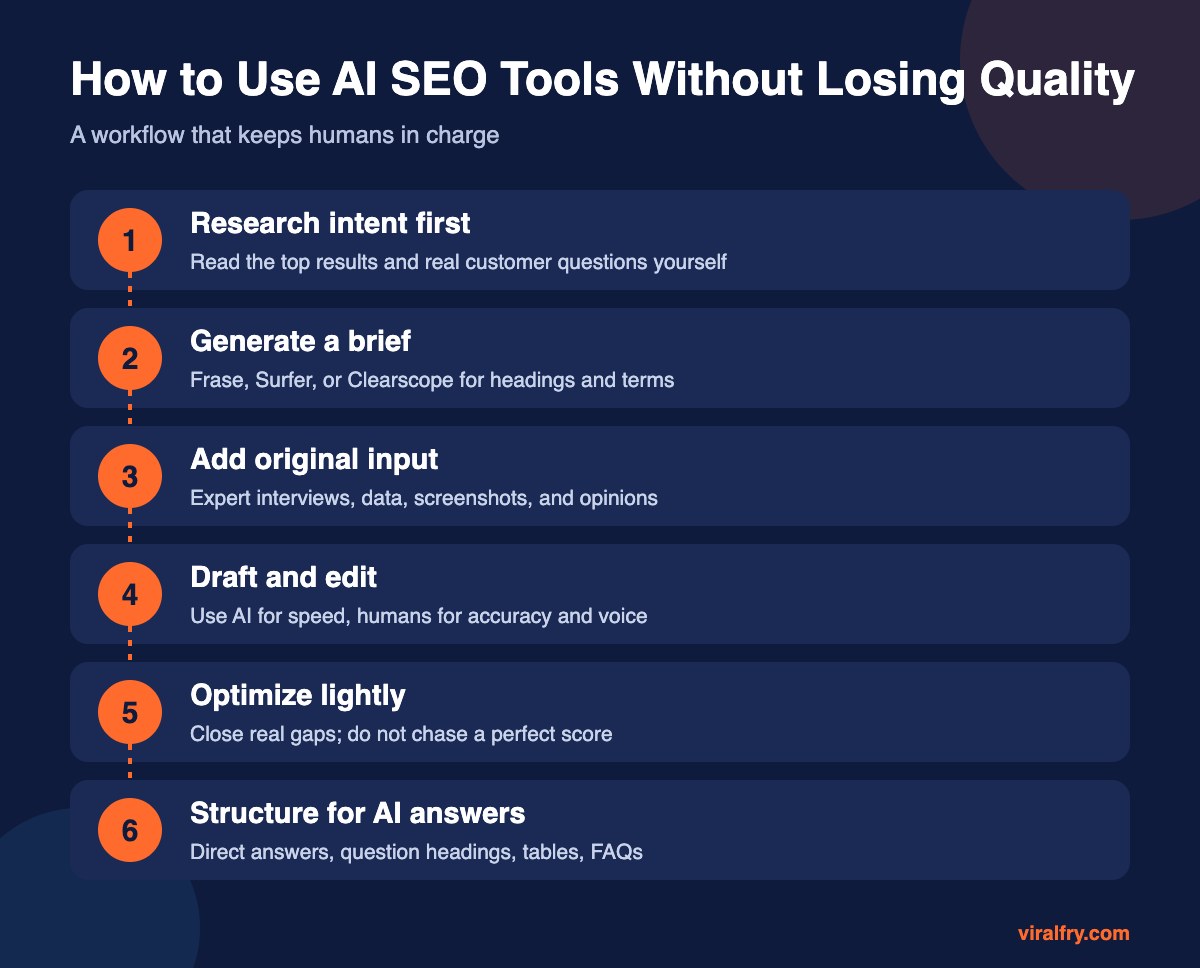
It can, if it is genuinely helpful. Google has said it rewards quality content however it is produced, but its spam policies target scaled content created mainly to manipulate rankings. In practice, unedited AI drafts tend to repeat what already ranks and add nothing new. Pages that win add experience: real examples, original data, expert quotes, and clear opinions.
How Do AI SEO Tools Help With AEO and GEO?
Answer engines and AI Overviews favor content that answers questions directly and is easy to quote. Use tools like Frase or AnswerThePublic to collect real questions, then write question-style headings with a 40 to 60 word answer below each. Our guides on heading structure for AEO and structuring HTML for AI Overviews show how.
How Should You Choose an AI SEO Tool?
- Start with the job: briefs, scoring, planning, or drafting
- Check whether it fits your editor (Google Docs, WordPress)
- Trial it on three real articles before committing
- Compare cost per article against time saved
- Avoid tools that promise to publish hundreds of pages automatically
Which AI SEO Tool Should You Start With?
If you write fewer than ten articles a month, start with a general AI assistant for outlines plus Frase or NeuronWriter for SERP-based briefs. That combination covers most needs at a low cost. If you manage a team of writers, Surfer or Clearscope gives everyone the same standard and makes editing faster. If you are planning a content program for a whole site, MarketMuse helps you decide what to write next and what to update. Whatever you choose, budget time for a subject matter review on every piece. That review is the step that turns a decent draft into something worth citing.
Key Takeaways
- AI SEO tools speed up research, briefs, and optimization.
- Surfer, Clearscope, Frase, and MarketMuse lead for content optimization.
- Treat scores as guidance, not goals.
- Human expertise and original input are what make content rank and get cited.
- Structure content with direct answers for AEO and GEO.
Frequently Asked Questions
What is the best AI SEO tool?
It depends on your needs. Surfer and Clearscope are strong for optimizing individual articles, Frase is fast for briefs, and MarketMuse is best for planning topic coverage across a site.
Does Google penalize AI content?
Google does not penalize content simply for being AI-assisted. It targets low-quality, scaled content made mainly to manipulate rankings. Helpful, accurate, original content can rank regardless of how it was drafted.
Can ChatGPT replace SEO tools?
Not fully. General assistants are great for outlines and rewriting, but they lack live search data, ranking analysis, and site crawling that dedicated SEO tools provide.
Are AI content scores reliable?
They are useful indicators of topic coverage, but chasing a perfect score can make content repetitive. Use them to find gaps, then edit for the reader.
Add as Preferred Source