The most important SEO tips for fintech websites are treating every page as YMYL content, showing real authors and expert reviewers, citing primary sources and keeping facts current, involving compliance early, targeting high-intent product and comparison searches, building calculators, making trust signals visible, explaining complex topics simply, earning authority through data-driven PR, and preparing for AI search. In finance, trust is the ranking strategy.
Fintech companies face a unique mix of challenges: strict regulation, cautious buyers, competitive keywords dominated by big banks and publishers, and Google’s higher quality bar for financial content. The tips below come from working with fintech teams on exactly these problems. For a related perspective, see our article on in-house vs agency for fintech startups.
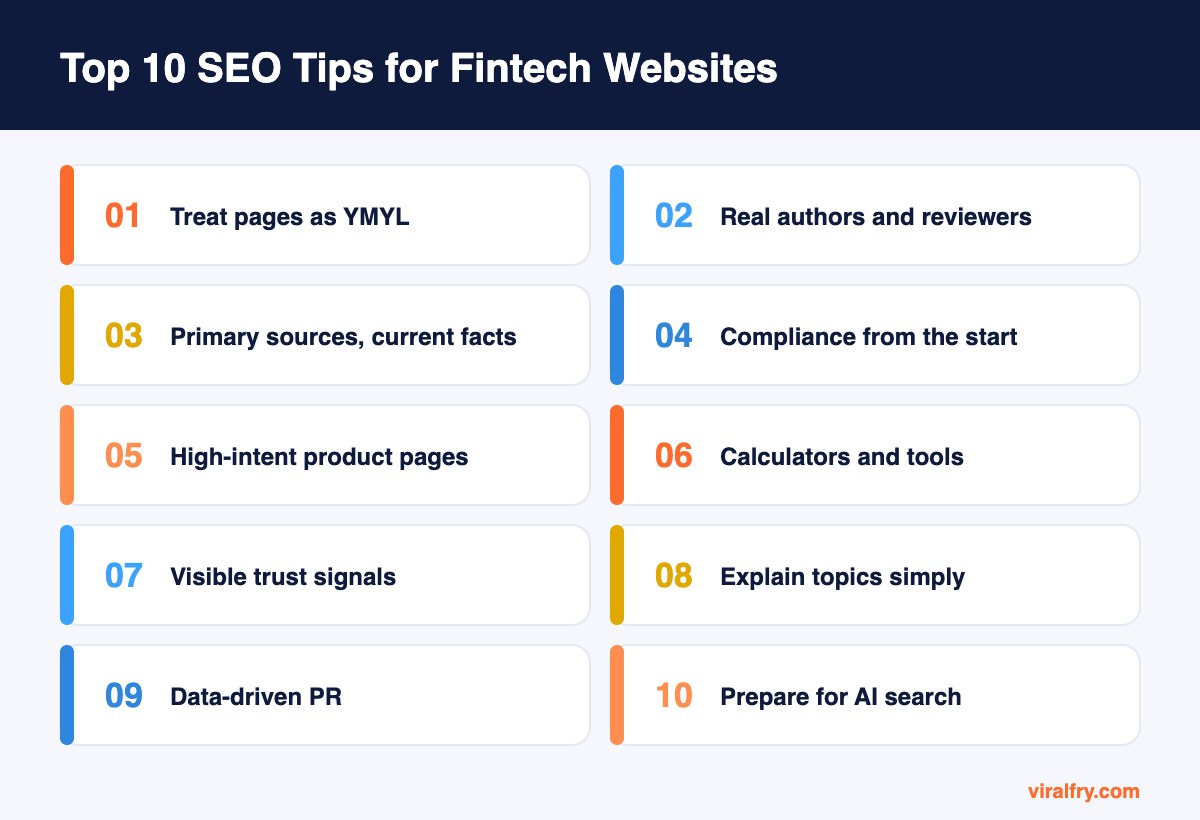
What Are the Best SEO Tips for Fintech Websites?
1. Treat every page as YMYL content
Google calls topics that can affect people’s money, health, or safety “Your Money or Your Life” (YMYL), and its quality raters hold them to higher standards. Almost everything a fintech publishes falls into this group.
That means accuracy, clear sourcing, and visible expertise are not optional extras. They are the price of entry for ranking at all.
2. Show real authors and expert reviewers
Add named authors with relevant credentials, and where possible a “reviewed by” line from a qualified expert, such as a CFA, CPA, or compliance professional. Link to author pages that explain their background.
Generic “Admin” bylines on financial content undermine trust with both readers and search engines.
3. Cite primary sources and keep facts current
Link to regulators, official rate pages, government statistics, and original research rather than other blogs. Show “last updated” dates and review rate-sensitive or regulation-sensitive pages on a schedule.
Outdated interest rates, fees, or limits can mislead users and damage rankings quickly.
4. Work with compliance from the start
Involve your compliance or legal team in the content process, not just at the final review. Agree on approved claims, required disclosures, and words to avoid.
A shared style guide speeds up approvals and prevents last-minute rewrites that delay publishing for weeks.
5. Target high-intent product and comparison searches
Fintech buyers search with clear intent: “best business bank account for startups,” “[product] vs [competitor],” “how to accept international payments.” Build honest product, use case, and comparison pages for these.
Our guide on SaaS SEO strategies explains how to structure comparison and alternatives pages.
6. Build calculators and tools
Loan calculators, fee estimators, currency converters, and savings tools attract consistent traffic and links. They also give users immediate value before they sign up.
Make sure the assumptions behind each tool are explained clearly on the page.
7. Make security and trust signals visible
Show licensing or regulatory status where relevant, security practices, data protection policies, and real contact information. Secure every page with HTTPS and keep the site fast.
Trust signals reassure cautious buyers and support the quality evaluation of YMYL pages.
8. Explain complex topics simply
Many fintech customers are not finance experts. Plain-language explainers of terms like APR, chargebacks, KYC, or interchange fees rank well and build trust.
Answer the core question in the first two sentences, then go deeper with examples and tables.
9. Earn authority through data and PR
Fintech journalists need numbers. Publish anonymized, aggregated insights from your platform, such as payment trends or small business cash flow patterns, and pitch them to financial media.
These earn high-authority links and mentions that are hard to get any other way.
10. Prepare for AI search in finance
AI assistants are cautious with financial topics and tend to rely on authoritative sources. Clear entity information, consistent product facts, reviews, and mentions in trusted publications improve your chances of being included.
See our guide to getting cited in AI answers.
Which Fintech Pages Should You Prioritize?
| Page type | Example | Why |
|---|---|---|
| Product pages | Business checking account | Direct conversions |
| Use case pages | Payments for marketplaces | High intent, specific audiences |
| Comparisons | [Your product] vs [competitor] | Buyers evaluating options |
| Calculators | Loan payment calculator | Traffic, links, and leads |
| Explainers | What is interchange? | Trust and top-of-funnel reach |
| Data reports | Small business payment trends | Links and press |
How Do You Balance SEO and Compliance?
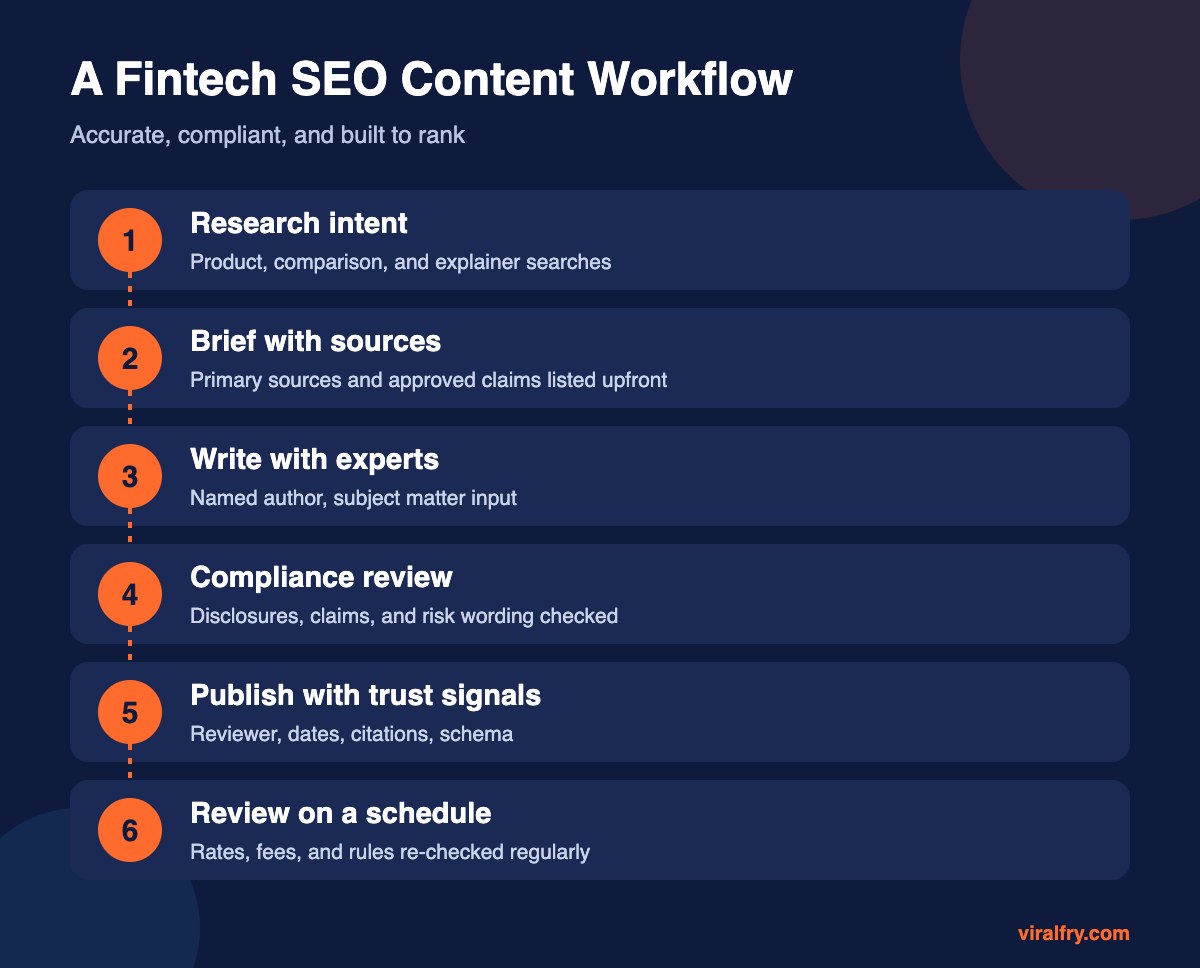
Make compliance part of the brief, not the last step. List approved claims, mandatory disclosures, and sources before writing begins. Use templates for recurring page types so reviewers check the same structure each time. Track approval times; if pages wait weeks, the process needs simplifying, not the SEO.
How Long Does Fintech SEO Take?
Fintech is competitive, so expect six to twelve months for meaningful rankings on core product keywords. Long-tail explainers and calculators can bring results sooner. Consistency, accuracy, and authority compound over time.
What Fintech SEO Mistakes Should You Avoid?
- Publishing financial advice without qualified authors or review
- Letting rates, fees, or regulations go out of date
- Copying competitor claims without verification
- Overpromising returns or approvals in headlines
- Hiding fees or terms, which erodes trust
What Does a Trustworthy Fintech Article Look Like?
Imagine an article titled “How Business Credit Cards Affect Your Startup’s Credit.” It opens with a two-sentence answer in plain English. Directly under the title, readers see the author’s name and role, a reviewer with a relevant financial qualification, and the date it was last reviewed.
Every statistic links to its source, whether a regulator, a credit bureau’s published guidance, or a government dataset. A clearly labeled box explains that the article is educational and not individual financial advice. Key terms like utilization and hard inquiries are defined the first time they appear.
A comparison table shows how different card features affect credit, and a short FAQ answers the questions founders actually ask. The page is fast, secure, and marked up with Article schema that lists the author and reviewer.
None of these elements is complicated. Together they send a consistent message to readers, search engines, and AI systems: this source can be trusted with money questions.
Should Fintech Companies Publish Content in Several Markets?
Only with local review. Rules, products, and terminology differ between countries, so a page written for US readers can be inaccurate or non-compliant elsewhere. Use hreflang for language and region versions, and have each market’s content checked by someone who knows local regulations.
Key Takeaways
- Fintech content is YMYL; accuracy and expertise come first.
- Use named experts, primary sources, and visible update dates.
- Build compliance into the content workflow.
- Target high-intent pages and build useful calculators.
- Earn authority with data-driven PR and trusted mentions.
Frequently Asked Questions
What is fintech SEO?
Fintech SEO is search engine optimization for financial technology companies, focused on ranking for product and financial topics while meeting high standards for accuracy, trust, and regulatory compliance.
Why is SEO harder for fintech websites?
Financial topics fall under Google’s Your Money or Your Life category, which requires stronger signals of expertise and trust, and keywords are often dominated by established banks and publishers.
Do fintech websites need expert reviewers?
It is strongly recommended. Named authors and qualified reviewers improve trust with readers and support the quality signals search engines look for on financial content.
What content works best for fintech SEO?
Product and use case pages, honest comparisons, calculators, plain-language explainers, and original data reports tend to perform best.
Add as Preferred Source