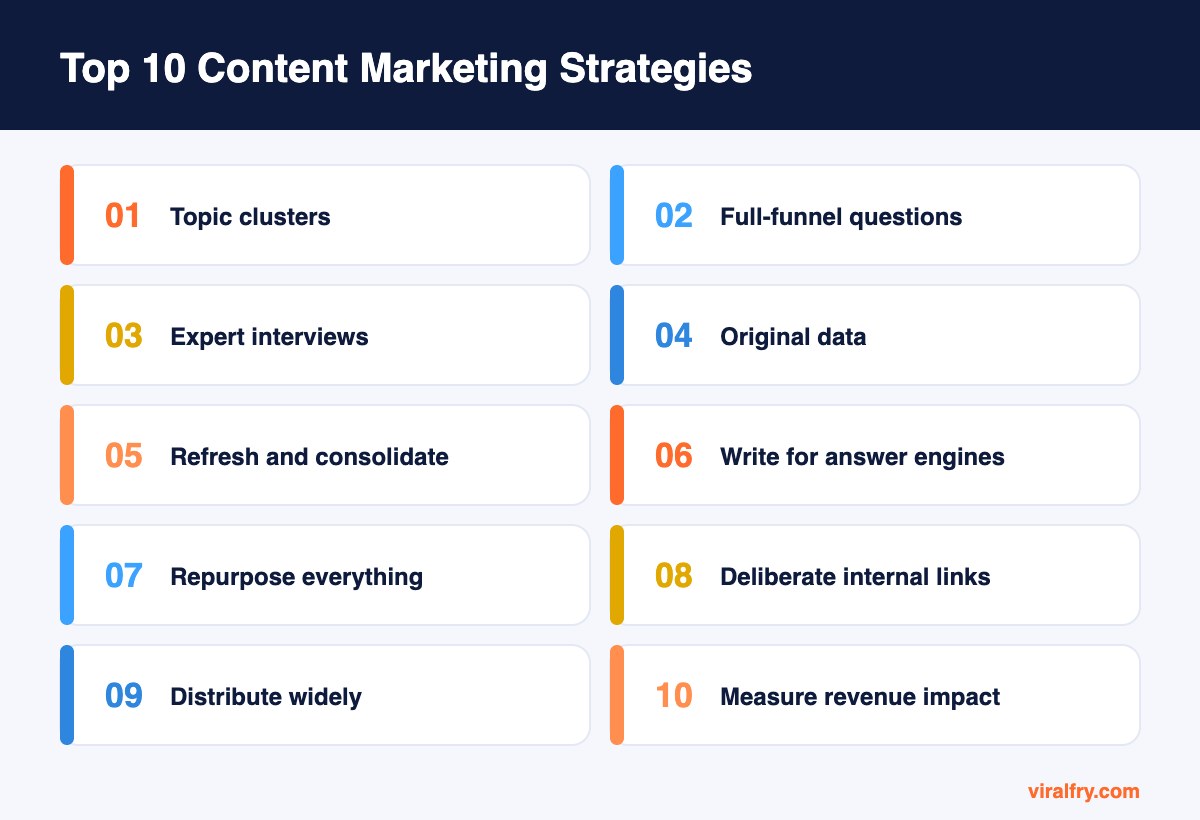
The content marketing strategies that grow organic traffic most reliably are building topic clusters, targeting questions across the whole funnel, interviewing your own experts, publishing original data, refreshing and consolidating existing content, writing for answer engines, repurposing major pieces, building internal links deliberately, distributing content widely, and measuring which content drives revenue. Together they build authority that search engines and AI assistants both reward.
Publishing more is rarely the answer. The sites growing fastest right now publish fewer, better pieces, update them often, and make sure each one earns attention beyond Google. Here is what that looks like in practice.
What Content Marketing Strategies Boost Organic Traffic?
1. Build topic clusters around your core services
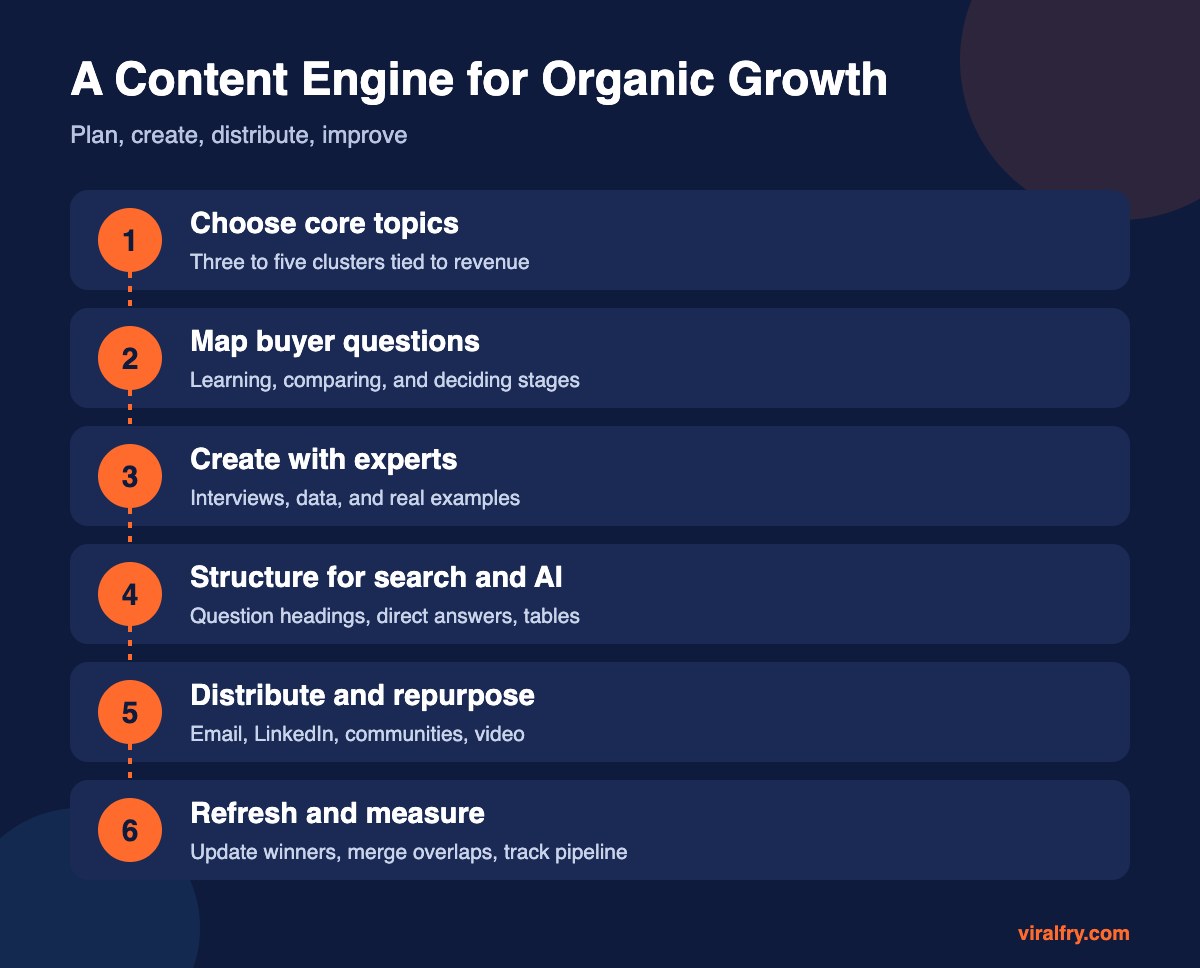
Pick the three to five topics that matter most to your business and build a cluster for each: one comprehensive pillar page and supporting articles that answer specific questions, all linked together.
Clusters help search engines see depth and authority, and they give readers an obvious path from learning to buying.
2. Target questions across the whole funnel
Do not only write top-of-funnel explainers. Mix “what is” content with comparisons, alternatives, pricing guides, and case studies that serve buyers close to a decision.
In our experience, bottom-of-funnel pages often bring fewer visits but far more leads.
3. Interview your own experts
A 20-minute conversation with your head of product, an engineer, or a senior consultant produces insights competitors cannot copy. Turn those interviews into articles, quotes, and examples.
This is the fastest way to add real experience to content, which both Google and AI answers increasingly reward.
4. Publish original data
Survey customers, analyze anonymized platform data, or run small experiments, then publish the findings. Data-led content earns links, press coverage, and AI citations.
Even a modest dataset with one surprising finding can outperform dozens of generic posts.
5. Refresh and consolidate existing content
Updating a post that already ranks is often faster than writing a new one. Refresh statistics, add missing sections, improve the opening answer, and merge overlapping posts.
Run a yearly content audit to find the best opportunities.
6. Write for answer engines
Use question-based headings, put a direct 40 to 60 word answer under each, and add tables and FAQs. That structure helps featured snippets, voice search, and AI Overviews.
Our guide to AEO tips for featured snippets covers the details.
7. Repurpose every major piece
Turn one strong article into a LinkedIn carousel, a short video, an email, and a few social posts. Each format reaches a different audience and can link back to the original.
Repurposing multiplies the return on research you have already done.
8. Build internal links deliberately
Every new article should link to related content and to a relevant service or product page. Older articles should link to new ones.
Internal links spread authority and guide readers, and they are one of the most underused traffic levers.
9. Distribute before and after publishing
Organic traffic grows faster when content earns early attention. Share it with your email list, post it on LinkedIn, contribute it to relevant communities, and send it to people you quoted.
Distribution often brings the first links and mentions that help a new page rank.
10. Measure what content drives revenue
Track organic sessions, but also assisted conversions, demo requests, and pipeline influenced by content in GA4 and your CRM.
Double down on the topics and formats that produce customers, not just clicks.
Which Content Types Drive the Most Organic Traffic?
| Content type | Traffic potential | Lead potential |
|---|---|---|
| How-to guides and tutorials | High | Medium |
| Comparison and alternatives pages | Medium | High |
| Original research and data | Medium, plus links | Medium |
| Templates, tools, and checklists | High | High |
| Case studies | Low | High |
| Glossary and definitions | High | Low |
A healthy mix includes high-traffic educational content that earns links and lower-traffic, high-intent pages that convert.
How Often Should You Publish?
Consistency matters more than volume. For most small and mid-sized businesses, two to four high-quality pieces a month, plus regular updates to existing content, outperforms daily low-effort posts. Plan a realistic calendar you can keep for a full year.
How Does Content Marketing Work With AI Search?
AI Overviews and assistants answer common questions directly, which reduces clicks for generic content. Content that still wins offers something an AI summary cannot: original data, first-hand experience, tools, and clear expert opinion. The same qualities make you more likely to be cited. See our GEO strategies guide for more.
What Does a 90-Day Content Plan Look Like?
Month one: audit existing content, choose two priority topic clusters, and interview two internal experts. Refresh your five best-performing posts with new data and clearer opening answers. Month two: publish one pillar page and three supporting articles for the first cluster, each with internal links, and repurpose the pillar into a LinkedIn carousel and email. Month three: publish one original data piece and pitch it to industry media, start the second cluster, and review results in Search Console and GA4. By the end of the quarter you will know which topics and formats deserve more investment.
Should You Hire Help With Content Marketing?
If you lack time, writers who understand your industry, or SEO expertise, outside help can speed things up. Read our guides on content marketing services and choosing a content marketing agency.
What Content Marketing Mistakes Hold Back Organic Growth?
The most common one is writing about what the company wants to say rather than what customers search for. Announcements, award posts, and vague thought leadership rarely rank. Start from real questions instead.
The second is spreading effort across too many topics. Twenty unrelated posts build less authority than eight tightly connected ones. Pick a lane, go deep, then expand.
The third is publishing and forgetting. Without distribution, a new post may sit unnoticed for months. Without updates, last year’s winners slowly slide down the results.
Finally, many teams outsource writing without giving writers access to experts or customers. The result is competent but generic content that looks like everything else on page one. Give writers interviews, data, and real examples, and the quality difference shows up in rankings.
Key Takeaways
- Build topic clusters around the subjects that drive revenue.
- Use expert interviews and original data to stand out.
- Refresh and consolidate before creating more.
- Structure content for search, answer engines, and AI.
- Distribute every piece and measure pipeline, not just traffic.
Frequently Asked Questions
What is the best content marketing strategy for SEO?
Building topic clusters around your core services, with expert-led content that answers real buyer questions, is one of the most reliable strategies for long-term organic growth.
How long does content marketing take to increase organic traffic?
Most programs see early gains in two to three months and stronger results in six to twelve months, depending on competition and consistency.
Is updating old content better than writing new content?
Often, yes. Refreshing posts that already rank can produce faster gains than new articles, especially when the updates add missing information and clearer answers.
How do I measure content marketing success?
Track organic traffic, rankings, and engagement, but also conversions, assisted conversions, and pipeline influenced by content.
Add as Preferred Source