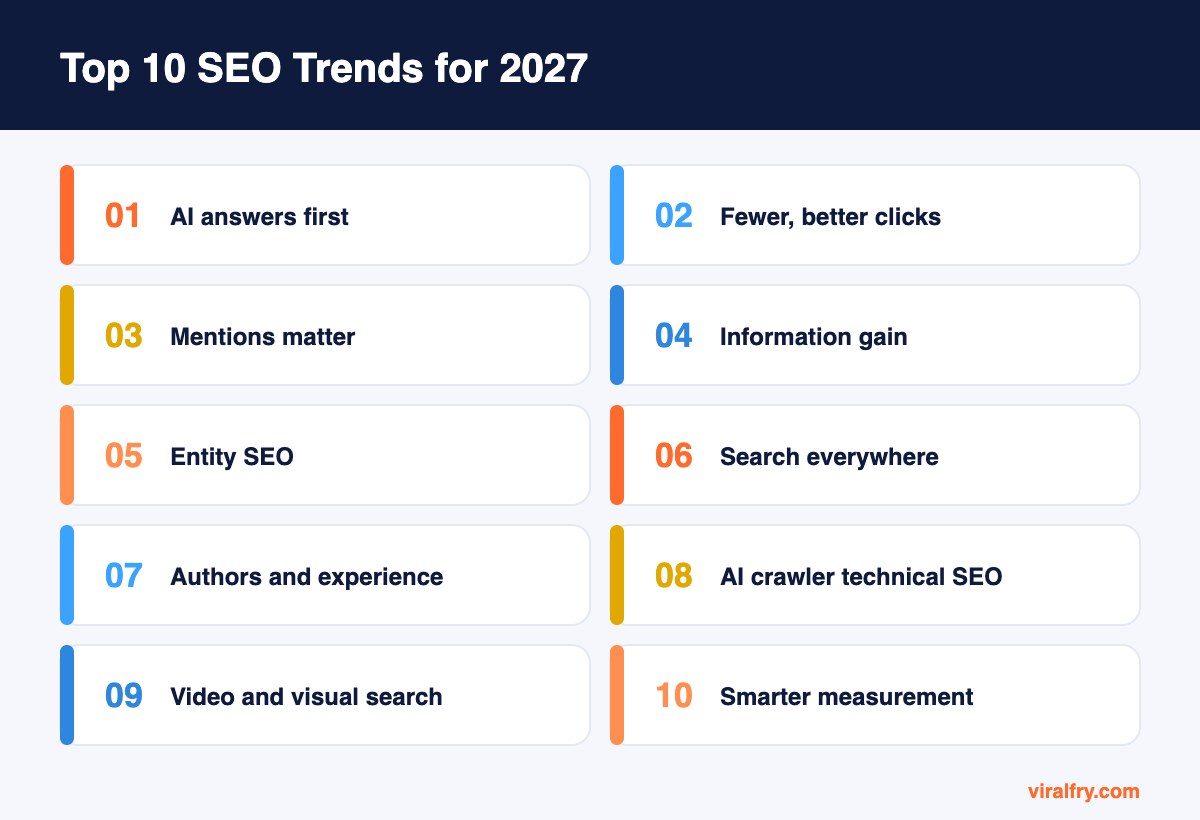
The biggest SEO trends to watch in 2027 are AI answers becoming the first touchpoint, fewer but more qualified clicks, brand mentions rivaling links, information gain as a differentiator, mainstream entity SEO, search everywhere optimization, a stronger focus on authors and first-hand experience, technical SEO for AI crawlers, growth in video and visual search, and new ways to measure visibility. All of them build on developments already visible in 2025 and 2026.
Trend lists often predict dramatic changes that never happen. This one sticks to shifts we can already see in client data and in how search products are evolving. None of them make SEO obsolete. They change what good SEO looks like.
What Are the Top SEO Trends for 2027?
1. AI answers become the default first touch
Google’s AI Overviews and AI Mode, ChatGPT search, Perplexity, Gemini, and Copilot now answer many questions before anyone clicks. Expect this to expand further into commercial and local queries.
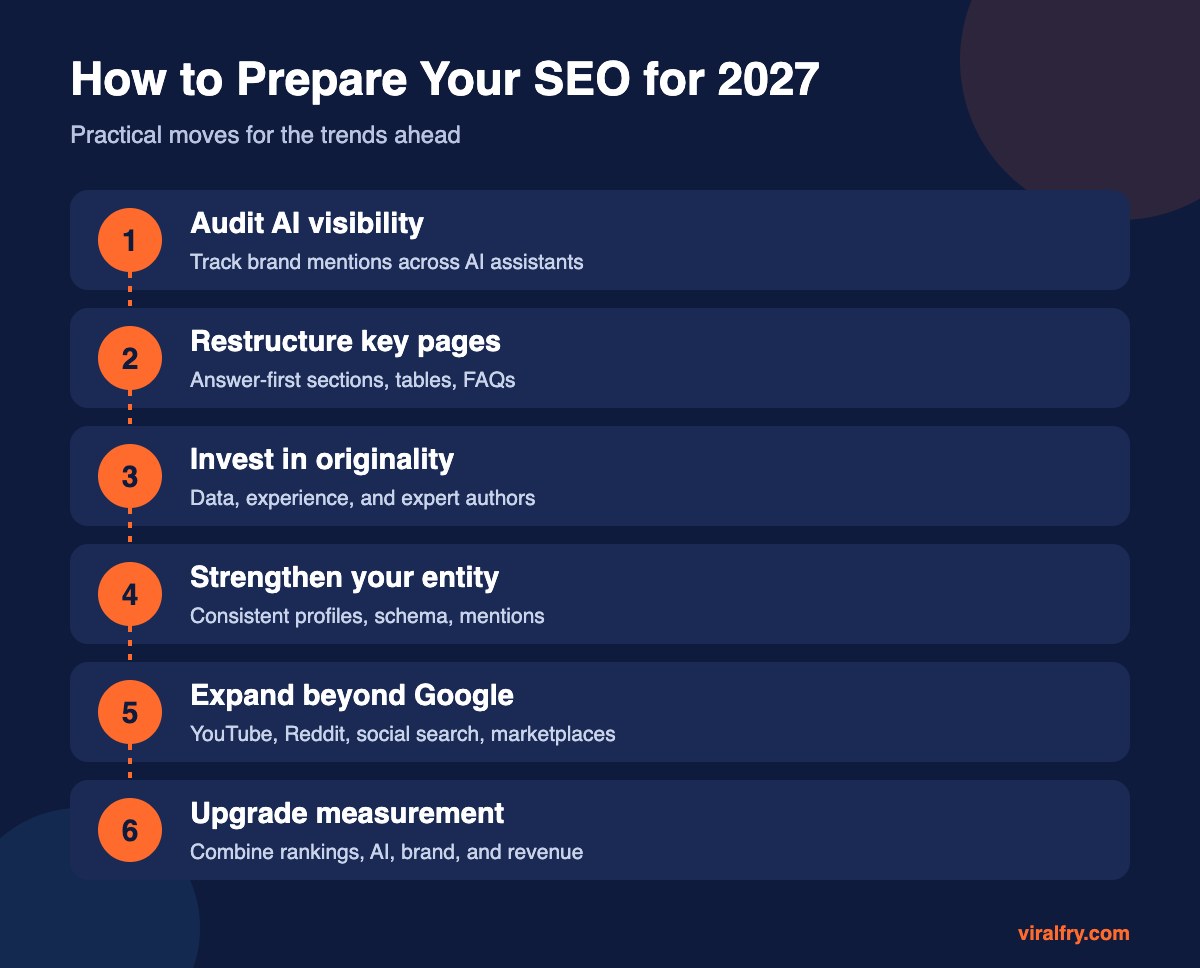
What to do: structure content with direct answers, track AI visibility alongside rankings, and focus on queries where users still need depth or a provider.
2. Fewer clicks, more qualified visitors
As AI and search features answer simple questions, informational clicks keep falling for many sites. The visitors who do click tend to be further along and more likely to convert.
What to do: measure success by conversions and pipeline, not only sessions, and build pages that serve decision-stage intent.
3. Brand mentions matter as much as links
AI systems describe brands based on what the wider web says about them. Mentions in trusted publications, reviews, and community discussions shape whether and how you appear.
What to do: invest in digital PR, review generation, and genuine community participation, not just link counts.
4. Information gain separates winners from the rest
With so much generic AI-written content online, pages that add something new, such as original data, tested methods, and expert opinion, stand out to both search engines and AI models.
What to do: make “what do we add that nobody else does?” a required question in every content brief.
5. Entity SEO goes mainstream
Search engines and AI models increasingly think in entities: brands, people, products, and their relationships. Clear, consistent entity data helps you get recognized and recommended.
What to do: align your About page, schema, profiles, and author pages. See how knowledge panels work.
6. Search everywhere optimization
People search on TikTok, YouTube, Reddit, Amazon, Instagram, and AI assistants, not only Google. Instagram posts from professional accounts can now appear in Google results too.
What to do: build a presence where your audience searches, and repurpose core content into video and social formats. Our Instagram search guide is a starting point.
7. Authors and first-hand experience in focus
Google’s quality guidelines emphasize experience, expertise, authoritativeness, and trust. Named authors with real backgrounds and visible first-hand testing carry more weight than anonymous content.
What to do: build author pages, show your work, and let practitioners write or review content.
8. Technical SEO extends to AI crawlers
Robots.txt now involves decisions about AI crawlers, and server-side rendering matters more because many AI fetchers do not run JavaScript fully.
What to do: review crawler access deliberately and keep core content in the HTML. See HTML best practices for GEO.
9. Video and visual search keep growing
Video results, short-form clips, and visual search through Google Lens are taking more space in results, especially for how-to and product queries.
What to do: create short videos for key topics, add transcripts, and optimize product images with descriptive file names and alt text.
10. Measurement gets harder, and smarter
Zero-click answers and AI referrals make traditional traffic reporting incomplete. Teams are adding AI visibility tracking, branded search trends, and self-reported attribution (“How did you hear about us?”).
What to do: build a scorecard that combines rankings, AI mentions, branded demand, and revenue.
Which SEO Fundamentals Will Not Change?
| Fundamental | Why it lasts |
|---|---|
| Crawlable, indexable pages | Every search and AI system needs access first |
| Matching search intent | Relevance is the core of any ranking system |
| Helpful, accurate content | Both people and AI reward it |
| Authority and trust | Links, mentions, and reputation still signal quality |
| Fast, usable pages | Good experiences keep users and support rankings |
Is SEO Dying Because of AI?
No. SEO is changing shape. AI tools still rely on search indexes and on well-structured, trustworthy web content, so the work of making content findable and credible matters more than ever. What declines is the value of generic, easily summarized content. We explored this in more depth in is SEO dead.
How Should Teams Change Their SEO Strategy?
Shift budget from volume content to fewer, deeper pieces with original insight. Add AI visibility to your reporting. Invest in digital PR and community presence to build mentions. Make sure your technical setup serves both search engines and AI crawlers. And align SEO with brand, product marketing, and sales, because AI answers reflect your whole reputation, not just your website. Our SEO vs GEO decision guide helps with prioritization.
What Should You Stop Doing in 2027?
- Publishing high volumes of generic AI content
- Measuring success only by organic sessions
- Chasing link counts instead of relevance and mentions
- Ignoring platforms beyond Google
- Treating SEO as a separate channel from brand
What Skills Will SEO Teams Need in 2027?
The core skills stay the same: understanding search intent, technical troubleshooting, content strategy, and analytics. What grows in importance is the ability to work across channels. SEOs increasingly collaborate with PR teams on mentions, with product marketers on positioning and comparisons, and with video teams on YouTube and short-form content.
Data skills matter more too. As zero-click answers grow, teams need to combine Search Console, GA4, CRM data, and AI visibility tracking into one honest picture of performance.
Finally, editorial judgment becomes a competitive advantage. AI can draft quickly, but deciding what is worth publishing, what adds genuinely new information, and what will earn trust is still a human job. Teams that invest in that judgment will outperform teams that only invest in output.
Key Takeaways
- AI answers are now a major first touchpoint in search.
- Expect fewer clicks but more qualified visitors.
- Mentions, entities, and original information drive visibility.
- Optimize for search across platforms, not only Google.
- Update measurement to include AI visibility and brand demand.
Frequently Asked Questions
What is the biggest SEO trend for 2027?
The continued growth of AI-generated answers across Google, ChatGPT, Perplexity, and other assistants, which changes how people discover brands and how visibility is measured.
Will AI replace SEO?
No. AI search tools rely on indexed, trustworthy web content, so SEO remains essential. Its focus shifts toward clarity, originality, authority, and visibility in AI answers.
What is search everywhere optimization?
It is the practice of optimizing for discovery across many platforms where people search, including YouTube, TikTok, Reddit, Instagram, marketplaces, and AI assistants, not only Google.
How should I measure SEO in 2027?
Combine rankings and organic conversions with AI visibility tracking, AI referral traffic, branded search trends, and self-reported attribution from customers.
Add as Preferred Source