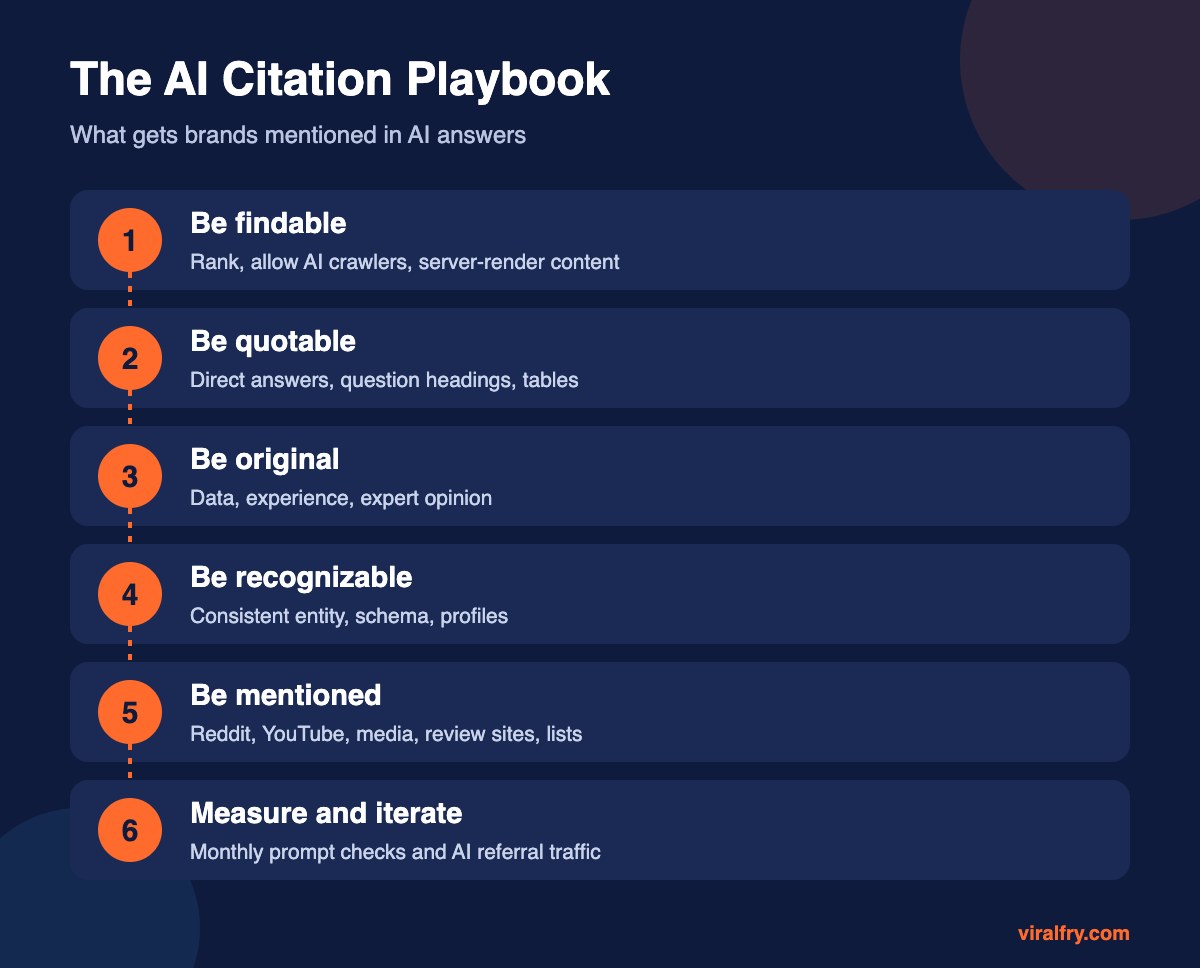
To get your brand cited in ChatGPT, Perplexity, and Google AI Overviews, rank well in regular search, answer questions directly in the first two sentences of each section, publish original data and first-hand experience, build a consistent brand entity, earn mentions on trusted sites like Reddit, YouTube, and industry media, and appear on credible comparison lists. Then let AI crawlers access your content, keep it fresh, and track your visibility monthly.
AI answers are becoming the first stop for research, especially in B2B. When a buyer asks an assistant to recommend tools or agencies, the brands named in that answer get a head start most marketing budgets cannot buy. Nobody outside these companies knows the exact selection logic, but the patterns below show up again and again in what gets cited.
How Do AI Search Engines Choose Which Sources to Cite?
Most AI search products follow a similar process: they interpret the question, retrieve relevant pages from a search index, pick the passages that best answer it, and write a summary with links. That means two things matter: being retrieved (an SEO problem) and being selected (a clarity and trust problem). The ten tactics below address both.
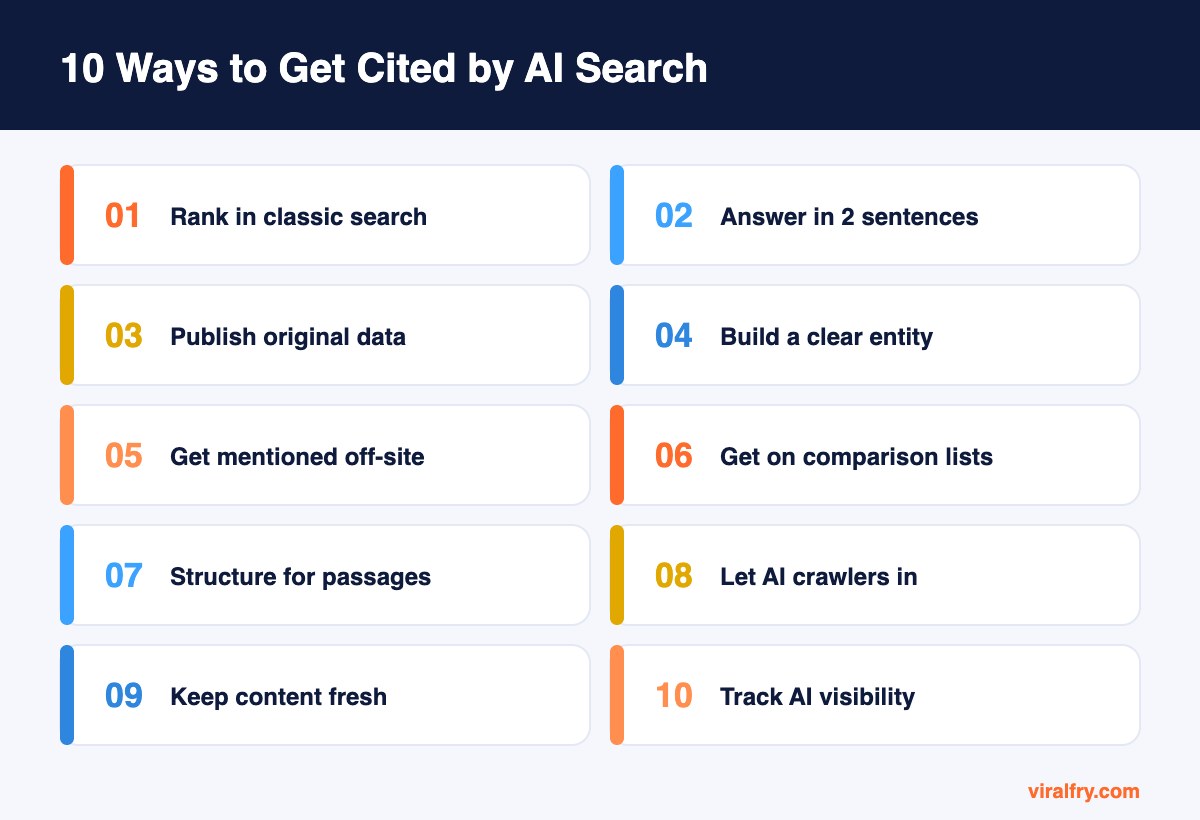
What Are the Best Ways to Get Cited by AI?
1. Rank well in traditional search first
AI answers that search the web lean heavily on pages that already rank. Google’s AI Overviews draw from its search index, and ChatGPT search and Perplexity both retrieve live results before writing an answer. If you are not on page one for a topic, your odds of being cited are low.
So the first GEO move is classic SEO: crawlable pages, solid technical health, relevant links, and content that matches intent.
2. Answer the question in the first two sentences
AI systems extract passages. A paragraph that answers the question directly, in 40 to 60 words, is far easier to quote than an answer buried after a long introduction.
Put that answer right below a heading that mirrors the question. Then add depth, examples, and caveats underneath.
3. Publish original data and first-hand experience
AI tools summarize common knowledge on their own. What they need sources for is new information: survey results, benchmarks from your own customers, test results, pricing comparisons, and expert opinions.
A single well-designed study can earn citations for years, both from journalists and from AI answers that reference it.
4. Build a clear, consistent brand entity
AI models need to know who you are. Use the same brand name, description, logo, and founder details across your website, LinkedIn, Crunchbase, directories, and review sites.
Add Organization schema with sameAs links to official profiles. If you qualify, work toward a Google knowledge panel.
5. Get mentioned on the sites AI tools trust
Studies of AI citations consistently show sources like Reddit, YouTube, Wikipedia, major publications, and review platforms appearing often. Brands that are discussed in those places get mentioned more in AI answers.
Contribute genuinely to relevant subreddits, publish helpful YouTube videos, and pursue digital PR in industry media. Mentions matter even without a link.
6. Earn a place on “best of” and comparison lists
When someone asks ChatGPT “what are the best CRM tools for startups,” the answer often mirrors existing listicles and comparison pages. If your brand appears on credible lists, it is more likely to appear in the answer.
Reach out to the authors of lists in your category, offer accurate information, and make it easy for reviewers to test your product.
7. Structure pages so passages stand alone
Use question-style H2s, short paragraphs, numbered steps, and real HTML tables. Each section should make sense if it is lifted out of the page on its own.
Our guide to structuring HTML for AI Overviews shows the exact pattern.
8. Let AI crawlers in
Check robots.txt. Allow search-focused crawlers such as OAI-SearchBot and PerplexityBot if you want to appear in those tools, and make sure Googlebot can reach everything important.
You can still block training-only crawlers if you prefer. Also make sure key content is in the server-rendered HTML; many AI fetchers do not run JavaScript fully.
9. Keep content fresh and dated
AI answers favor current information for anything that changes, such as prices, tools, laws, and statistics. Update important pages regularly, show a visible “last updated” date, and keep dateModified in your schema accurate.
Do not fake freshness by changing dates without real edits.
10. Track your AI visibility every month
Make a list of 20 to 30 questions your buyers ask. Each month, ask them in ChatGPT, Perplexity, Gemini, and Google, and log whether your brand is mentioned or cited.
Pair that with AI referral traffic in GA4 and branded search trends. Dedicated AI visibility tools can automate this as your program grows.
How Do ChatGPT, Perplexity, and AI Overviews Differ?
| Platform | Where sources come from | What helps most |
|---|---|---|
| Google AI Overviews and AI Mode | Google’s search index | Strong rankings, clear answers, trust signals |
| ChatGPT search | Web search results retrieved at question time, plus model knowledge | Being indexed, allowing OAI-SearchBot, brand mentions |
| Perplexity | Live web retrieval with visible citations | Fresh, well-structured pages, allowing PerplexityBot |
What Should You Avoid When Chasing AI Citations?
- Mass-producing thin AI pages; they rarely get cited and can hurt your site
- Hiding key facts in images or behind JavaScript
- Inconsistent brand details across profiles
- Spammy Reddit self-promotion, which communities quickly remove
- Blocking search crawlers by accident in robots.txt
For the strategy behind all of this, read our complete guide to GEO and SEO vs GEO.
What Does a 30-Day AI Citation Plan Look Like?
- Week 1: List 25 buyer questions. Check each in ChatGPT, Perplexity, Gemini, and Google. Note who gets cited and why.
- Week 2: Pick your five most important pages. Add a direct answer under every heading, convert comparisons into tables, and update facts and dates.
- Week 3: Fix entity basics: Organization schema, consistent profiles, an accurate About page, and author bios with credentials. Check robots.txt for AI crawlers.
- Week 4: Start off-site work: answer two relevant Reddit threads helpfully, pitch one data point to an industry publication, and contact one comparison list author.
Repeat the Week 1 checks at the end of the month and compare. Small, consistent improvements beat one big push.
Key Takeaways
- AI citations start with strong traditional rankings.
- Answer-first, well-structured passages are easiest to quote.
- Original data and expertise give AI a reason to cite you.
- Consistent entity information and off-site mentions build trust.
- Track AI visibility monthly and keep key pages fresh.
Frequently Asked Questions
How do I get my website cited by ChatGPT?
Make sure your pages are indexed and rank well, allow OAI-SearchBot in robots.txt, answer questions directly with clear structure, publish original information, and earn mentions on trusted third-party sites.
Can I pay to be included in AI Overviews?
No. You cannot pay for organic citations in Google AI Overviews. Google may show ads in or near AI features, but citations come from organic sources.
How long does it take to get cited in AI answers?
Pages that already rank can start appearing within weeks of restructuring. Building brand mentions and authority usually takes several months.
How can I check if my brand appears in AI answers?
Ask AI tools the questions your buyers ask and log the results monthly, track AI referral traffic in GA4, and consider AI visibility tracking tools as your program grows.
Add as Preferred Source