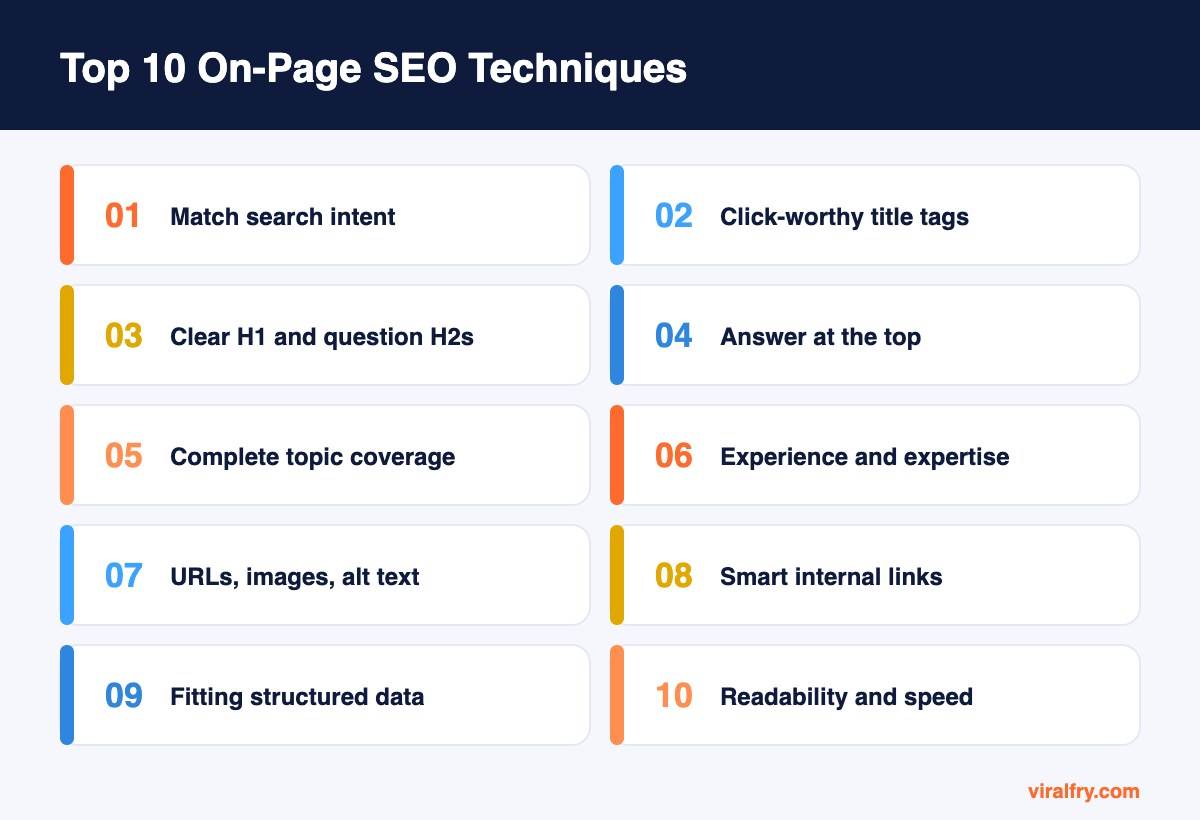
The most effective on-page SEO techniques are matching search intent, writing click-worthy title tags, using one clear H1 with question-based subheadings, answering the main question at the top, covering the topic completely, showing real experience, optimizing URLs and images, building internal links, adding fitting structured data, and keeping pages readable and fast. These are fully in your control and often move rankings within weeks.
Off-page factors like links take months to build. On-page work can be done this afternoon. That is why we always start client projects by improving the pages that already get impressions but sit just below the top results.
What Are the Best On-Page SEO Techniques?
1. Match the search intent exactly
On-page SEO starts before you write. Search the target keyword and study what ranks: the format (guide, list, product page, tool), the depth, and the angle. Your page needs to fit that pattern before any other technique matters.
If the top results all answer a quick question, a long essay will struggle. If they are detailed comparisons, a short post will too.
2. Write a title tag that earns the click
Put the main keyword near the start, keep it to roughly 50 to 60 characters, and add a reason to click: a year, a number, or a clear benefit. “SEO Audit Checklist: 25 Checks to Find Ranking Problems” beats “SEO Audit.”
Remember Google may rewrite titles that do not reflect the page, so keep them honest and specific.
3. Use one clear H1 and question-based subheadings
Your H1 should state the topic plainly. Your H2s should mirror the questions searchers ask, which helps both readers who skim and search engines matching sections to queries.
This structure also helps featured snippets and AI answers, as explained in our guide to heading structure for AEO.
4. Answer the main question at the top
Give the core answer in the first two or three sentences, then expand. Readers who just need the answer get it immediately, and readers who want depth keep scrolling.
This is also the passage most likely to be quoted in a snippet or AI Overview.
5. Cover the topic completely, not repetitively
Look at the subtopics the top pages cover and the questions in People Also Ask. Make sure you answer them, and add at least one angle the others miss.
Covering a topic well is different from repeating the keyword. Use natural language and related terms, not keyword stuffing.
6. Show experience and expertise
Add what only you can: real screenshots, results from your own work, original examples, and the name and credentials of the author. Cite primary sources for facts.
These signals help Google trust your page and help AI systems decide which source to rely on.
7. Optimize URLs, images, and alt text
Keep URLs short and descriptive (/seo-audit-checklist/). Compress images, give them descriptive file names, and write alt text that describes what the image shows.
Use modern formats like WebP and set width and height to avoid layout shift.
8. Build smart internal links
Link to the page from your strongest related pages with descriptive anchor text, and link out from it to supporting content. Internal links help search engines understand topic relationships and importance.
Every new page should receive at least three relevant internal links.
9. Add structured data that fits the page
Use Article, Product, FAQ, HowTo, Organization, or LocalBusiness schema when it accurately describes the content. Validate it with the Rich Results Test.
Schema does not guarantee rich results, but it makes your content easier for machines to understand.
10. Improve readability and page experience
Short paragraphs, clear subheadings, bullet points, tables for comparisons, and fast loading keep people reading. Remove intrusive pop-ups on mobile.
Engaged readers are a good sign that you matched intent, and fast pages make every other technique more effective.
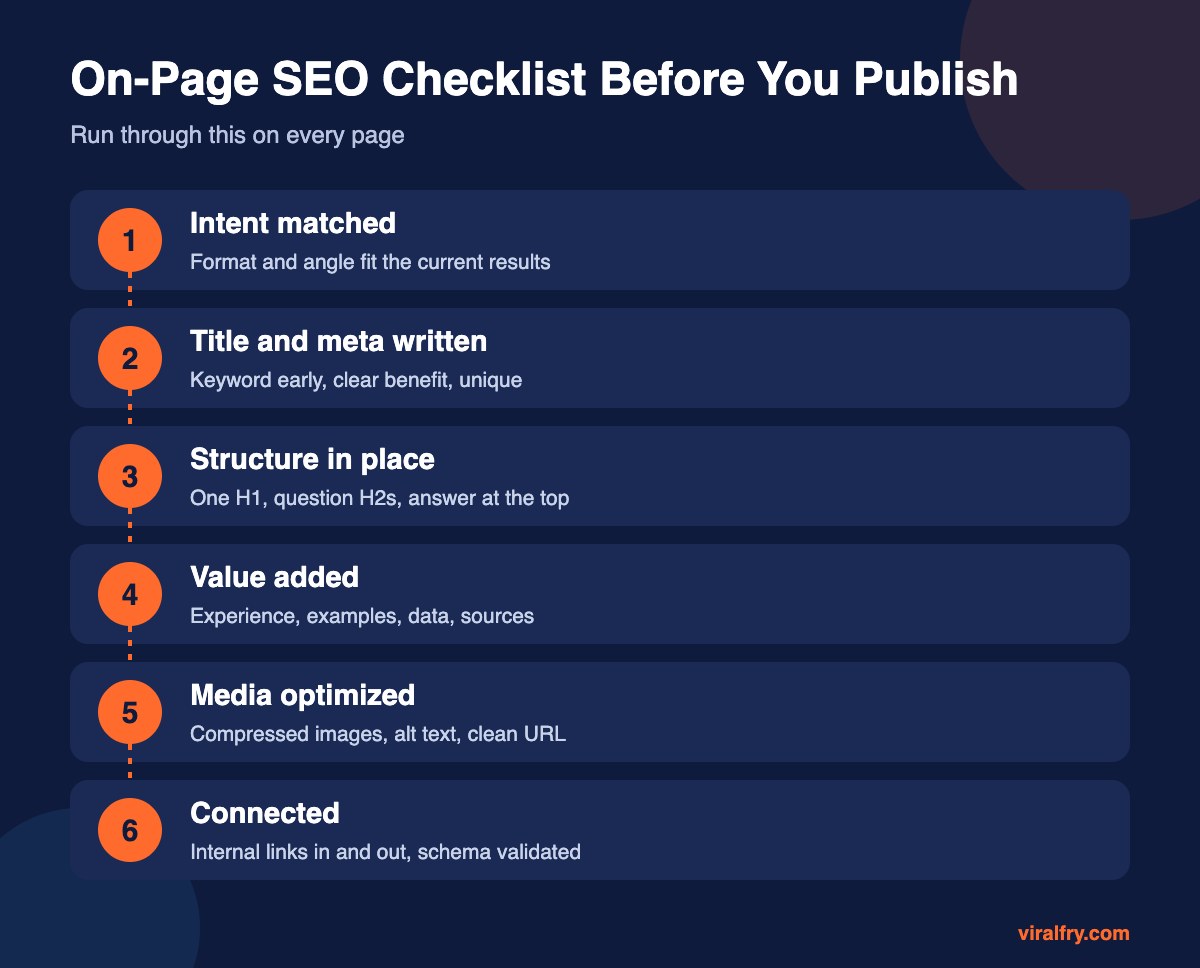
Which On-Page Element Matters Most?
No single element wins on its own, but the title tag and the main content carry the most weight. A strong title helps Google understand the topic and earns clicks, and great content keeps people satisfied. Our breakdown of which on-page element carries the most weight explores this in detail.
How Do You Apply On-Page SEO to Existing Pages?
- Open Search Console and find pages with high impressions and an average position between 4 and 20.
- For each, compare your page with the current top three results.
- Fix intent gaps first, then rewrite the title and opening paragraph.
- Add missing subtopics, a comparison table, or an FAQ section.
- Add internal links from three relevant, strong pages.
- Request indexing and review results after three to four weeks.
Does On-Page SEO Help With AI Search?
Yes. The same habits that help pages rank, especially question-based headings, answer-first paragraphs, tables, and clear authorship, make content easier for AI Overviews and assistants to quote. See how to structure HTML for AI Overviews.
Which On-Page SEO Mistakes Should You Avoid?
- Stuffing the keyword into every sentence
- Writing several pages for the same intent
- Leaving default or duplicate titles
- Hiding key content behind tabs or images
- Ignoring mobile layout and speed
What Does an On-Page SEO Rewrite Look Like?
Take a page titled “Our Services” that ranks in position 14 for “bookkeeping services for startups.” The H1 says “Welcome,” the first paragraph talks about the company history, and pricing is hidden on a separate page.
The rewrite changes the title to “Bookkeeping Services for Startups | Monthly Plans From Day One,” the H1 to “Bookkeeping Services for Startups,” and opens with two sentences explaining exactly what is included and who it is for. It adds H2s for the questions founders ask: what does it cost, how does onboarding work, and what software do you use. It adds a comparison table of plans, two short client examples, and an FAQ.
Internal links from the blog posts about startup finance now point to this page with descriptive anchors. Nothing about the domain changed, yet pages rewritten this way regularly climb several positions within a month or two because they finally answer what searchers came for.
Key Takeaways
- Intent match comes before every other technique.
- Titles, headings, and the opening answer do the heavy lifting.
- Add experience and original value, not more keywords.
- Connect pages with internal links and validate schema.
- Start with pages already ranking in positions 4 to 20.
Frequently Asked Questions
What is on-page SEO?
On-page SEO is the practice of optimizing the content and HTML of individual pages, including titles, headings, text, images, internal links, and structured data, so they rank higher and earn more relevant traffic.
What is the difference between on-page and off-page SEO?
On-page SEO covers everything on your own pages. Off-page SEO covers signals from elsewhere, such as backlinks, brand mentions, and reviews.
How long does on-page SEO take to work?
Improvements to pages that already rank can show results within a few weeks of recrawling. New pages usually take longer.
How many times should I use my keyword on a page?
There is no ideal count. Use the main keyword in the title, H1, and opening, then write naturally with related terms and variations.
Add as Preferred Source