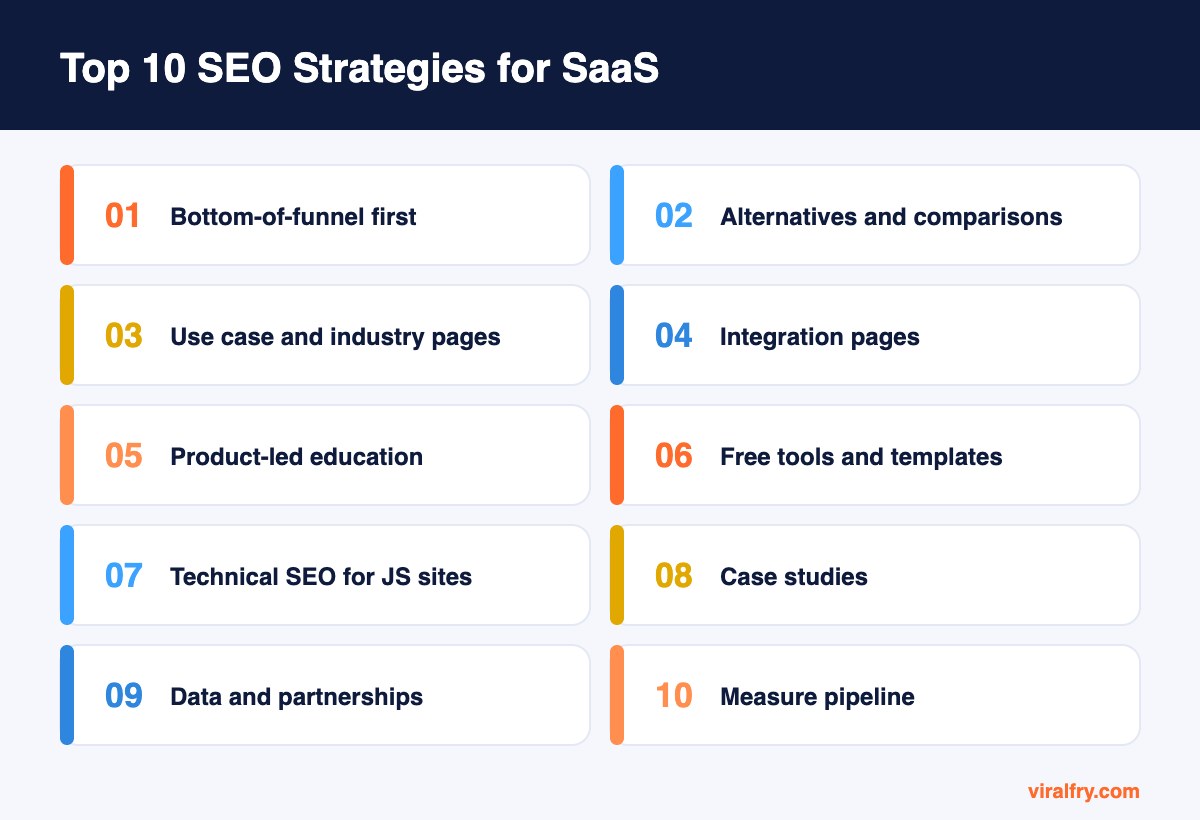
The most effective SEO strategies for SaaS companies are targeting bottom-of-funnel keywords first, building competitor alternative and comparison pages, creating use case and industry pages, scaling integration pages, publishing product-led tutorials, offering free tools and templates, fixing technical SEO on JavaScript-heavy sites, turning customer stories into case studies, earning links through data and partnerships, and measuring SEO by pipeline.
SaaS SEO is different from SEO for a blog or an online store. Sales cycles are longer, buyers compare many tools, and the goal is trials, demos, and revenue, not page views. That changes which pages you build first. If you are looking for outside help, our guide to the best SEO agencies for B2B SaaS is a good starting point.
What Are the Best SEO Strategies for SaaS Companies?
1. Start with bottom-of-funnel keywords
Most SaaS teams start with broad educational content because it brings traffic. We usually start at the other end: “[category] software for [use case],” “[competitor] alternatives,” “[tool] pricing,” and “best [category] tools.” These pages bring fewer visitors but convert at far higher rates.
Once they are in place, top-of-funnel content has somewhere to send readers.
2. Build competitor alternative and comparison pages
Buyers search “[competitor] alternatives” and “[your tool] vs [competitor]” when they are actively evaluating. Create honest, detailed comparison pages with feature tables, pricing differences, and who each tool suits best.
Fair comparisons build trust. Pages that trash competitors usually backfire with savvy B2B buyers.
3. Create use case and industry pages
Map your product to specific jobs and industries: “project management for agencies,” “CRM for real estate teams.” Each page should show workflows, screenshots, and examples relevant to that audience.
These pages capture long-tail, high-intent searches and help sales teams too.
4. Use integration pages programmatically
If your product integrates with other tools, build a page for each integration with setup steps, use cases, and screenshots. People search for “[tool A] [tool B] integration” constantly.
See our programmatic SEO examples for how companies like Zapier do this at scale.
5. Publish product-led educational content
Write tutorials that solve real problems and naturally show your product as part of the solution. A guide on “how to build a sales pipeline report” can demonstrate the workflow inside your tool.
This approach teaches and converts at the same time, without feeling like an ad.
6. Build free tools and templates
Calculators, generators, graders, and templates attract both traffic and links. They are especially effective in SaaS because they give users a taste of your product’s value.
Gate the advanced version behind a free trial or signup to turn tool users into leads.
7. Fix technical SEO for JavaScript-heavy sites
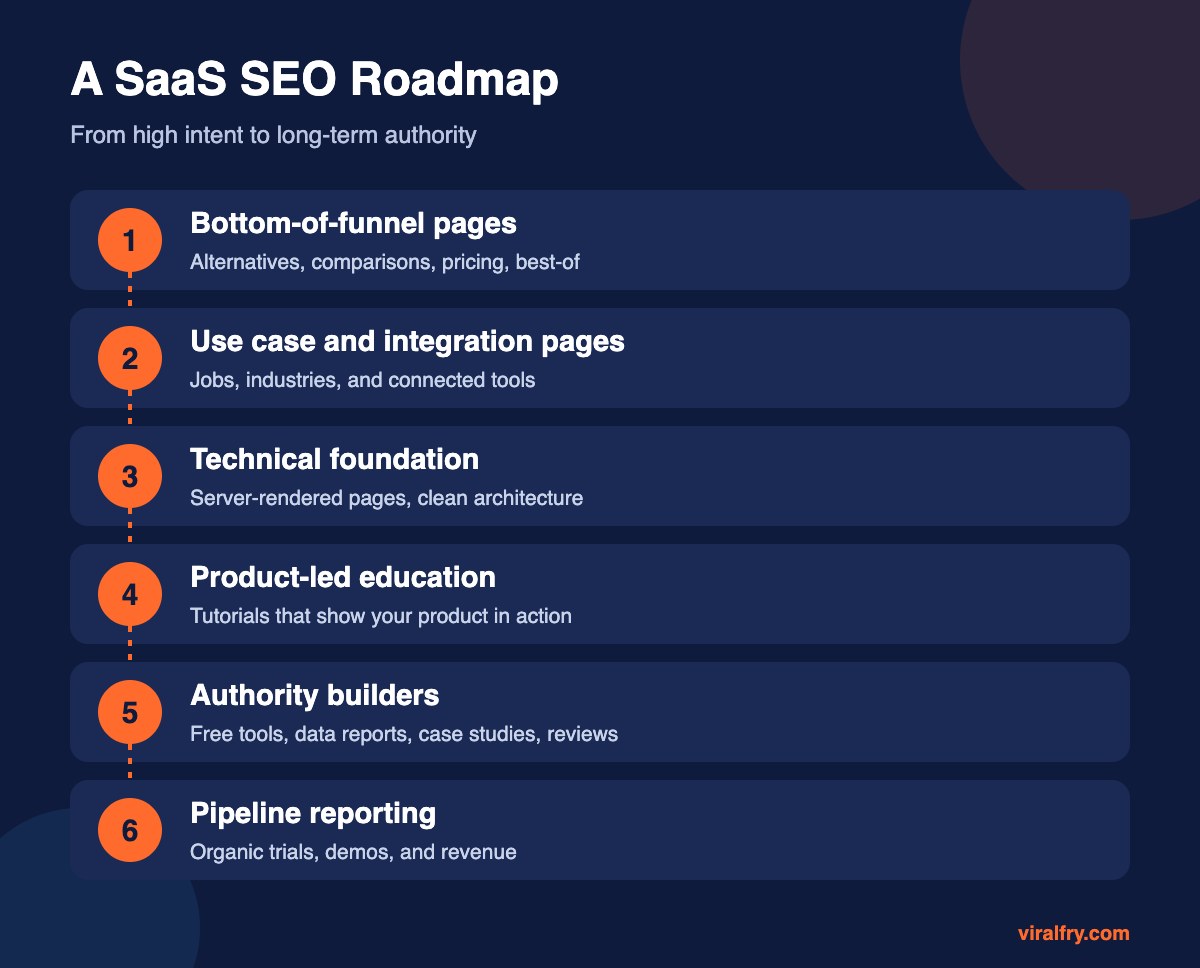
Many SaaS marketing sites are built on JavaScript frameworks. Make sure key pages are server-rendered or statically generated, keep the app and docs on clean, crawlable URLs, and manage indexing between marketing pages, docs, and app screens.
Run a crawl after every site release.
8. Turn customer stories into case studies
Detailed case studies with real numbers rank for searches like “[category] case study” and support buyers in late-stage evaluation.
They are also strong E-E-A-T signals and frequently cited sources for AI tools describing your product.
9. Earn links and mentions through data and partnerships
Product usage data (anonymized and aggregated) can power benchmark reports that earn press and links. Integration partners, review sites like G2 and Capterra, and podcast appearances add authority.
Mentions on review sites and comparison lists also shape how AI assistants recommend tools in your category.
10. Measure SEO by pipeline, not traffic
Connect organic sessions to trials, demos, and closed revenue in your CRM. Report on organic-sourced pipeline and payback, not just rankings.
This keeps the SEO program focused on pages that move the business and earns continued investment from leadership.
Which SaaS Pages Should You Build First?
| Page type | Example | Intent |
|---|---|---|
| Alternatives | Best [competitor] alternatives | High |
| Comparison | [Your tool] vs [competitor] | High |
| Use case | [Category] software for agencies | High |
| Integration | [Your tool] + Slack integration | Medium to high |
| Pricing | [Your tool] pricing | High |
| Tutorial | How to [solve problem] in [tool] | Medium |
| Glossary | What is [industry term] | Low |
How Does AI Search Change SaaS SEO?
B2B buyers increasingly ask ChatGPT, Perplexity, and Gemini to shortlist tools. Those answers draw heavily on review sites, comparison articles, community discussions, and well-structured vendor pages. To appear, keep your product information consistent everywhere, earn reviews, get included in credible comparisons, and publish clear, factual pages about features, pricing, and use cases. Our guide on getting cited in ChatGPT and AI Overviews covers the tactics.
How Long Does SaaS SEO Take?
Bottom-of-funnel pages on an established domain can start generating demos within two to three months. Building authority for competitive category keywords usually takes six to twelve months. The strongest SaaS SEO programs we have seen were consistent for two years or more.
What SaaS SEO Mistakes Should You Avoid?
- Writing only top-of-funnel blog posts with no path to the product
- Hiding pricing, which pushes buyers to competitor pages that explain it
- Letting app screens and duplicate docs pages get indexed
- Publishing biased comparison pages that buyers do not trust
- Reporting traffic instead of trials and pipeline
What Does a Strong SaaS Alternatives Page Include?
Start with a short, honest summary: who the competitor is great for and who might want something different. Then list five to eight alternatives, including your own product, with a one-line verdict for each.
Add a comparison table covering pricing model, key features, integrations, ideal team size, and support. Include screenshots from real use and link to each vendor’s official pricing page so readers can verify details.
Answer the questions buyers ask during evaluation: how hard is migration, how long does onboarding take, and what happens to existing data. Finish with a clear but low-pressure call to action, such as a free trial or a migration guide.
Update the page every quarter. Pricing and features change quickly in SaaS, and an outdated comparison loses trust, rankings, and AI citations faster than almost any other page type.
Who Should Own SEO Inside a SaaS Company?
SEO works best when one person owns it but several teams contribute. Marketing owns strategy and content, product marketing supplies positioning and comparisons, engineering keeps the site fast and crawlable, and customer success provides case studies and real user questions. A monthly cross-team review keeps priorities aligned.
Key Takeaways
- Start with high-intent pages: alternatives, comparisons, use cases, pricing.
- Scale integration pages with real setup details.
- Product-led tutorials and free tools combine traffic and conversions.
- Make JavaScript sites crawlable and keep architecture clean.
- Measure SEO by organic pipeline and revenue.
Frequently Asked Questions
What is SaaS SEO?
SaaS SEO is search engine optimization for software-as-a-service companies, focused on attracting qualified buyers and converting them into trials, demos, and customers.
What keywords should SaaS companies target first?
Start with bottom-of-funnel keywords such as competitor alternatives, comparisons, use case searches, and pricing queries, because they convert at higher rates.
Should SaaS companies create competitor comparison pages?
Yes. Honest, detailed comparison pages capture buyers who are actively evaluating tools and are among the highest-converting SaaS pages.
How do you measure SEO success for SaaS?
Track organic trials, demo requests, pipeline, and revenue in your CRM alongside rankings and traffic.
Add as Preferred Source