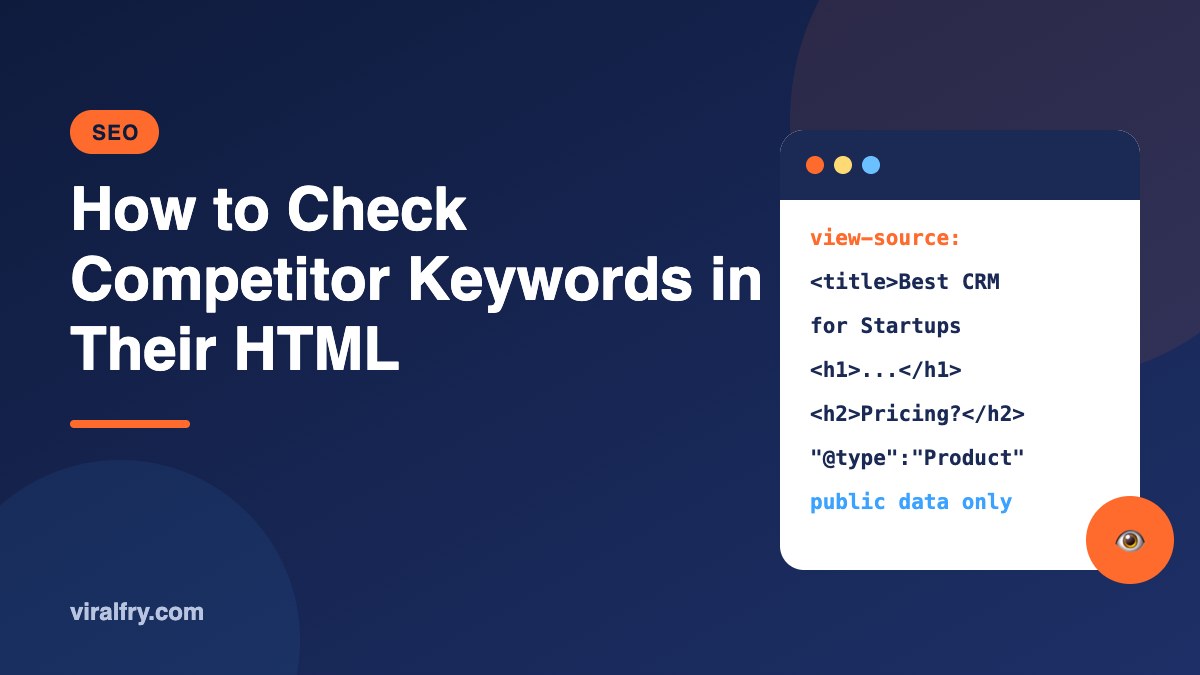
To check what keywords a competitor targets in their HTML, open their page, choose View Page Source, and look at the title tag, meta description, H1 and H2 headings, image alt text, internal link anchors, and JSON-LD schema. Those spots show which phrases they are deliberately optimizing for. It’s ethical because you’re reading public information any visitor can see; it stops being ethical when you copy their content, scrape aggressively, or try to access anything that isn’t public.
This is one of the oldest tricks in SEO and still one of the most useful. Ten minutes in a competitor’s source code often tells you more about their strategy than an hour in a paid tool.
Where Do Keywords Show Up in HTML?
| Element | What it tells you |
|---|---|
| <title> | Their primary target keyword and angle |
| meta description | How they pitch the page and secondary terms |
| <h1> | The main topic they want to rank for |
| <h2> and <h3> | Subtopics and questions they cover |
| Image alt text | Supporting terms and product names |
| Internal link anchors | Which pages they consider important and for what terms |
| JSON-LD schema | Page type, products, FAQs, authors |
| URL slug | The keyword they chose when creating the page |
The meta keywords tag, if you still see one, is mostly a curiosity. Google ignores it, but it can occasionally reveal the terms a team was thinking about.
How Do You View a Competitor’s HTML?
- Open the page in Chrome, Edge, or Firefox.
- Right-click and choose View Page Source, or add
view-source:before the URL. - Use Ctrl+F or Cmd+F to find
<title,name="description",<h1,<h2, andapplication/ld+json. - Use a browser extension that shows headings and meta tags if you want it faster.
What Should You Compare Against Your Own Page?
- Do they use the keyword earlier in the title than you do?
- Which questions do their H2s answer that yours don’t?
- Do they use tables, FAQs, or schema you’re missing?
- How many internal links point to the page, and with what anchors?
- Is their main content in the HTML, or rendered by JavaScript?
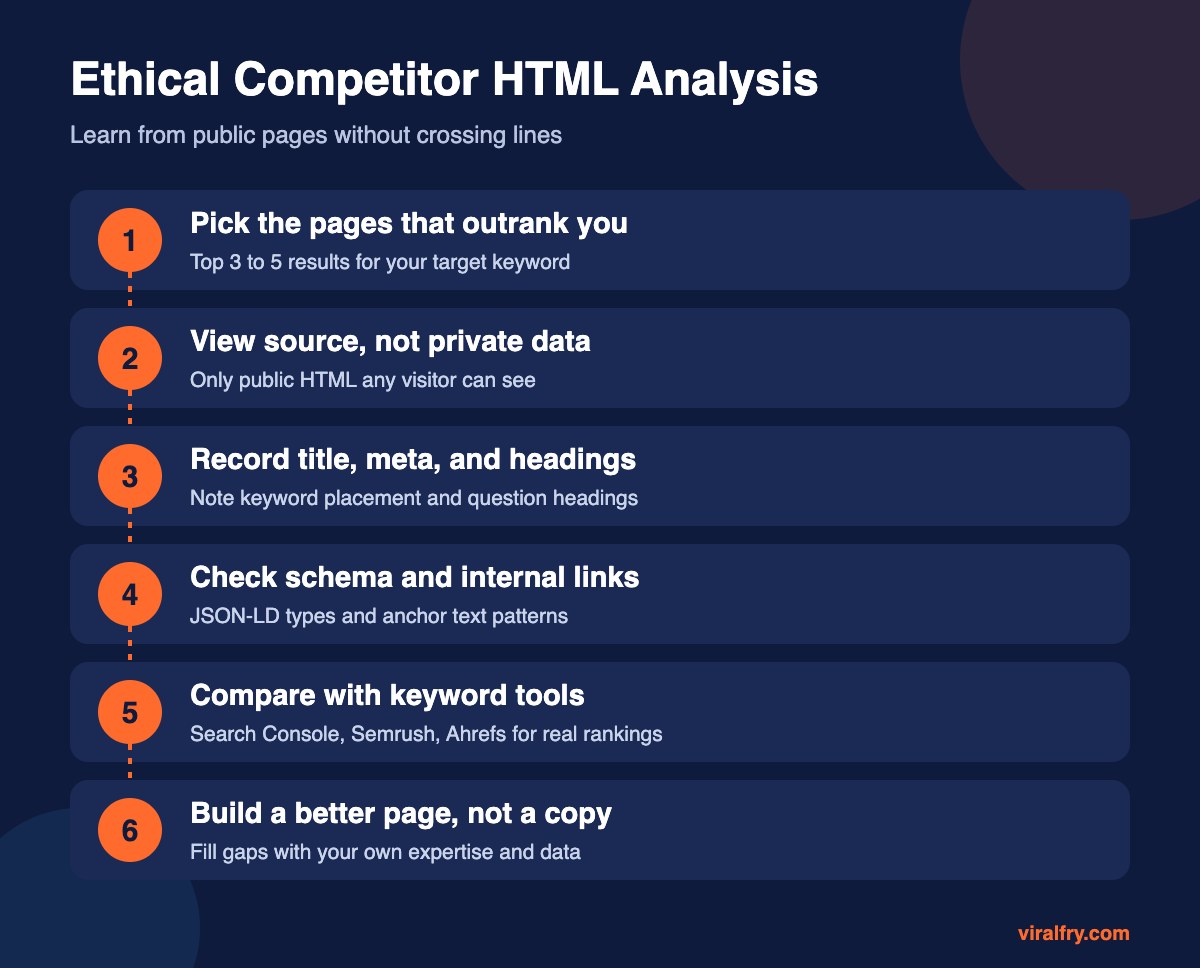
Then check whether those choices actually help. A competitor’s HTML shows intent, not results. Confirm real rankings with a keyword tool or by searching yourself. Our best free SEO tools list has options.
Where Are the Ethical Lines?
- Fine: reading public pages, noting keyword placement, studying structure, using commercial SEO tools
- Not fine: copying text, images, or unique data; publishing a near-duplicate page
- Not fine: aggressive scraping that ignores robots.txt or strains their server
- Not fine: trying to access staging sites, admin areas, or anything behind a login
The goal is to understand the bar, then clear it with your own experience, examples, and data. A copied page rarely outranks the original anyway.
What Do You Do With What You Find?
- List the keywords and questions the top pages share.
- Note the gaps none of them cover well.
- Update your title, H1, and H2s to match intent more closely.
- Add the missing sections, with original insight.
- Fix technical gaps using our HTML on-page audit checklist.
Key Takeaways
- Title tags, headings, alt text, anchors, and schema reveal target keywords.
- View Page Source shows exactly what crawlers get.
- Reading public HTML is ethical; copying and invasive scraping are not.
- Use findings to build a better page, not a clone.
Frequently Asked Questions
Is it legal to look at a competitor’s source code?
Viewing the public HTML of a website is something every browser does and is generally fine. Copying copyrighted content or accessing non-public areas is not.
Can I see a competitor’s meta keywords?
If they still use the meta keywords tag, it is visible in the page source. Google ignores it for ranking, so it is not a reliable indicator of their strategy.
What is the best tool to see competitor keywords?
Free methods include view source and Google search. Paid tools such as Semrush and Ahrefs estimate which keywords a page actually ranks for and how much traffic it gets.
Should I copy a competitor’s title tag?
No. Learn from its structure and keyword placement, then write your own title that better matches intent and your unique angle.
Add as Preferred Source