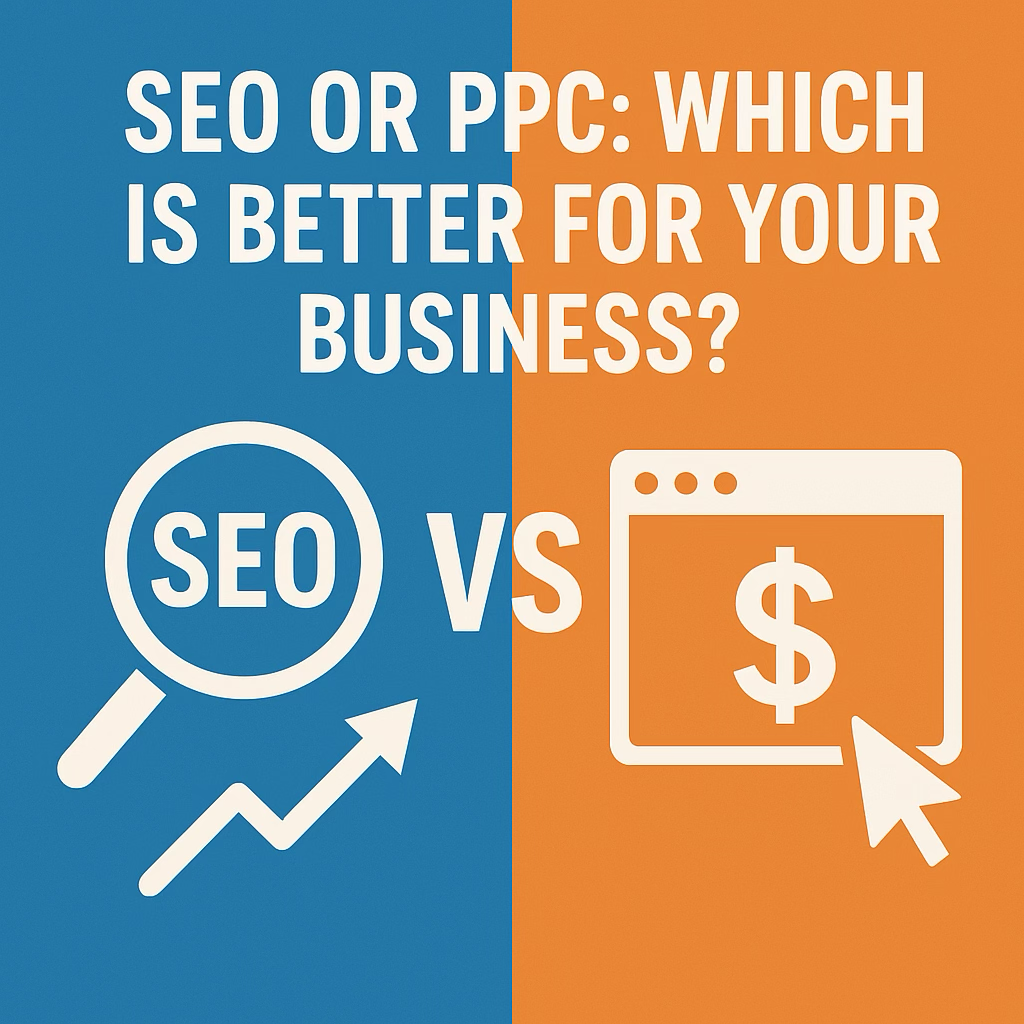
Short answer: Neither is better in every case. SEO (search engine optimization) tends to win on long-term cost efficiency and compounding visibility. PPC (pay-per-click advertising) wins on speed, control and testability. The right choice depends on how soon you need results, how much budget you can commit, how competitive your market is and what you are trying to achieve. Many businesses end up using both, with each channel covering the other’s weak points.
What SEO and PPC Actually Are
SEO is the practice of improving a website so it appears in the unpaid (organic) results of search engines like Google and Bing. It covers technical health (speed, crawlability, mobile usability), content that answers what people are searching for, and signals of authority such as links from other reputable sites. You do not pay per click. You pay in time, expertise and content production.
PPC is a model in which you pay a platform each time someone clicks your ad. In search, the best-known systems are Google Ads and Microsoft Advertising. Advertisers bid on search terms, and the platform decides which ads show based on factors including bid, ad relevance and expected quality of the landing page. When you stop paying, the ads stop appearing.
The core difference is ownership versus rental. Organic rankings are earned and can persist without ongoing ad spend, though they are never guaranteed. Paid placements are rented and disappear when the budget does.
SEO vs PPC at a Glance
The table compares the two channels on the criteria that most often decide the question.
| Criterion | SEO | PPC |
|---|---|---|
| Time to first results | Usually months | Can begin as soon as campaigns are approved and live |
| Cost structure | Upfront and ongoing investment in content, technical work and links; no per-click fee | Pay per click, plus management time or fees |
| Cost over time | Often falls per visit as pages keep earning traffic | Stays roughly proportional to traffic bought |
| Traffic stability | Can shift with algorithm updates and competitors | Stable while budget lasts; stops when it ends |
| Control over placement | Low; search engines decide | High; you choose terms, budgets, audiences and copy |
| Testing speed | Slow, since changes take time to be reflected | Fast; ad copy and landing pages can be compared quickly |
| Click trust | Many users favor organic results | Ads are labeled as ads |
| Best for | Building durable visibility and authority | Launches, promotions, time-sensitive goals |
These are general tendencies. Individual results vary by industry, competition and execution.
When SEO Is the Better Choice
SEO usually makes more sense when:
- You can wait. If your business can tolerate several months before organic traffic builds, the compounding effect is attractive.
- Your audience researches before buying. Informational searches such as “how to,” “best,” and “what is” are often better served by useful content than by ads.
- You want to lower acquisition costs over time. A page that ranks keeps attracting visits without a per-click charge, though it still needs maintenance.
- Your market has lots of long-tail demand. Many specific, lower-volume queries can be expensive to cover with ads but cheap to cover with content.
- You are building a brand. Consistent presence in organic results builds familiarity and credibility.
The limits are real. Rankings cannot be bought or guaranteed, and algorithm changes can move them. Results are harder to attribute precisely to individual actions.
When PPC Is the Better Choice
PPC usually makes more sense when:
- You need traffic now. A new site, a product launch or a seasonal offer cannot wait for organic rankings to develop.
- Your keywords are dominated by established sites. In very competitive categories, ads may be the faster route to visibility.
- You need to test an offer. Because you control the message and the audience, PPC can show quickly which headlines, prices or landing pages convert.
- You have a clear unit economics model. If you know what a customer is worth, you can calculate how much you can afford to pay per lead or sale.
- The topic has strong buying intent. Searches like “buy,” “near me” or “pricing” often suit paid search, since the searcher is close to acting.
The limits: costs rise with competition, traffic stops when spending stops, and poorly managed campaigns can waste money quickly. Click fraud and low-quality traffic are known risks that need monitoring.
How to Decide: Five Questions
- How soon do you need results? Weeks points toward PPC. A year-long horizon favors SEO.
- What is your budget shape? PPC needs a steady media budget. SEO needs sustained investment in people or agency time, with less direct cost per visit.
- How competitive are your target searches? Check who ranks and what the ad auctions look like. Heavy competition in both makes the decision harder and raises the importance of niche targeting.
- What do you know about customer value? Without conversion tracking and an estimate of lifetime value, PPC spending is hard to judge. SEO is more forgiving of imprecision but still needs measurement.
- Do you have content and technical capacity? SEO depends on being able to publish useful pages and fix site issues. PPC depends on good landing pages and ongoing campaign management.
Why Many Businesses Use Both
The two channels are not rivals in practice. They support each other in several ways:
- Keyword discovery. PPC data shows which search terms actually lead to conversions, which can guide content priorities for organic work.
- Coverage. Appearing in both paid and organic positions on the same results page can increase overall visibility, although the incremental effect varies and should be tested.
- Risk balance. If an algorithm update hits organic traffic, paid campaigns can cushion the drop. If ad costs climb, organic traffic reduces dependence on them.
- Shared assets. Strong landing pages, clear messaging and fast load times improve both.
A common sequence is to start with PPC for early traffic and learning while investing in SEO foundations, then shift the balance as organic pages mature. Businesses that want help planning this kind of mix can look at the search marketing services from ViralFry, though you should evaluate any provider against your own goals and budget.
Common Mistakes When Choosing
- Treating SEO as free. It has no click fee, but it costs time and skill.
- Expecting PPC to fix a weak offer. Ads send visitors; they do not make a poor page convert.
- Judging SEO too early. Evaluating after a few weeks misreads how the channel works.
- Ignoring measurement. Without conversion tracking in an analytics tool, neither channel can be assessed properly.
- Chasing traffic instead of customers. Visits matter only if they lead to enquiries, sales or other goals you have defined.
Frequently Asked Questions
Is SEO cheaper than PPC?
Often over the long run, because a page that ranks can keep attracting visits without a per-click fee. In the short run SEO may cost more than a small ad test, since content and technical work come first.
Which is faster, SEO or PPC?
PPC is faster. Campaigns can start delivering clicks soon after launch, while organic rankings typically take months to develop.
Does PPC help SEO?
Paid ads do not directly improve organic rankings. Google has said ad spend does not influence organic ranking. The indirect benefits are data and testing insights.
Should a small business start with SEO or PPC?
It depends on cash flow and urgency. A business that needs customers soon and can measure returns may begin with a small PPC budget, while building basic SEO such as an accurate business listing and clear service pages. Local businesses often find the local aspects of SEO especially worthwhile.
Conclusion
The question “SEO or PPC” has no universal winner. SEO builds durable, lower-cost visibility but takes time and offers little control. PPC delivers fast, measurable traffic but stops when the money does. Match the channel to your timeline, budget, competition and the strength of your tracking, and expect to revisit the balance as your business changes.
A practical next step: list your three most valuable products or services, check the search results for the terms customers would use, and note which are crowded with ads, which are dominated by established sites, and which have gaps. That small exercise will usually show where to start. If you want to see how an agency frames this work, you can review the ViralFry website alongside other providers.
Add as Preferred Source